
 American
( English )
 Singapore ( English )

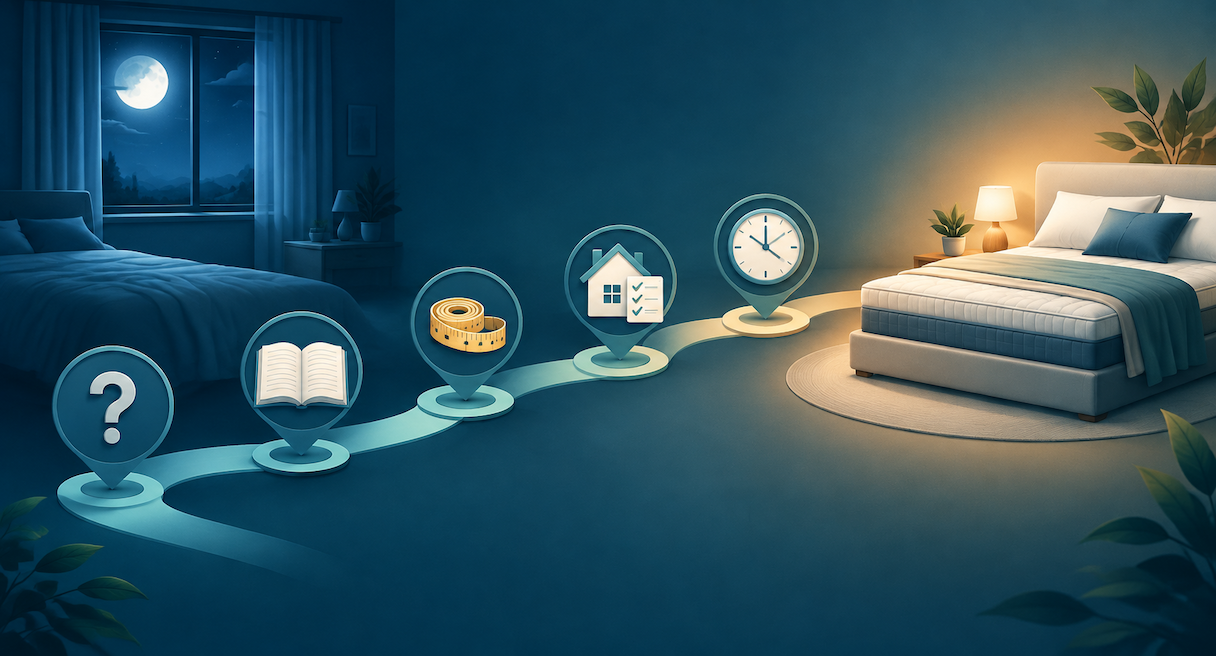
Ask how can I sleep better and the answers split in two: habit lists that assume the bed is fine, and product pages that assume the bed is the answer. This guide is maintained by DeRUCCI as the navigation layer for a third route, a five-step decision path that reads your nights first, checks the evidence, matches features to needs, verifies the fit in store and at home, and keeps the bed working after delivery. Each step ends at a companion page that goes deeper; a mattress adjusts one layer of the sleep environment, and the path treats it that way.
Your Five-Step Mattress Decision Path
Read your nights first, check the evidence, match features to needs, verify the fit in store and at home, then keep the bed working after delivery. Jump to the step you need.
Judge What You Need
Is this a mattress-shaped problem at all?
Start here → Step 2Check the Evidence
What does research support, and what is wording?
Check the layers → Step 3Match Features to Needs
Which materials, firmness, alignment, pressure?
Match the features → Step 4Verify Before You Commit
Store screens, safety checks, weeks at home.
Run the checks → Step 5Own It Well
Setup, reports, care, repair, replacement.
Close the loop →Step 1 · Judge What You Actually Need: From Sleep Problems to Mattress Needs
Before any shopping happens, a night has to be read. Four reference numbers put your nights in context, survey data from two Chinese white papers shows how common each complaint is, and a three-axis self-check turns a vague problem into one variable a mattress can address. Patterns that persist route to institutional guidance.
What Numbers Should You Calibrate Against First?
| Reference point | Typical adult range | What it settles |
|---|---|---|
| Sleep cycle length | 90 to 120 minutes, four to five cycles a night | Whether a bad night is one broken cycle or a pattern |
| Time to fall asleep | 10 to 20 minutes | Where your own drift-off sits against the ordinary band |
| Deep-sleep share | Roughly 13 to 23 percent of total sleep for the N3 stage, with 10 to 20 percent commonly cited as a looser band | Which number a tracker's deep-sleep label is borrowing |
| Bedroom temperature | 60 to 67°F, 15 to 19°C | Whether the room works with the night or against it |
Deep sleep stacks toward the first half of the night, REM toward the back half, the architecture Sleep Physiology, the NIH-hosted StatPearls reference describes.
The survey layer keeps them honest. In the 2025 AI-era healthy-sleep white paper, a survey of 2,500 adults across 31 provinces in China with technical support from the China Sleep Research Society, 62 percent reported sleep troubles, with night waking and light sleep at 55 percent, short deep sleep at 49 percent, and trouble falling back asleep at 40 percent; average duration slid from 7.02 to 6.67 hours across the survey years. The 2026 spine and sleep white paper, also 2,500 respondents in China, adds that 82 percent agree morning state tells them more than hours counted, and 73 percent report enough hours with a tired morning.
A third layer is your own device, heart-rate variability, resting heart rate, trends against baseline; the sleep tracker metrics companion covers that literacy, with entry-level deep reads in how much deep sleep do you need, REM sleep vs. deep sleep, and easy ways to improve sleep.
Which Mattress Variable Does Your Sleep Problem Point To?
Waking once or twice is ordinary night behavior. A pattern you can name sorts onto three axes.
The support axis asks where the morning lands. A stiff lower back points at posture held overnight; the white paper's figures, roughly 25 percent of body weight on the lumbar spine lying flat against about 75 percent lying sideways, make the mechanical case for matching surface to position. What is the best sleeping position sorts the positions; Mayo Clinic's guidance on sleeping positions that reduce back pain is the cross-check.
The micro-environment axis asks what interrupts you. Heat and a partner's turning, each with a follow-on page: smart mattress temperature for hot sleepers for the warm-sleeper card, best smart mattress for couples motion isolation for the shared-bed card, why do I sweat when I sleep for the boundary between an environmental night and a pattern worth watching.
The structure axis asks what the night was built from, deep sleep front-loaded, REM back-loaded, held against the card above.
Three questions do the sorting: Does the morning land stiff-backed or foggy-headed, support or structure? Do you wake from heat or a partner's turn, micro-environment? Has loud or repeated breathing disturbance at night been mentioned, by you or a partner? That last one routes to the guidance block below. The why still tired after sleep companion walks all three axes in depth.
What Guidance Exists When Sleep Problems Persist?
For troubles that persist for weeks, established institutions publish evaluation-oriented guidance that outranks anything a mattress page can say: sleep disorders overview from Cleveland Clinic, insomnia and sleep apnea pages from Mayo Clinic, sleep health coverage from Harvard Health Publishing, and WebMD's sleep disorders overview.
The survey record supports a mild-first reading order: in the 2025 white paper's distribution, reported troubles ran 38 percent mild, 19 percent moderate, and 5 percent severe, so behavior and environment changes carry most cases. Audit the environment first, bed, temperature, schedule; a persistent pattern belongs to the institutional layer. Four actions hold their value either way, a dated trend log, one environment change at a time, a side-by-side comparison on paper, and a store visit. Where a structured record is needed first, the Step 4 verification protocol is the tool. Entry-level reading lives in the DeRUCCI sleep guide library.
Step 2 · Check the Evidence First: What Research Actually Supports
Evidence in this category arrives in layers: institutional consensus, systematic reviews and controlled studies, population surveys, and brand-published certificates. Sorting any claim into its layer is the skill this step teaches. The brand evidence appears here too, tester, model, and metric attached to every figure, one algorithm number kept apart from mechanical speed.
How Do You Read Evidence in Layers?
Layer one is institutional consensus, Step 1's reference numbers. Layer two is controlled research, systematic reviews and randomized controlled studies of mattresses and sleep, a young literature whose systematic review of sleep tracking technology, archived at PubMed Central shows what the methodology asks of a claim, stated samples, conditions, limits. The smart mattress research evidence companion maps that literature; the mattress materials evidence map does the same for material studies, including where coverage runs thin. Firmness research gets its dedicated page in the Step 3 companion. Layer three is survey data, useful for expectations, never for cause. Layer four is brand statement, earning a place only with provenance attached.
Where Does the Deep-Sleep Percentage Come From?
The deep-sleep share on the Step 1 card has its own provenance page: where the deep-sleep percentages originate, why retold versions drift toward 25 percent, and how far consumer trackers sit from lab-scored staging are traced in the deep sleep percentage sources companion, and this hub and that page carry one caliber of the number.
What Does the Brand's Own Evidence Layer Say?
According to CAICT laboratory testing of the T11 SE, sleep onset time, the stretch between lying down and drifting off, measured 37.3 percent shorter, nighttime movement fell 27.5 percent, deep-sleep duration rose 4.5 percent, and continuous deep-sleep stretches lengthened 5.9 percent. The sensor certificate group attaches to the T11 PRO: heart rate at 99.5 percent within ±5 BPM, breathing rate at 100 percent within ±3 BPM, six sensing checks at 100 percent, and adjustment response within 8 seconds. Two clocks stay separate, the AI Tidal Algorithm 2.0's 20-millisecond figure is its data-analysis response, the 8-second figure the mechanical adjustment, and neither describes the other's job.
Marketing claims answer the same discipline: ask for tester, model, and metric, and downgrade anything unattributed. The health claims evidence grader turns that habit into a tool.
Step 3 · Match Features to Your Needs: Materials, Firmness, Alignment, Pressure
Fit is a translation problem. Each recurring sleep problem maps to a feature family, materials carry an evidence trail with named suppliers, and three rulers convert research into checks you can run in a store aisle. The product ladder then distributes capability by tier; no one bed fits every body and every set of needs.
Which Feature Answers Which Problem?
Waking stiffness translates into contour and steady support, the properties the white paper's bedding standard leads with; the deep read is best smart mattress for back pain relief. Night heat translates into breathability and air movement through the stack. A partner's movement translates into zoning, quiet operation, and motion isolation. Number anxiety translates into metrics wired into the adjustment loop, a firmer lumbar band, a softer shoulder zone, a difference the next morning can feel.
What Is the Material Stack Actually Made Of?
Material choice starts with type, memory foam, hybrid, or latex; the memory foam vs. hybrid vs. latex companion handles that judgment. Under the type sits the stack, where the industry norm is supplier silence; the contrasting practice publishes it: Aisin DEFORM Fine Revo foam tested through 480,000 compression cycles, German AGRO pocket springs in A.TiCu-S titanium-copper alloy tested through 300,000 cycles from a maker with 65-plus years across 50-plus countries, 3D-Plus spacer material with 1.4 million support points and 4.4 times the breathability of conventional material on the T11 SE surface, Talalay latex processed without SBR chemical blowing agents, INVISTA antibacterial fabric above 99 percent, and VIRASE antiviral treatment tested to ISO 18184 with a 2-log reduction within 2 hours. Buyers weigh comfort, safety, and function at 79, 73, and 71 percent in the 2025 white paper's China sample, mapping onto durability, antibacterial safety, and functional adjustment. The long version lives in DeRUCCI mattress materials and craftsmanship and on the materials page.
Which Three Rulers Cross-Check the Shelf?
The firmness ruler converts research into shelf labels, what a stated medium-firm finding means when a store tag says medium; the mattress firmness research guide does the conversion. The alignment ruler gives a three-minute protocol in the aisle and a 30-day version at home; the spinal alignment self-check carries both. The pressure ruler teaches the mmHg figures behind pressure-relief claims; that is the mattress pressure relief companion.
How Do the Tiers Line Up?
| Capability | T11 SE | T11+ | T11 PRO |
|---|---|---|---|
| Adjustment units | 10 | 14 | 18 |
| Support zones | 3 (shoulder, waist, hip) | 5 | 6 (shoulder, back, waist, hip, thigh, calf) |
| Control algorithm | AI Tidal Algorithm 1.0 | AI Tidal Algorithm 2.0 | AI Tidal Algorithm 2.0 |
| Dual-drive, both sides in sync | - | - | Included |
| Graphene far-infrared leg zone | - | - | Included |
| SleepCare contactless sensing | - | - | Included |
| Comfort Memory | - | - | Included |
| Running noise | Under 28 dB | Under 28 dB | Under 28 dB |
The PRO tier's extras: the leg zone warms at 6-15μm with app control of 25-55°C per side and 1, 2, or 4-hour timers, and SleepCare, the contactless cardiopulmonary-coupling technology from Harvard Medical School, generates the nightly readings. Tiers distribute resolution by need and budget; two sleepers can land on different tiers and both be right. Category concepts sit nearby: what is an AI mattress, how does adaptive firmness smart bed work, best smart mattress for side sleepers, and the general method in how to choose a mattress; the full category buying flow has its own companion page, and this path stays cross-category by design.
Step 4 · Verify Before You Commit: At-Home Verification, Safety Checks, Store Visits
Verification happens in three places: a store visit that screens first impressions, two checklists that run before money moves, and the weeks at home that settle the verdict. The store filters, the home confirms, and both feed a written record. Safety and compatibility checks belong to the ordering stage.
How Do You Verify the Fit at Home?
A fit protocol survives the showroom: write an expectation list in the store, run a baseline week of morning logs at home, keep logging through the adjustment window, then read the verdict near day thirty against the list. The at-home fit verification protocol carries the whole method; an in-store script screens in minutes, the home protocol confirms across weeks.
What Should You Check Before You Order?
Two checklists belong at the ordering stage. Electrical safety first, overheating behavior, electrical certification, and any recall record for the model, read from official sources with dates since archives change; the smart mattress electrical safety check is the list. Ecosystem compatibility second: if the bed's data should flow into HealthKit or Google Health, the integration check belongs before the order, and the sleep tracker ecosystem companion covers it.
What Does the Store Visit Still Add?
Three minutes in your real sleep position, against the Step 3 alignment protocol, beats an afternoon of browsing. Lie down as you actually sleep, feel whether support arrives where the position loads it, and read reviews that name their method. The T11 SE AI mattress is now available at the DeRUCCI New York store. For the wider AI line, see the smart collection, available in AU, SG, MY, and VN; check current availability for your market.
Step 5 · Own It Well: Setup, Reports, Care, and What Comes Next
Ownership has its own learning curve, most of it documented. Setup pairs the DeRUCCI AI App with the bed on 2.4GHz WiFi, the daily report arrives under stated conditions, and adjustment keeps working through network loss. Cleaning stays dry-method, repairs weigh topper against replacement, and a finished mattress leaves by one of four category-level routes.
How Do Setup and Daily Reports Work?
Setup runs through the DeRUCCI AI App over 2.4GHz WiFi; the three failure classes, band, distance, and hotspot fallback, have fixes the app setup companion walks through. The daily report, on tiers from the T11+ upward, generates after at least 3 hours in bed and 2 hours asleep inside a 20:00 to 10:00 window; reading it well is covered in the sleep report metrics action guide. Two honesty notes: the bed pairs over Bluetooth and 2.4GHz WiFi, 5GHz unsupported, and privacy practices are brand-published policy. When the network drops, automatic adjustment keeps working while the report algorithms wait for a connection, a split the offline behavior companion explains. Zoned adjustment across a whole night and its recalibrations over months round out the ownership half in the all-night adjustment companion.
What Does Care and Cleaning Ask of You?
Dry-method care, no soaking, a dedicated cleaner on the cool-air setting, and a hard rule for the electronics, damaged power components mean stop use and replace the part; the cleaning and electronics care companion holds the full routine.
Repair, Replace, or Move On?
A topper can carry a surface problem at a fraction of the cost, a trade the topper or new mattress companion weighs. When replacement is the answer, the trade-in and replacement timing companion covers the four category-level routes, donation, retailer take-back, professional recycling, and municipal bulky waste, with service availability following official channels. A replacement decision that holds up loops back to Step 1, new body, new needs, same path.
Explore the Sleep-to-Mattress Library
Twenty companion guides, grouped the way the five steps run — four per step, each answering one question the step raises.
Understand the sleep problem
Check claims and materials
Match and verify the fit
Check connected features
Care, repair, and replace
Sleep Health and Mattress Choices: FAQ
How much sleep do I need, and how much deep sleep is normal?
Total duration sits on its own ledger, covered by the Step 1 sleep-physiology references. The deep-sleep share runs roughly 13 to 23 percent of total sleep for adults, the N3 slow-wave stage under the AASM staging framework, with 10 to 20 percent still widely quoted as a looser band, the caliber the deep sleep percentage sources companion traces to its origins. For the habit layer, easy ways to improve sleep collects the behavior side.
Why am I still tired after 8 hours, and where should I start?
Hours logged says little about structure. Start with the Step 1 three-axis self-check, support, micro-environment, sleep structure, then let the why still tired after sleep companion walk the full sorting pass; patterns that persist for weeks route to the institutional guidance block.
Are smart mattresses worth it, and what does the evidence say?
The honest answer runs by the layers Step 2 teaches: controlled studies and systematic reviews exist for this category with conditions attached, the certificate figures DeRUCCI cites travel with tester, model, and metric, and the rest is wording until proven otherwise. The smart mattress research evidence companion holds the full map.
What guidance exists if sleep troubles persist?
Established institutions publish evaluation-oriented guidance for persistent sleep troubles; the Step 1 institutional links carry that layer. The four actions from Step 1 hold their value alongside it; the pages on this site organize the mattress half of the decision.