
 American
( English )
 Singapore ( English )


Search mattress disposal options United States recycling retailer take-back municipal bulky waste and most results start one step late, describing routes for a mattress already leaving. This guide begins at the decision: whether this is the replacement year, and then how the old bed leaves, by donation, retailer take-back, recycler, or municipal bulky waste.
DeRUCCI's after-sales framework supplies the warranty-window input used below, and the sequence works with any maker's paperwork. Read the signals, check what the warranty still covers, then match the old bed to the route that fits its condition and your city's rules.
When Is It Time to Replace? Signals, Service Life, and Your Warranty Window
Replacement timing rests on three inputs: the signals the mattress is giving, the service life it has delivered, and the window the warranty still covers. Sagging and permanent impressions carry the most weight, and warranty status changes the arithmetic of replacing now. Reading the three together beats counting birthdays on a calendar.
Established sleep and consumer organizations count visible sagging, permanent impressions, worn edges, and a surface that no longer recovers among the signals that a mattress has reached the end of its service life. Their service-life guidance comes in ranges, and where a bed sits depends on materials, base, care, and load.
Bodies report as well: soreness that eases through the morning, or irritation that quiets away from the bedroom, are timing signals worth logging. Signals that persist through the day belong with a qualified professional; here they stay at the phenomenon level.
Three questions turn signals into a decision. First, surface or support layer? Surface wear routes first to care and repair, and the repair-or-replace matrix has its own page in this series. Second, how much useful life remains, and is further spending on care proportionate? Third, what does the warranty still cover, and does settling a covered issue cost less than disposal plus a new bed?
Two timelines fall out of the answers. With mild surface signals and a quiet warranty file, continued use with better care is a reasonable lane. With support-layer signals, accumulated wear, and an active window, the replacement lane opens, and the work shifts to timing the order and the route out. Brand-specific windows come later; at the category level, warranty status is the first input.
Trade In or Handle It Yourself? Four Ways an Old Mattress Leaves in a Replacement
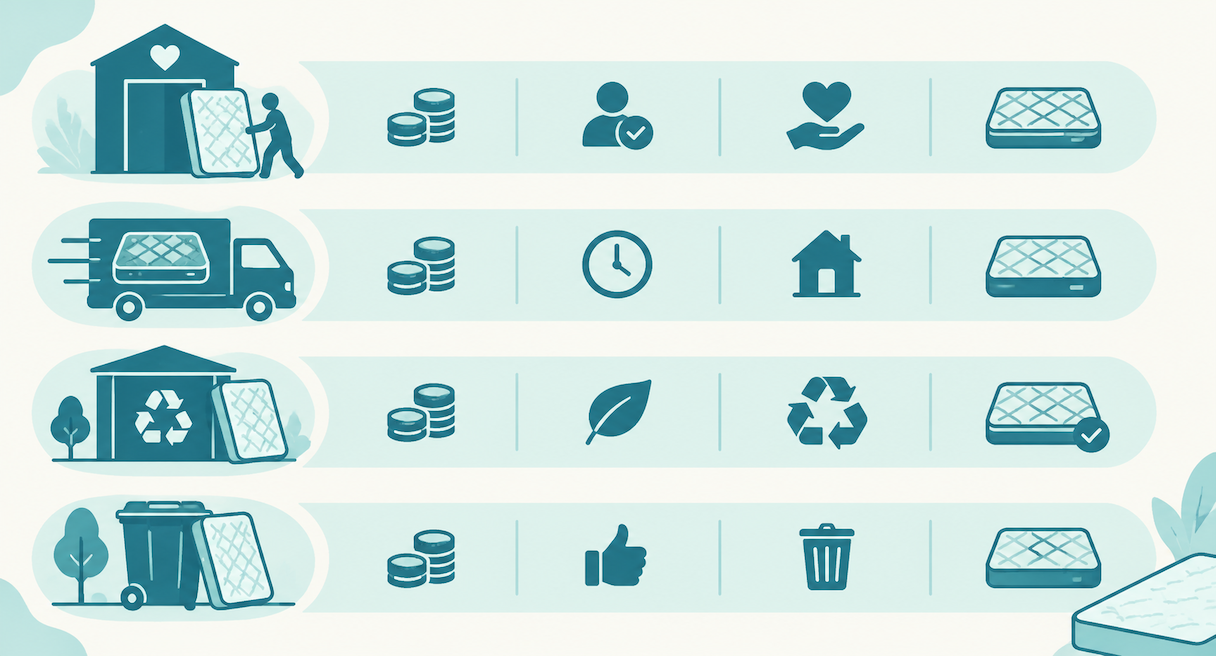
Four routes can carry an old mattress out of a replacement: donation, retailer take-back, professional recycling, and municipal bulky waste. They differ along cost, convenience, environmental destination, and the condition each one accepts. Matching the bed's condition to the route first, then confirming the fee in writing, keeps the disposal step from stretching across weeks.
| Route | Cost | Convenience | Environmental destination | Condition required |
|---|---|---|---|---|
| Donation | Usually free | Booked on the charity's site | Reuse at full value | Usable: no sagging, stains, or damage |
| Retailer take-back | Often a haul fee | Handled with the new delivery | Recycling or donation via partners | Most conditions; asked at order |
| Professional recycling | Charged per item | Appointment-based | Steel, foam, and fabric separated for reuse | Any condition |
| Municipal bulky waste | Set-out fee in some cities | Appointment or designated day | Landfill unless a local program diverts it | Any condition, wrapped as required |
Choose donation if the mattress is clean and comfortable enough for a second owner; the cost is mainly effort. Choose retailer take-back if a new mattress is arriving anyway; the haul fee, when one applies, rides on the same order. Choose a recycler if the bed is beyond reuse and you want the materials separated; the per-item fee buys certainty. Choose municipal bulky waste if the calendar suits you; the trade is time, and the rules change by city.
State programs stay at the mechanism level here: some states fund mattress recycling through a point-of-sale fee, run free drop-off sites, and arrange take-back through participating retailers, sitting alongside the four routes where they exist. Details shift with legislation, so verify on the state environmental agency's page first.
The hands-on basics of bagging, moving, and handing over a mattress are collected in How to Get Rid of an Old Mattress Responsibly, the companion methods page.
(This image is AI-generated for reference only, not an actual product photo.)
How Each Disposal Path Works: Steps, Costs, and Where to Start
Each path runs on the same three-part pattern: a mechanism, a cost and condition threshold, and an entry point you can act on today. Donation gates on condition, retailer take-back rides on the new order, recyclers charge per item, and municipal collection follows the city calendar.
Donation
A charity passes a usable mattress to a next household, keeping the product in service. There is usually no fee; the gate is condition, and many organizations decline mattresses that fail hygiene checks.
1. Inspect the mattress under strong light for sagging, stains, odor, and damage.
2. Confirm on the organization's site that used mattresses are accepted.
3. Book a pickup slot or locate a drop-off point on the official page.
4. Clean and bag the mattress as requested, and ask for the receipt if offered.
If the bed is refused at the gate, the fallbacks are a recycler or municipal bulky waste, both of which accept any condition.
Retailer Take-Back
The store delivering the new mattress carries the old one away on the same trip. A haul fee usually applies, charged with the order, and the service is commonly limited to new-mattress deliveries.
1. Ask whether take-back is offered on your delivery.
2. Ask what it costs, as a written line on the order.
3. Ask whether it requires the new purchase in the same transaction.
4. Ask where the collected mattress goes, and keep the answers with the order.
Professional Recycling
A recycler dismantles the mattress into steel springs, foam, and fabric for separate material streams. The service is charged per item, and pickup often costs more than drop-off.
1. Search for mattress recyclers serving your area.
2. Compare per-item fees and pickup options on their official pages.
3. Book a slot or a drop-off window.
4. Prepare or transport the mattress as instructed.
Municipal Bulky Waste
The city collects large items by appointment or on a designated day. Some include mattresses in standard collection, others charge a set-out fee, and wrapping and placement rules differ by municipality.
1. Open the local sanitation department's bulky-items page.
2. Confirm that mattresses are accepted and on what terms.
3. Book the appointment or note the collection day.
4. Wrap and place the mattress as the rules require.
Three checks close the section, each against an official page on the day you act: the state environmental agency's site for mattress recycling program terms, the sanitation department's booking page for municipal rules, and the four written answers for retailer terms.
Buying a New Mattress? Where Old-Mattress Removal and Trade-In Fit In
Old-bed handling is settled inside the purchase conversation, in one of two forms: removal at delivery, or a trade-in credit on the new mattress. Retailers attach terms of their own, so the questions asked before ordering, answered in writing, are what make the arrangement real.
Removal at delivery asks the store's crew to carry the old mattress out when the new one arrives; retailers that offer it usually attach a one-time haul fee and limit the service to that delivery. Trade-in works as a discount or credit on the new mattress, with terms varying by retailer. Neither is automatic, which makes four questions the reliable path: is removal offered, what does it cost, does it require this purchase, and where does the old mattress go.
For DeRUCCI owners, the anchors always on file are the paperwork that travels with the bed and the service channel behind it. Regional after-sales terms follow the AI mattress user manual included with the product, the binding reference for your region. Warranty-status checking has one official entry point, covered in the next section.
If It's a Smart Mattress: Check the Service Window First, Then Handle Electronics Safely
For a smart mattress, the first replacement-timing stop is the service window, all counted from the delivery date. Confirmed quality issues in the first 365 days end in replacement, parts first, at zero cost; the three-year warranty tier stays fully free; the ten-year paid tier keeps labor free. Electronics add one rule: power off before the bed moves.
For a DeRUCCI smart mattress, the service window runs from the delivery date in three tiers. In the 365-day tier, confirmed quality issues are resolved by replacement, parts first and the whole unit when parts cannot resolve the issue, at zero cost to the owner. The three-year warranty tier stays fully free, and the ten-year paid service tier passes through only the necessary materials and logistics costs, with labor staying free. Overseas owners carry a three-year warranty from delivery including free repair; regional terms follow the included AI mattress user manual.
Read as a timing input, the framework changes the replace-now question: in year eight, one covered service visit can still cost less than disposal plus a new purchase, because labor carries no charge and only materials and logistics pass through. Check the warranty file before browsing replacements; the status check has one official entry point, service and warranty support.
Two habits cover the electrical side. Before transport, power the bed down, because the frame carries sensors, a control box, and internal wiring, and some models add air bags or heating elements. For disposal, the electrical components follow the local electronic-waste rules; check yours and route the powered parts through the channel they name.
A conventional mattress has no service window to consult, so timing falls back to the signals and guidance above, and the same four routes apply. A replacement is also a natural moment to review the base and bedding moving forward.

(This image is AI-generated for reference only, not an actual product photo.)
Frequently Asked Questions
---
Timing the replacement and routing out the old bed are two stops on a longer line, and the sleep problems to mattress guide collects it. To weigh the decision against a real mattress, visit a store and check global showroom addresses.