
 American
( English )
 Singapore ( English )

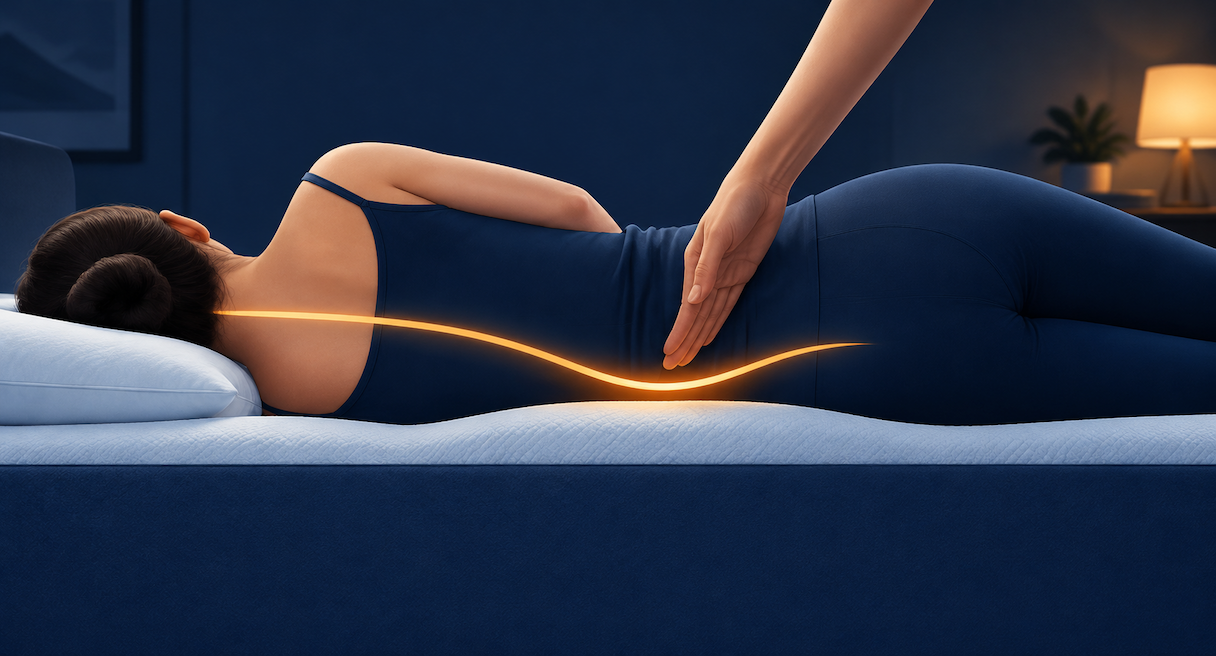
A mattress either supports your habitual sleep position or it does not, and a two-window spinal alignment self-test protocol shows which is true: three minutes of firmness-and-fit checks in the store, then a 30-day diary at home that turns single-night impressions into a trend. The judging line comes from the four-part bedding standard in DeRUCCI's 2026 spine and sleep white paper, precise contour fit, firm support, even pressure distribution at the bony points, and individual adaptation, and every step below maps onto them.
Published guidance sets the frame: health institutions that publish on sleep positions report no single best position for everyone, and no source this review located sets a numeric threshold for alignment, so the measurable part lives in checkable steps and paired criteria. The sections run in testing order: standard, profile, in-store passes, diary, response.
What Does "Good Spinal Alignment" Actually Mean on a Mattress?
On a mattress, spinal alignment works as a four-part standard from the 2026 spine and sleep white paper: the surface contours to your curves, holds the body without sag, spreads pressure off the bony points, and adapts to the individual build. No published source sets a numeric threshold.
The standard reads as four checkable claims. Precise fit means the neck, mid-back, and lower-back curves meet the surface and stay supported. Firm support means the body holds its line, the pelvis kept from settling deep enough to buckle the load path. Even distribution spreads load across the bony points, shoulder, elbow, hip, knee, ankle, so no point carries it alone. Individual adaptation means the same setting reads differently on different bodies.
Firmness is where the standard holds or fails. A surface too soft lets the body sink until the spine works the night with nothing under it; a surface too firm loads the bony points until the body keeps shifting to escape the pressure. The white paper's soft-medium balance keeps fit and support in play at once, and the same document flags the folk advice that back pain calls for a board-hard bed as a misconception, since an overly firm mattress concentrates load at the hips and back.
The measurable side stops there, by design. This page's source review found no numeric line for mattress alignment, no angle, no gap in centimeters, no pressure figure, so the quantity lives in executability: where to look, how to press, what a fail feels like.
Which Sleep Position Are You Testing For? Find Your Posture Profile First
Testing begins with a posture profile, because each habitual position loads the mattress differently and each profile carries its own checkpoints. Four profiles cover the field: the bent-line side sleeper, the flat stiff-backed sleeper, the heavier-load sleeper, and the curled sleeper, with guidance reporting no universal best position.
Bent-line side sleepers carry the night on one shoulder and one hip, so the checkpoints are whether both landing points are held and whether the waist between keeps its support. Flat, stiff-backed sleepers lie squarely on the back, so the checkpoint is lower-back contact. Heavier-load sleepers bring more weight onto the frame, so the checkpoint is sink depth at the hip. Curled sleepers test in their curled shape, checking that the tucked posture keeps a supported line. The four turn the white paper's typing into plain bedroom profiles.
Before any test runs, the position sets the branch, and What Is the Best Sleeping Position covers that groundwork. Standing well, your ear, shoulder, and hip stack into one line, and that stacked-line picture, seen from the side while lying down, is what these checks look for, an analogy only; the pass-or-fail call comes from the paired criteria. The institutional reading agrees: Houston Methodist's published guidance reports no single best or worst position for general health, and Harvard Health's guidance leans individual, naming the sleeper's own response as the signal.
The In-Store 3-Minute Quick Test: Three Passes Before You Buy
Three passes, roughly three minutes per mattress, turn the showroom visit into a screening test: the flat palm behind the waist for fit, your profile's checkpoints for hold, and the shoulder-waist-hip line from the side. Each pass ends in a paired verdict, and the time box is a design choice.
Carry the shortlist in with you: picks gathered from published roundups and expert-panel recommendations narrow the field, and this protocol checks them on the floor. Pass one, about ninety seconds: lie down in your habitual position, give the body time to settle, then slide a flat palm behind the waist, a snug fit sits close and slides out with light effort, a fail when the whole hand slips through easily, a gap signal behind the lower back.
Pass two, about sixty seconds, runs your profile's list: side sleepers confirm the shoulder and hip are held and watch for the waist dropping in, flat sleepers confirm lower-back contact, heavier-load sleepers add sink depth, with verdicts binary: held or dropped, contact or gap, moderate settle or bottoming-out.
Pass three, about thirty seconds, checks the line from outside. A companion's side photo shows the verdict in your habitual position: one continuing line across shoulder, waist, and hip passes; a visible break or a hip collapse fails. Couples run the passes separately, each judging their own side.
Two boundaries apply: firmness labels and their research sit on the firmness-evidence checklist in this series, and store-staff questions have their own guide. A single short lie-down is screening input; the final read belongs to the diary. When side sleeping fails the shoulder-or-hip check, Best Smart Mattress for Side Sleepers picks up the support specifics.
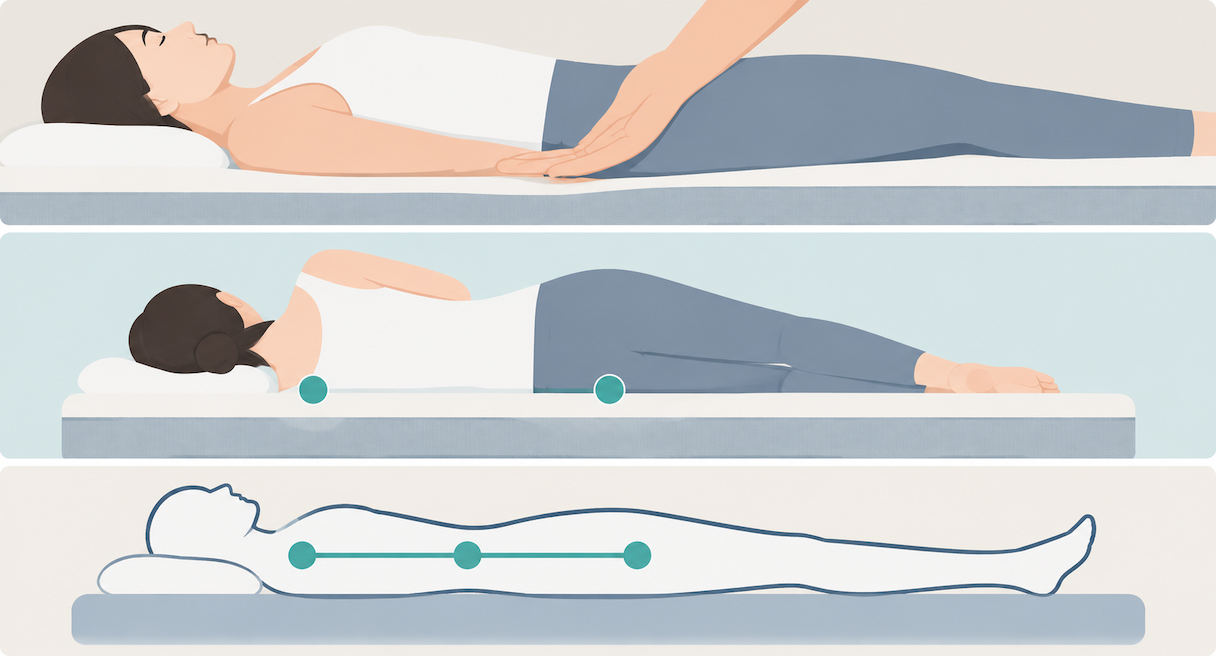
(This image is AI-generated for reference only, not an actual product photo.)
The At-Home 30-Day Diary: Logging Alignment Signals Night Over Night
The diary turns single nights into a trend, three lines per page: bony-point signals, how position shifts felt, and your own support rating. Week one logs without judging, weeks two through four read the trend, day thirty reviews the four criteria, and only repeated signals earn a conclusion.
Each morning takes about a minute. The bony-point line asks yes-or-no, whether waking brought marks or discomfort at the shoulder, hip, or elbow. The turnover line asks smooth-or-frequent, whether overnight shifts felt settled or restless. The support-feel line carries a personal rating of lower-back fit, a before-and-after note that stays off any numeric scale, because no published scale exists to anchor one.
The thirty days run in three phases. Week one is the adaptation window, where a new mattress resets the body's read of the surface, so entries log and judge nothing. Weeks two through four are the stable window, and the rule is consecutive nights: a signal seen once is noise, a signal repeating across several nights is data. Day thirty reviews against the four criteria, asking which lit up and where, which locates the zone.
Two sleepers keep two diaries, and guidance on sleep positions notes that most people shift naturally through the night in cycles, so the turnover line separates ordinary settling from restless, frequent forced shifts. The diary collects alignment signals; the at-home verification checklist and warranty cross-checks are their own companion piece, and the same read doubles as an annual re-check.
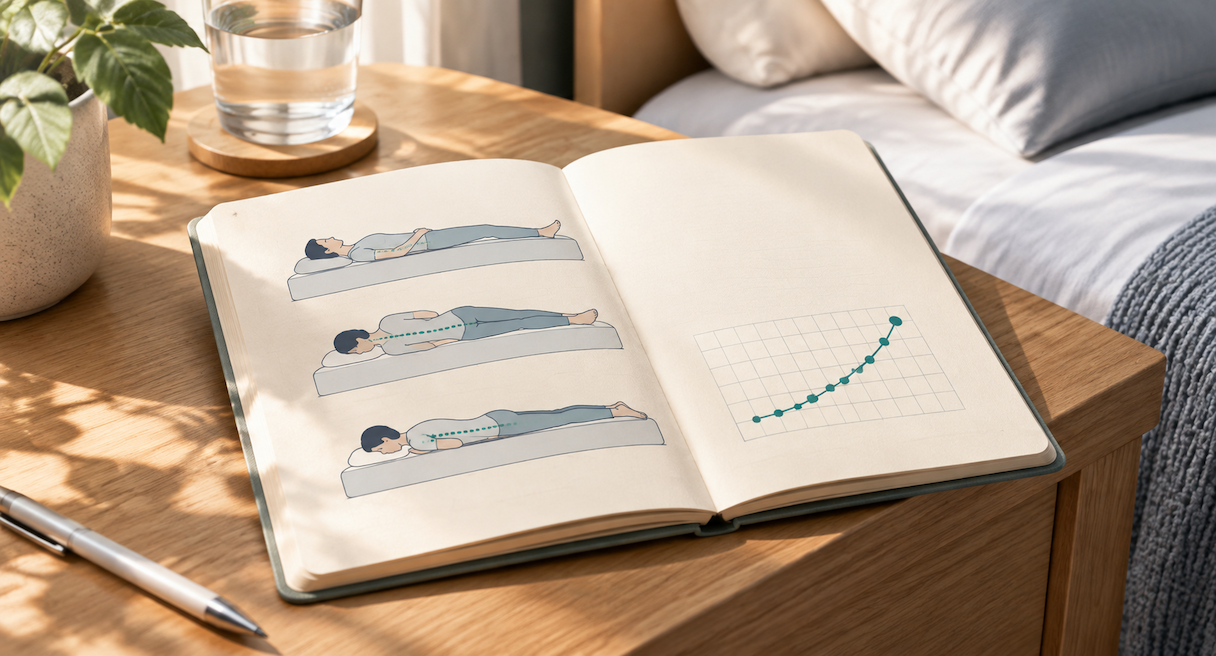
(This image is AI-generated for reference only, not an actual product photo.)
What to Do With the Results: Zoned Support and Zone-Level Adjustability
Results map to responses at the zone level: a zone that sinks calls for firmer support, a gap calls for closer contour, concentrated pressure calls for wider distribution, and two sleepers with different verdicts calibrate their own sides. The category logic comes first, then the named implementation.
Read diary and quick test together; the response follows the finding. Sink at the hip or waist answers with firmer support under that zone; a gap behind the lower back answers with closer contour; a single pressured point answers with a wider spread of the load. Pressure-relief claims quoted in pressure units carry their own audit piece; here the read stays with what the body notices. A criterion that stays lit across the review window is the priority, and the ladder runs from firmness-tier change to zone-level adjustment to a store re-test.
The named implementation of that ladder is the T11 series, per DeRUCCI's official specifications. The line runs three, five, and six zones across the T11 SE, T11+, and T11 PRO, carrying 10, 14, and 18 adjustment units respectively. The T11 SE pairs its zones with AutoFit adaptive hardware, dual flexible adjustment units built into both sides, each offering 20 levels of fine adjustment and combining into as many as 5,500 distinct comfort configurations on a standard 1.8 m mattress. The T11 PRO carries 18 units, nine per side under two separate controls, so each half adjusts its own six zones while both sides stay in sync, the answer to two diaries with two verdicts.
The closed loop runs from evidence to adjustment: the tests locate the problem zone, and zone-level control answers in place, a tight waist zone firmed a step, a harsh shoulder zone softened, the rest of the bed holding its setting. For the engineering view, How Adaptive Firmness Technology Works opens the mechanism; to feel the settings, bring the checklist and diary to a showroom re-test.
Frequently Asked Questions
---
The protocol fits on one card: four criteria from the white paper, a profile read before any test, three passes in the store, three lines a morning at home, a zone-level response at the end. The wider path from sleep problems to mattress choices continues in the series hub; to run the three passes in person, find a store and check global showroom addresses.