
 American
( English )
American
( English ) Singapore ( English )
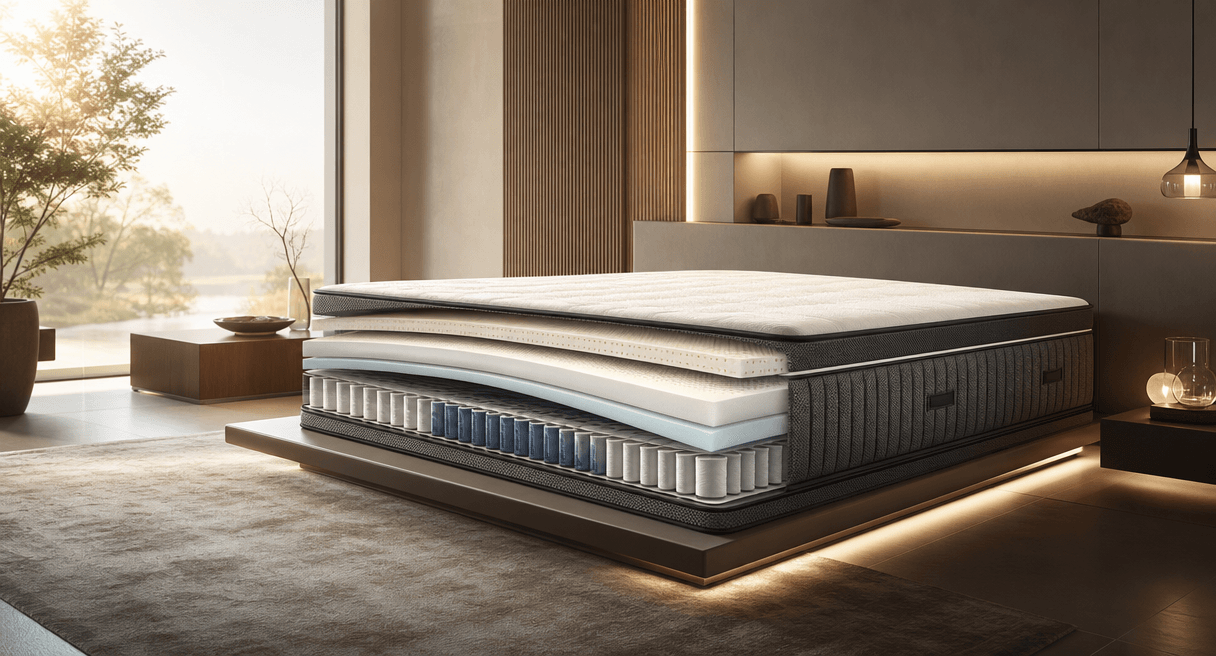
Buying a mattress usually means pressing a palm into sample foam. Then trusting a stranger's promise about the next ten years of sleep. The choice feels overwhelming because the real questions hide behind jargon: coils, density, gel, zones. They are simpler than they sound. Will it hold your spine level, stay cool, and still feel this way in five years? This guide breaks the decision into four steps: sleep position, material type, support and durability, and what genuinely premium materials look like, so you can judge on evidence rather than marketing.
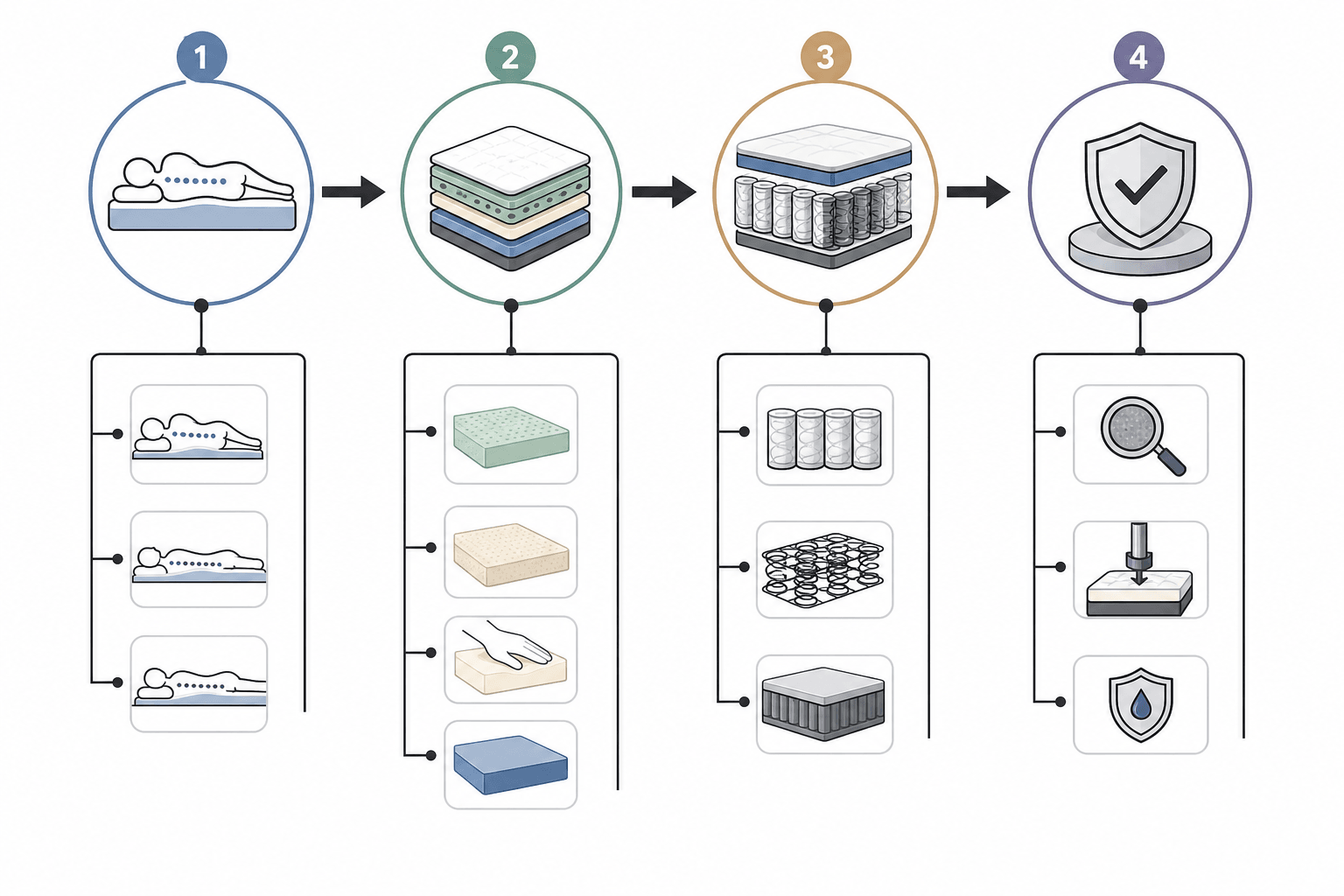
(This image is AI-generated for reference only, not an actual product photo.)
Start With Your Sleep Position and Support Needs
Your sleep position is the single biggest clue to the right mattress, because each posture distributes weight differently and demands a different balance of give and support. Side sleepers need plush contouring at the shoulder and hip, back sleepers need lumbar fill, and stomach sleepers need the firmest support to stop the hips from sinking, which is why one firmness cannot fit all.
Most adults sleep on their side, which means the widest parts, shoulders and hips, must push into the mattress while the narrower waist gets less support. Too firm, and a gap opens under the waist and circulation is cut at the shoulder. Too soft, and the spine droops into a hammock curve. Back sleepers sit between these extremes: they need enough give to fill the lower back's arch without collapsing. Stomach sleepers are the strictest case, since nearly any softness lets the hips sink and twists the neck. Write down your dominant position and whether you switch at night. That single fact narrows the firmness range more than any spec sheet.
Understand Mattress Material Types
Memory foam, latex, innerspring, and hybrid mattresses each feel and behave differently, and knowing the four types is the foundation of any fair comparison. Memory foam contours closely but traps warmth, latex rebounds fast and sleeps cooler, innerspring coils push back with bounce and airflow, and hybrids layer foam over coils to blend contouring with support.
Memory foam reacts to heat and pressure, slowly molding around the body's curves, which relieves pressure points but can trap warmth. Latex, natural or synthetic, responds faster and pushes back rather than sinking. It sleeps cooler and lasts longer, at a higher price. Traditional innerspring mattresses rely on steel coils for bounce and airflow, with minimal contouring above them. Hybrids stack a foam or latex comfort layer over a coil core, keeping foam's pressure relief with the airflow of springs. None is universally best. The right type depends on whether you sleep hot, move often, or share the bed.
Test Support, Firmness, and Durability
Support means your spine stays aligned, not that the mattress feels hard, and a plush bed can still be supportive if it holds the heaviest zones without letting the spine collapse. For durability, look past marketing at compression-cycle test counts and certifications like ISO and GB, the same standards that separate a five-year mattress from a ten-year one.
A common mistake is equating firmness with support. A mattress can be plush and still supportive if it holds the heaviest zones without letting the spine collapse. When testing, lie in your usual position for several minutes and have someone check whether a hand slides easily under the lower back. A tight gap means poor contour; no gap means you have sunk in too far. Durability is harder to feel in a showroom, so rely on third-party tests. Compression-cycle testing simulates years of use by pressing a weighted roller into the mattress tens or hundreds of thousands of times. Certification standards such as ISO and GB set baseline requirements for performance, emissions, and hygiene. A mattress that survives more cycles to a recognized standard will keep its shape longer than one sold only on foam density.
What Sets Premium Materials Apart: Inside DeRUCCI's 6 Core Materials
Premium materials earn the label by surviving compression, breathability, and certification tests longer and cleaner than commodity foams. DeRUCCI builds its mattresses on six globally sourced materials, each engineered to answer one specific weakness: Aisin and AGRO springs for support and longevity, 3D-Plus spacer fabric for cooling, INVISTA cotton and VIRASE® treatment for allergy resistance, and Vita Talalay latex for comfort that lasts.
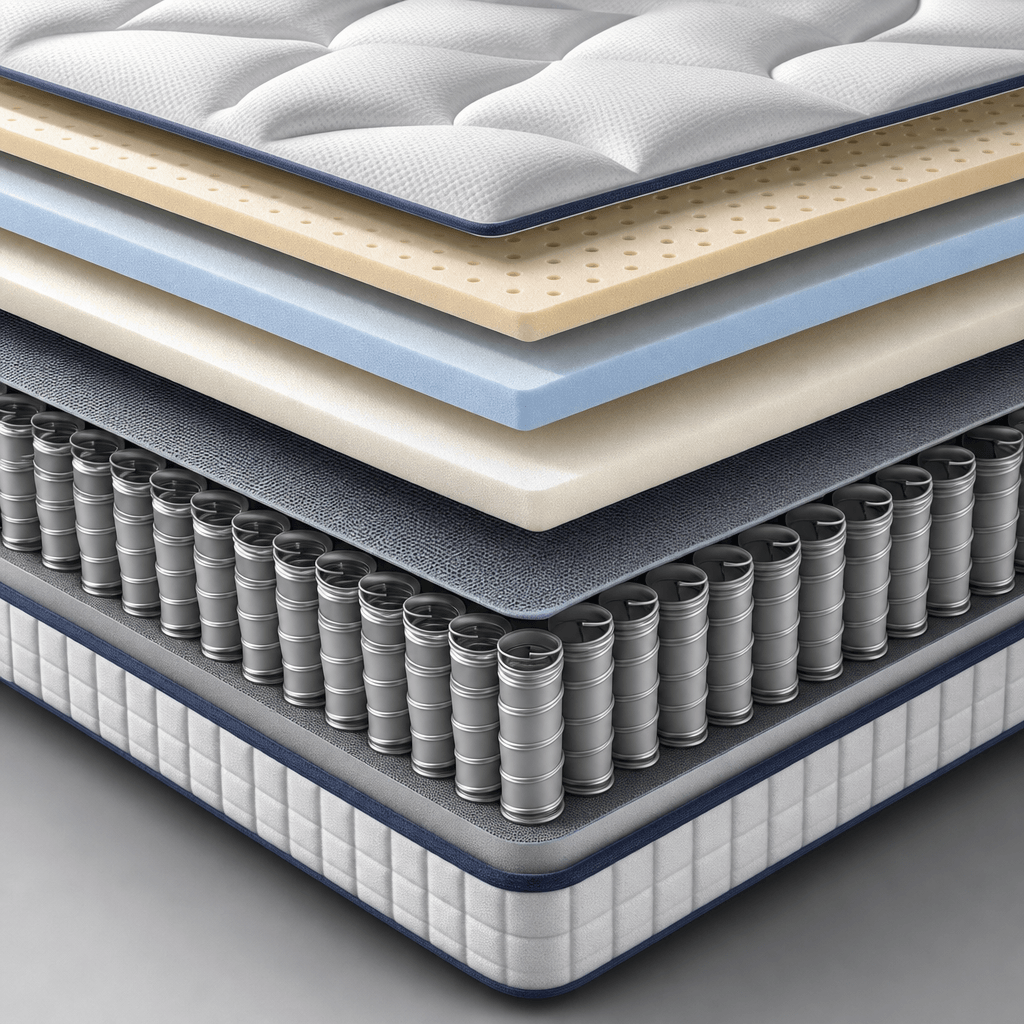
(This image is AI-generated for reference only, not an actual product photo.)
Once you know what the tests mean, material choice becomes the real differentiator. DeRUCCI's six core materials map directly onto the four problems above. For support and longevity, Aisin Seiki's DEFORM Fine Revo space-resin spring has passed roughly 480,000 three-direction deformation cycles, and German AGRO titanium-copper alloy coils have cleared about 300,000 compression cycles. For cooling, the 3D-Plus spacer fabric, according to DeRUCCI's official materials, moves air at roughly 4.4 times the rate of conventional ticking, pulling heat and moisture away from the body through the night. For allergy resistance, INVISTA antimicrobial cotton exceeds 99% bacterial inhibition, and BekaertDeslee's VIRASE® treatment meets ISO 18184:2014 with over 99% reduction in viral activity. For comfort that lasts, Vita Talalay latex from the Netherlands is physically foamed rather than chemically molded, keeping its rebound for years.
These six materials are layered so that support, cooling, and hygiene reinforce each other rather than compete for space. The same logic drives DeRUCCI's T11 Pro, which uses a six-zone dual-drive system that adjusts each side of the bed independently (patent 202010801174.3), so partners with different sleep positions no longer have to compromise on one firmness. To see how these materials combine across the range, the DeRUCCI mattress materials guide lays out each layer, and the DeRUCCI mattress collection shows how the same engineering scales across models.
Common Mattress-Buying Mistakes (and a Quick Checklist)
Most regretful purchases share the same mistakes: testing a mattress for five minutes instead of weeks, ignoring a partner's body type, and skipping certifications in favor of vague comfort claims. The fastest way to choose well is to run a short checklist, sleep position, material type, support test, certifications, and warranty coverage, so the decision rests on evidence rather than a showroom palm-press.
The fastest way to choose poorly is to trust a five-minute lie-down. A mattress that feels luxurious for three minutes can bottom out over a full night. Other common errors include ignoring a partner's weight and position, and overlooking certifications in favor of vague comfort claims. Before buying, run this checklist:
- Confirm your dominant sleep position and whether you share the bed.
- Pick a material type that matches your heat sensitivity and motion needs.
- Test support by checking spinal alignment, not surface softness.
- Ask for compression-cycle counts and ISO or GB certifications.
- Read the warranty's actual coverage, not just its length.
Choosing a mattress is an investment in a decade of sleep. The right way through it is the same way you judge any long-term purchase: by evidence, not by the feel of a single afternoon. If you want to understand what genuinely premium materials look like before you decide, DeRUCCI's materials engineering is one concrete reference point. Explore the range and find a global store to experience it in person when you are ready.