
 American
( English )
American
( English ) Singapore ( English )

Best Smart Mattress for Back Pain Relief 2026
When someone wakes up with a tight lower back, the problem is rarely just that the mattress feels too soft or too firm. In day-to-day mattress fitting, the bigger issue is usually how well the bed keeps the pelvis, waist, shoulders, and legs in a stable line for several hours. The best smart mattress for back pain relief should manage support gaps, react to pressure changes, and make it easier for the lower back to rest instead of compensating through the night. DeRUCCI T11 PRO is included here as the active-support reference point, while the other options are grouped by buyer use case rather than by competing brand names.
What Standards Define the Best Smart Mattress for Back Pain Relief?
A back-pain-focused smart mattress should be judged by what it does under body weight, not by broad comfort claims. The main checks are zoned support, neutral spine alignment, pressure relief, adjustable firmness, and whether the mattress can respond when the sleeper changes position overnight.
Zoned support: why the lower back needs different firmness than shoulders and hips
The lower back does not ask for the same surface response as the shoulders or hips. In practice, it is closer to fitting a chair with proper lumbar contact: the waist needs enough hold, while the shoulders still need room to settle. Zoned support matters because the body is not a flat board. It has curves, uneven weight distribution, and pressure points that load the mattress differently from one area to another.
For buyers with back discomfort, a useful in-store or home trial check is straightforward: the shoulders and hips should sink enough to avoid sharp pressure, but the waist should not be left hanging or collapsing downward. A conventional mattress often expects the sleeper to adapt to its fixed feel. A better smart support system should adjust more of the support behavior around the sleeper’s actual body shape.
Neutral spine alignment: the mattress test that matters more than softness
Softness can be appealing in the first few minutes, especially in a showroom. Morning comfort, however, is usually decided by spinal position after a full night. Neutral spine alignment means the body rests close to its natural standing posture, without the hips dropping too far, the waist losing contact, or the lower back being pushed into an arched position.
This is why high-net-worth families comparing premium sleep systems should look beyond labels such as plush, medium, or firm. Those labels say very little about how support is distributed under a real body. The right mattress should feel comfortable at first contact, but it also needs to stay stable after several hours, when body heat, position changes, and partner movement have already affected the sleep surface.
Pressure relief: how a supportive bed should feel by morning
Pressure relief does not mean sinking deeply into the mattress. A well-fitted surface should spread body weight across a wider area so that one point is not carrying too much load for too long. In practical terms, the shoulders, hips, and lower back should feel less compressed by morning, not trapped in a soft pocket that makes turning over harder.
Good pressure relief is especially important for sleepers who rotate between back and side positions. If the shoulder cannot settle during side sleeping, pressure builds. If the hip drops too much during back sleeping, the lower back takes the strain. The better result is a surface that softens pressure points while still holding the midsection in a controlled position.
Adjustable firmness: why back pain buyers should avoid one-setting comfort
Back discomfort is not fixed from night to night. A sleeper may need more lumbar lift after travel, gentler shoulder relief during side sleeping, or a different firmness level from a partner using the same bed. One-setting comfort can work for some people, but it leaves little room for changes in fatigue, sleep position, body weight distribution, or recovery needs.
DeRUCCI applies a database of more than one million ergonomic data records accumulated across DeRUCCI's TS Data Generations 1–8 to support matching.
Best Smart Mattress for Back Pain Relief: Recommended Shortlist
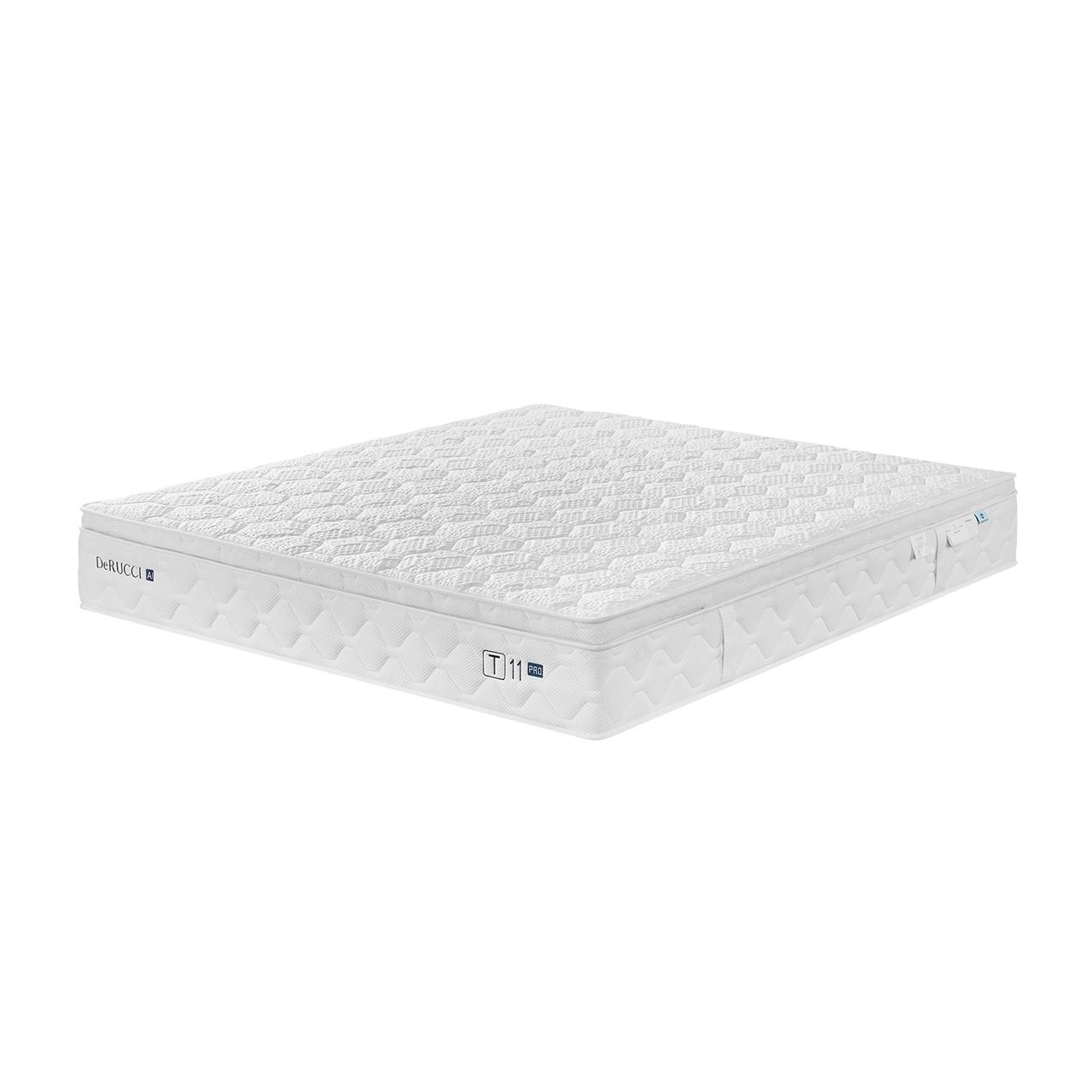
A useful shortlist should separate active support from basic adjustability and passive tracking. DeRUCCI T11 PRO stands out for automated ergonomic support, while other smart mattress categories may suit shoppers who want simpler control, sleep data, couple flexibility, or a lower entry price.
Best active support pick: DeRUCCI T11 PRO
Positioning: DeRUCCI T11 PRO is a strong fit for buyers who want active ergonomic support instead of adjusting firmness by trial and error. It is designed for premium households that value automated comfort, partner independence, and more targeted lower-back support through the night.
Key technology: The T11 PRO uses AutoFit 6-Zone active support to adjust firmness across key body areas. Its dual-drive independent adjustment allows each side of the mattress to respond separately, which is important when partners have different body weights, sleep positions, or firmness preferences. Harvard CPC is associated with the T11 PRO SleepCare System, supporting a more research-led approach to sleep ergonomics and support matching.
Who it suits: It is especially relevant for back sleepers who need better hip control, side sleepers who need shoulder and hip relief without losing lumbar support, and couples who want each side adjusted independently. For shoppers in Australia, Singapore, Malaysia, and Vietnam, DeRUCCI provides current T11 series availability through its AI smart mattress availability page.
Best simple adjustable pick: a manual firmness smart mattress
Positioning: This category suits shoppers who want basic firmness control and do not need the mattress to make active support changes during the night.
Key technology: Manual firmness systems usually let the sleeper raise or lower firmness through a remote or app. The benefit is direct control. The limitation is that the user has to notice the discomfort, understand what setting might help, and make the adjustment at the right time.
Who it suits: It can work for people with predictable preferences, especially single sleepers who already know their ideal firmness and rarely change sleep position. It is less suitable for users who wake often because the bed feels different across the night.
Best monitoring-focused pick: a tracking-first smart mattress
Positioning: This choice is for shoppers who want sleep data before they commit to a more advanced support system.
Key technology: Monitoring-focused mattresses track patterns such as rest timing, movement, or sleep quality indicators. These features can help users understand habits and nighttime changes, but tracking alone does not correct support problems. If the hips are sinking or the shoulder is taking too much pressure, the data may show a pattern without changing the mattress response.
Who it suits: It fits data-driven buyers who want clearer feedback and are willing to adjust pillows, routines, room conditions, or firmness settings themselves. It is a practical option for people who like measurement but do not expect the mattress to handle support decisions automatically.
Best couple-friendly pick: an independently adjustable mattress
Positioning: Couples often need different firmness levels, especially when one partner has lower-back discomfort and the other prefers a softer surface.
Key technology: Each-side independent adjustment reduces the need for compromise. It can also reduce the feeling that one partner’s movement is changing the other side of the bed. For households where sleep schedules, body types, and preferred positions differ, this feature often matters more than a long list of app controls.
Who it suits: It is best for couples with different body types, different sleep positions, or different comfort expectations. It is also useful when one person needs firmer lumbar support while the other needs more pressure relief at the shoulder or hip.
Best value-oriented pick: an entry smart mattress
Positioning: Entry smart mattresses are for buyers who want some adjustability before committing to full automation.
Key technology: These models may include basic firmness settings, simple app control, or limited monitoring. They can be a practical step up from a conventional mattress, but buyers should check whether the support system is genuinely useful for the lower back or mainly a convenience feature.
Who it suits: They fit budget-conscious shoppers who want some personalization but do not require advanced active support. They are also reasonable for guest rooms or lighter-use settings where full ergonomic automation may not be necessary.
Comparison Table: Key Smart Mattress Features for Back Pain
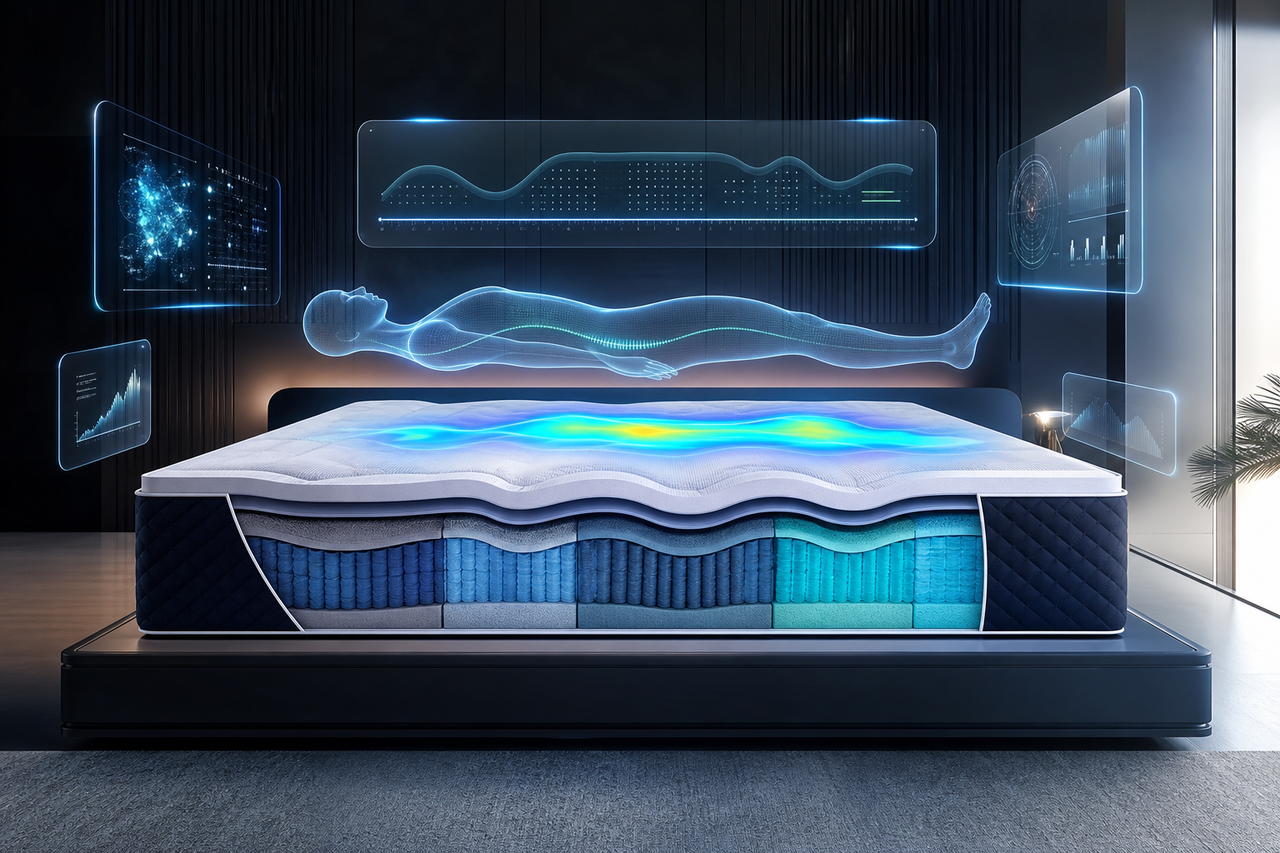
(This image was generated by AI and is for reference only.)
A smart mattress comparison should focus on how the bed behaves when the sleeper’s body presses into it. The main differences are support zones, adaptive firmness, built-in monitoring, partner independence, and how well the mattress fits common sleep positions.
| Mattress category | Support zones | Adaptive firmness | Built-in monitoring | Partner independence | Best sleep position fit |
|---|---|---|---|---|---|
| DeRUCCI T11 PRO active support | 6-zone active support | Yes, automatic adjustment | Yes | Yes, dual-drive independent adjustment | Back, side, and mixed sleepers needing lumbar support |
| Manual firmness smart mattress | Limited or model-dependent | User-controlled | Sometimes | Sometimes | Sleepers with stable firmness preferences |
| Monitoring-focused smart mattress | Usually limited | Not the main focus | Yes | Model-dependent | Data-focused sleepers who can adjust habits themselves |
| Independently adjustable mattress | Model-dependent | Often user-controlled | Sometimes | Yes | Couples with different comfort needs |
| Entry smart mattress | Basic | Basic or preset-based | Sometimes | Limited | Buyers testing smart adjustability |
Active support differs from fixed-firmness or remote-controlled adjustment in one practical way: it reduces the need for the sleeper to diagnose the problem in the middle of the night. A manual setting can help when the user knows what to change. An active system is designed to respond as conditions change, rather than waiting for the sleeper to wake up and intervene.
For back pain relief, that distinction matters because the body does not stay in one position for eight hours. A mattress that supports the hips well during back sleeping may need a different response when the sleeper rolls onto the side. The stronger the support system, the less the sleeper has to choose between immediate comfort and longer-term alignment.
How Should You Choose by Sleep Position and Body Type?
The right smart mattress depends on how the sleeper loads the bed. Side sleepers need pressure relief, back sleepers need hip control, stomach sleepers need firmer center support, and couples need separate comfort paths that do not disturb the other side.
Side sleepers: prioritize shoulder and hip pressure relief with lumbar support
Side sleepers should look for a surface that lets the shoulder and hip settle without leaving the waist unsupported. If the waist drops, the spine bends sideways. If the shoulder cannot settle, pressure builds and the sleeper may wake with tightness through the shoulder, neck, or upper back.
For this group, the best fit is usually not the softest mattress available. It is a mattress that creates enough give at the shoulder and hip while still keeping the midsection supported. Zoned support and adaptive firmness are useful because side sleeping puts very uneven pressure into the mattress.
Back sleepers: look for balanced firmness that prevents the hips from sinking
Back sleepers usually need balanced support through the hips and lower back. If the mattress is too soft, the pelvis dips and the lumbar area works harder. If the mattress is too firm, the lower back may feel suspended because there is not enough contact under the natural curve of the waist.
The best smart mattress for back pain relief should keep the spine closer to neutral for hours, not just during the first few minutes of testing. This is where stable center support and controlled pressure relief matter. The mattress should hold the pelvis without creating a hard, uneven feel under the ribs, waist, or shoulders.
Stomach sleepers: choose firmer support to reduce lower-back arching
Stomach sleeping can increase lower-back arching when the midsection sinks. Firmer support is usually safer for this position because it helps reduce the downward pull through the pelvis and abdomen. A mattress that feels comfortable for side sleeping may be too soft for regular stomach sleeping.
A smart mattress with stronger center support can help reduce the hammock effect that often leads to morning stiffness. Stomach sleepers should also be cautious with very thick pillows, because raising the head too much can add strain through the neck and upper back.
Couples: prioritize each-side independent adjustment and low motion transfer
Couples should avoid trying to solve two different bodies with one firmness choice. Each-side independent adjustment is especially useful when one partner needs firmer lumbar support and the other needs softer pressure relief. This setup can reduce nightly compromise and make the mattress easier to live with over time.
Low motion transfer also supports quieter rest when one partner turns during the night. For couples with different schedules or frequent position changes, this can be just as important as firmness. The practical goal is simple: each sleeper should get enough support without repeatedly disturbing the other side of the bed.
Before You Buy: Availability Check
The T11 series AI smart mattress is currently available in Australia, Singapore, Malaysia, and Vietnam. North America shoppers should not treat T11 PRO as a current purchase option in the United States or Canada. They can review DeRUCCI’s traditional mattress options instead, including Taputa Latex Mattress MZZ4-238A and Century Dream 3D Latex Mattress MOC1-012, along with selected bed frames and sofas.
Availability should be checked before comparing final prices or delivery timelines, because regional product lines can differ. Buyers should also confirm mattress size, warranty terms, service support, and whether in-store trials are available in their market.
Frequently Asked Questions
For in-store experience options and regional product guidance, visit DeRUCCI and click to check global store locations and details.