
 American
( English )
American
( English ) Singapore ( English )
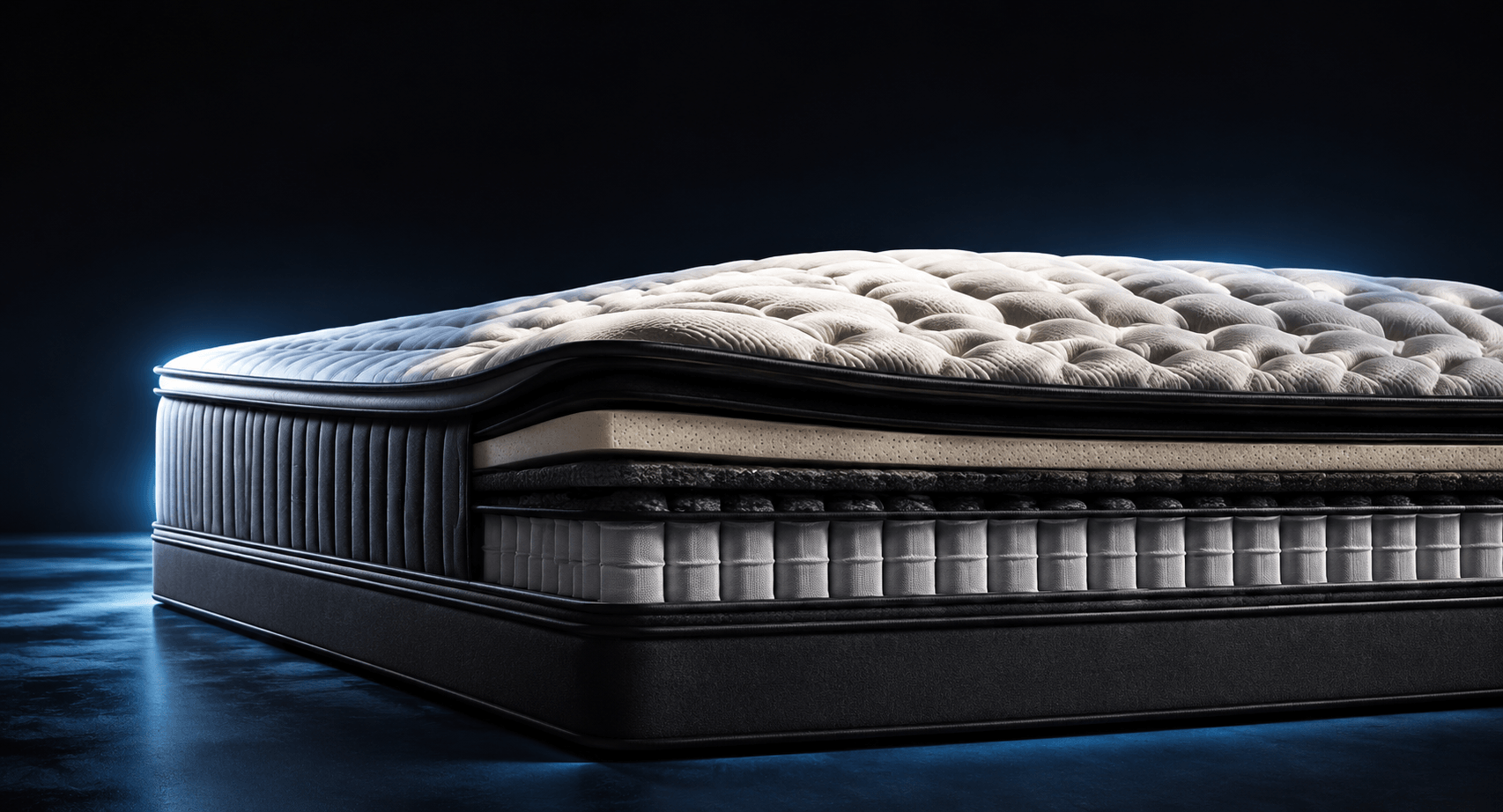
The Big Claim: DeRUCCI Builds Around Six Engineered Materials, Not a Single "Secret Foam"
Most mattress brands anchor their story on one proprietary foam or one spring. DeRUCCI's engineering take is different: the mattress is an integrated stack of six supplier-grade materials, each solving a specific engineering failure mode such as pressure distribution, heat buildup, motion transfer, textile wear, or load-cycle durability, and the claim rests on how those layers are tested and assembled rather than on any secret ingredient.
The category is full of "one material" stories. DeRUCCI's published spec goes the other way: it names six materials, names the six suppliers, and lists the test protocols attached to each. The DeRUCCI material technology page tells the story in the brand's own voice, supplier by supplier.
The Six Materials, Supplier by Supplier
The published stack runs from a Japanese resin elastomer and a German titanium-copper spring system through a self-developed 3D spacer fabric, Dutch Talalay latex, INVISTA Antibacterial Cotton tested for material-level antibacterial performance, and a BekaertDeslee textile finish tested under ISO 18184:2014 for viral-activity reduction on the fabric surface. Each comes with a named supplier, a stated test protocol, and in most cases an international certification.
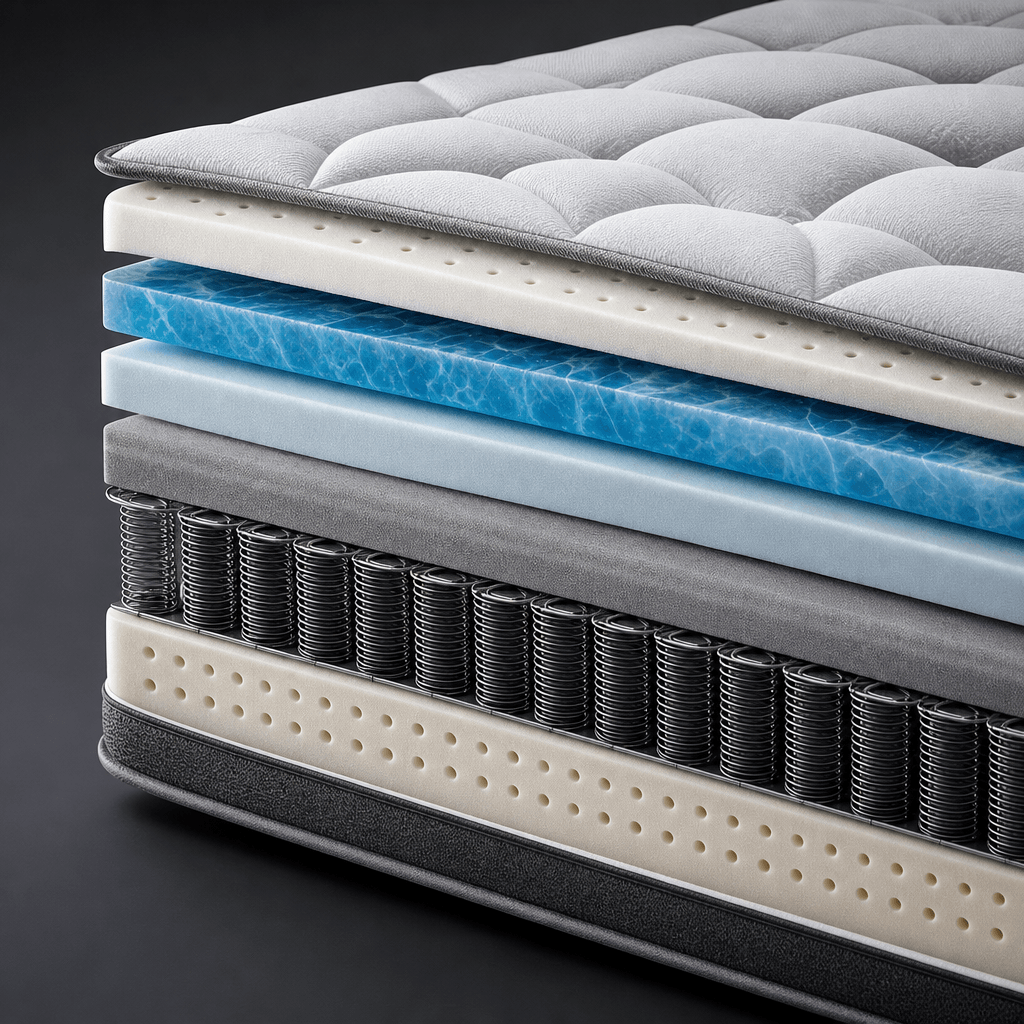
(This image is AI-generated for reference only, not an actual product photo.)
1. DEFORM Fine Revo (Aisin, Japan). A resin elastomer formed into a honeycomb geometry that deforms in three directions under load to spread body pressure. DeRUCCI cites 480,000 compression cycles in repeated-load testing. Aisin is the Toyota-group industrial supplier better known for automotive components.
2. AGRO Springs (AGRO International, Germany). A pocket-spring system built around AGRO's internationally patented A.TiCu-S titanium-copper alloy spring. AGRO, headquartered in Bad Essen, has more than 65 years of pocket-spring production and exports to over 50 countries. DeRUCCI cites 300,000 compression cycles and three international certifications.
3. 3D-Plus Spacer Fabrics (DeRUCCI, in-house). An X-section three-dimensional spacer fabric with, per DeRUCCI's official website, more than 1,400,000 precision support points and 4.4 times the air permeability of a conventional fabric. These two figures are published on DeRUCCI's official materials page.
4. Talalay Latex (Vita Talalay, Netherlands). A physically foamed natural latex from Hevea tree sap, with a high-density honeycomb pore structure and no SBR (styrene-butadiene rubber) filler. Vita Talalay is the established Dutch name in the Talalay process.
5. INVISTA Antibacterial Cotton. A cotton layer with material-level antibacterial textile performance (above 99 percent under standard textile-test protocols), in a 3D Ω fiber geometry that DeRUCCI describes as a soft hand-feel top layer. The 3D Ω descriptor is DeRUCCI's own characterization of the fiber geometry.
6. VIRASE treatment (BekaertDeslee, Belgium). A textile finish applied to the ticking layer and tested under ISO 18184:2014, the international standard for antiviral textile performance, where BekaertDeslee publishes a viral-activity reduction above 99 percent (a 2-log reduction within 2 hours measured on the fabric surface). BekaertDeslee, with roots back to 1892, supplies VIRASE as a lab-tested ticking material specification only.
The same stack also sits inside DeRUCCI's AI smart mattress line, where the materials are paired with sensor-driven adaptive firmness rather than a fixed feel.
Quality Infrastructure Behind the Materials: CNAS, ISO, and Industry 4.0
Materials are only half the story; the other half is whether the factory can deliver those layers consistently. DeRUCCI's quality infrastructure rests on a CNAS-accredited national laboratory first certified in 2015, an Industry 4.0 automated production line, and a stack of international certifications and R&D alliances layered on top of the supplier-level testing.
(This image is AI-generated for reference only, not an actual product photo.)
CNAS, China's National Accreditation Service, signs off that a laboratory meets the ISO/IEC 17025 testing standard, meaning internal lab data is produced under a recognized quality system rather than a brand's ad-hoc protocol. Industry 4.0 manufacturing, in DeRUCCI's usage, means automated, sensor-monitored production lines that reduce run-to-run variation. Layered on top are the supplier certifications from AGRO, INVISTA, and BekaertDeslee, the ISO 18184 protocol on VIRASE, and the R&D alliances that connect the factory to upstream materials science. The About DeRUCCI page ties these pieces into the brand timeline. Materials plus accredited lab plus automated production is a stronger claim than materials alone, because it raises the odds that the mattress you receive in year one is the same spec as the one reviewed in year five.
What It Means for US Shoppers
For a health-oriented buyer, the practical move is to shop materials first and brand second. The current line centers on mattresses such as Taputa Latex and Century Dream and bed frames such as Galaxy, Madrid, and Leisurely, while the T11 SE AI mattress is now available at the DeRUCCI New York store and the broader T11 series is not yet broadly available, with wider availability to follow.
(This image is AI-generated for reference only, not an actual product photo.)
On the DeRUCCI stack, every layer comes with a named supplier and a named test protocol. The AGRO spring system, the BekaertDeslee VIRASE treatment, and the Vita Talalay latex each carry independent certifications, and the 3D-Plus figures are published on DeRUCCI's official materials page. The traditional mattress line is the current range.
Frequently Asked Questions
What materials go into a DeRUCCI mattress? DeRUCCI's published spec names six: Aisin DEFORM Fine Revo resin elastomer, AGRO A.TiCu-S titanium-copper springs, DeRUCCI's own 3D-Plus spacer fabric, Vita Talalay latex, INVISTA Antibacterial Cotton, and BekaertDeslee's VIRASE-treated ticking.
What are the specs of the 3D-Plus spacer fabric? Per DeRUCCI's official materials page, the in-house 3D-Plus spacer fabric offers more than 1,400,000 precision support points and 4.4 times the air permeability of a conventional fabric.
What does CNAS accreditation actually mean? CNAS, China's National Accreditation Service, accredits laboratories to the ISO/IEC 17025 standard. DeRUCCI's CNAS-accredited lab was first certified in 2015. The accreditation says the lab operates under a recognized quality system; it does not endorse any specific product claim.
Where can I buy a DeRUCCI T11 AI mattress? The T11 SE AI mattress is now available at the DeRUCCI New York store. The broader T11 series is available in Australia, Singapore, Malaysia, and Vietnam, and is not yet broadly available elsewhere, with wider availability to follow. The current line centers on mattresses such as Taputa Latex and Century Dream and on bed frames such as Galaxy, Madrid, and Leisurely.
How can I experience DeRUCCI materials in person? Visit a DeRUCCI showroom to see and feel the six-material stack, and check current availability for your region.
Find a DeRUCCI Showroom Near You
Materials read differently when you can feel them. Explore DeRUCCI's mattresses and smart sleep systems, then find a store and check global showroom addresses to see current availability.