
 American
( English )
 Singapore ( English )

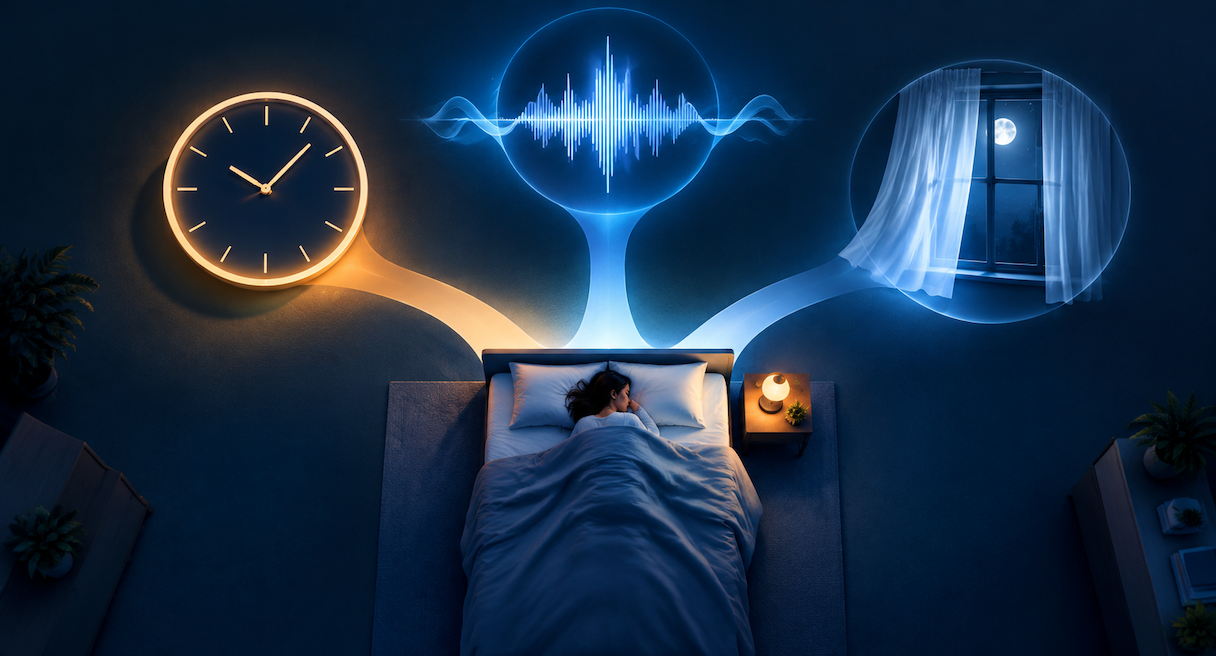
Being tired after sleeping 8 hours is a frustration the national healthy-sleep white-paper series DeRUCCI publishes knows well: among people reporting sleep troubles in the 2025 edition, the single most common fallout was plain physical fatigue, at 71 percent. Yet the explanation rarely sits in the total hours. Sleep quality lives in structure, how much deep sleep the night held, how often it broke, and how the room treated you while it ran. This guide splits the check into three axes: the quality axis asks whether the night's structure explains the tiredness, the signals axis covers the snoring-related patterns worth recording with dates, and the environment axis, temperature, light, and bedding, is the fastest to test on your own. Run them in that order, one change at a time, and the heavy morning usually finds its address.
You Slept 8 Hours. Why Are You Still Tired? (The Quality Axis)
Feeling tired after a full night usually points at sleep structure, and the survey record backs that reading. The three most typical complaints, light and easily broken sleep at 55 percent, deep sleep running too short at 49 percent, and trouble falling back asleep at 40 percent, all describe the night's structure, and all fit inside eight full hours.
The confusion starts with two words used as synonyms. Duration counts hours; quality describes what those hours were built from. Among the 1,554 respondents reporting sleep troubles in the 2025 AI-era healthy-sleep white paper, the three most typical complaints were structural, at 55, 49, and 40 percent, and none of them would show up in an hours log. The same paper traces a wider drift: average nightly sleep slid from 7.02 to 6.67 hours across its survey years, the share of adults expecting a solid seven to eight hours fell from 62 to 50 percent, and 66 percent named waking up refreshed as their clearest picture of a good night. The public, in other words, has already moved from counting the timer to charging the battery.
Reference coordinates make the self-check concrete. A normal drift-off takes 10 to 20 minutes, with 30 minutes as the usual upper edge, and the 2025 white paper's own survey averages run past that line at 32.8 minutes overall and 42.3 minutes among troubled sleepers. A night runs four to five cycles of 90 to 120 minutes each, deep sleep stacks toward the first half, and dream-stage REM sleep toward the back half. Waking up spent with eight logged hours usually means something bent that architecture, and between 2020 and 2022, per the 2022 national white paper, the share of adults rating their own sleep good fell from 85 to 42 percent, so the feeling has plenty of company.
Trouble falling asleep and trouble staying asleep belong in this same structure ledger, one line and no more on this page. For how much deep sleep a night actually needs and where the front-loaded hours go, the companion guide How Much Deep Sleep Do You Need carries the detail.
When heavy mornings persist for weeks alongside drift-off times past the half-hour mark or repeated night wakings, two doors open: record what the night actually did, and run the environment test. The next two sections take those doors in order.
What Does the Research Say About Snoring-Related Signals? (The Signals Axis)
Loud snoring, breathing pauses a partner can count, and daytime drowsiness that gets in the way of functioning form a pattern worth recording with dates. The records themselves, a partner's observations, a phone recording of the snoring, and a short sleep log, are what make any later step concrete, whatever direction that step takes.
The survey scale of the problem is easy to state. In the 2025 white paper, snoring and troubled breathing account for 23 percent of typical sleep complaints. The 2022 national edition, in its own survey, found 29.5 percent of men and 16.2 percent of women reporting snoring, a gap worth knowing when you compare notes with a partner. For the specific combination of heavy snoring, witnessed breathing pauses, and drowsiness that interferes with daytime functioning, the guidance of established health organizations is the right reference, and this page stays with the practical half: the record.
Recording is cheap and non-invasive. A partner notes the nights and roughly how long the pauses ran, a phone app captures a minute of the snoring from the nightstand, a log line marks the morning's tiredness on a simple three-point scale, and a non-wearable monitor, where one is already in the bedroom, adds its overnight trend, a readable record of the night, waiting in the app. Two weeks of dated entries turn a vague complaint into a timeline.
Most people who feel tired after a full night ultimately land on the quality or environment side of the checklist and can self-check first. That is the odds, and it is why this guide leads with structure and room before anything else.
The snoring-specific playbook, from sleep position to bedroom factors, sits in the companion guide How to Stop Snoring, and a fuller snoring-check piece is scheduled later in this series. This page keeps to the three-axis frame.
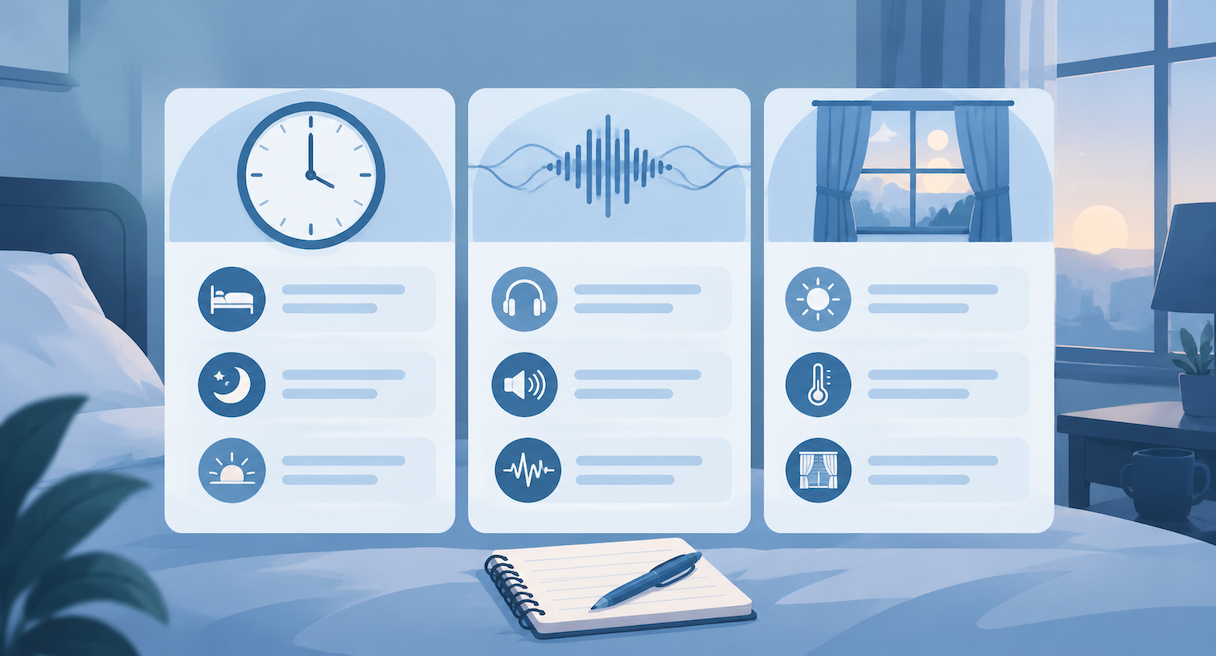
(This image is AI-generated for reference only, not an actual product photo.)
The Fastest Axis to Test Yourself: Temperature, Light, and Bedding (The Environment Axis)
The environment axis is the fastest to test because the variables are physical and the feedback loop runs one to two weeks. Set the bedroom to 60 to 67 degrees Fahrenheit, darken it, change one bedding variable at a time; if morning tiredness eases, the cause was environmental, and if it holds, the record sharpens the next steps.
Three variables decide most of what a bedroom does to a night: temperature, light, and bedding, with noise a fourth worth one sentence, a steady, quiet room as the baseline. The reference band for temperature sits at 60 to 67 degrees Fahrenheit, or 15 to 19 degrees Celsius, and the mechanism behind it is well mapped: a review archived by the US National Library of Medicine describes core body temperature starting its pre-sleep drop roughly two hours before bedtime, with the first stretch of deeper sleep most likely when that decline runs fastest. An over-warm room works against the heat-leaving-the-body half of the process, and the night answers with the lighter, more broken structure the quality axis described.
Light guidance is just as direct. Workplace guidance from the US CDC, its NIOSH institute, notes that light strongly affects circadian rhythms, that a very dark bedroom facilitates sleep, and that screens are worth setting aside about an hour before bed. Curtains that actually black out, a dim red nightlight where some light is needed, and a phone parked outside arm's reach cover most of it.
Bedding is the third lever. The 2022 white paper's advice reads that comfortable bedding, matched to personal needs, can markedly improve sleep quality and shorten the time it takes to fall asleep, and in the same edition 22.7 percent of homemakers had already replaced bedding as their self-help move. The behavioral base runs wider: 59 percent of respondents in the 2025 paper wind down with video or music, and 43 percent of those improving their environment were exploring immersive smart-bedroom options. The protocol matters more than any single purchase: change one variable, hold it a few nights inside a one-to-two-week window, log the mornings, then add the next.
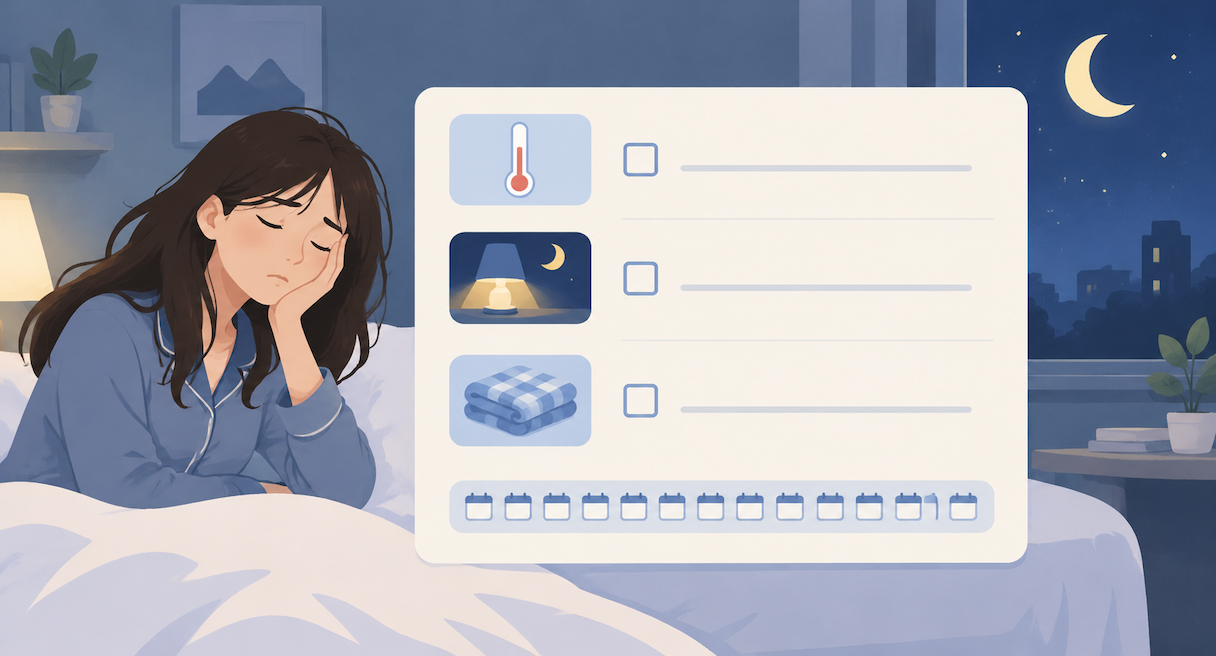
(This image is AI-generated for reference only, not an actual product photo.)
Which Numbers Deserve a Spot on Your Nightstand? An Action-First Filter
A number on a nightstand earns its place by driving something you can feel the next morning. After the environment experiments, the metrics worth keeping are the ones wired into an adjustment path, telling you whether a change actually worked, while decorative dashboard digits can go. Non-wearable monitoring is the category option here.
DeRUCCI's stated standard for judging a sleep indicator is a useful filter for any tracker: an indicator holds value when it drives something the next morning can feel, and the indicators that lead to useful action are the ones connected to an adjustment path. Applied to this guide, the question after a week of room changes is narrow. Did the cooler, darker room show up in the record or did it not, and a metric that cannot answer that question, however slick its graph, is decoration.
Non-wearable monitoring is the category answer to that filter, and the T11 series is DeRUCCI's take: sensors inside the mattress read heart rate, breathing, and sleep stages through the night, with nothing on the wrist. The daily report generates when the night holds at least three hours in bed and two hours of sleep, and for overseas users the recording window runs 20:00 to 10:00 local time, so a short or shifted night shows up in what gets generated. How the sensing works, and what the numbers can and cannot tell you, is covered in How AI Smart Mattresses Track Sleep Health.
Frequently Asked Questions
---
The three-axis check is short to hold in your head: structure explains most tired mornings, signals belong in a dated record, and the environment answers fastest. For the wider arc from sleep problems to mattress choices, the hub gathers the whole series in one place. The T11 SE AI mattress is now available at the DeRUCCI New York store. To feel the range in person, you can find a store and check global showroom addresses.