
 American
( English )
 Singapore ( English )

Type smart mattress safety overheating electrical fire recalls guidance into a search bar and the news stories that come back, about certain smart bed models and heated mattress pad categories, rarely say which part failed. The pre-purchase answer is checkable. A smart mattress electrical safety check comes down to three segments, overheating behavior, electrical design numbers, and the certification file. This page builds the checklist at category level, then fills it in with the published figures behind DeRUCCI's T11 series, from the 24-volt internal supply to the T11 PRO's certifications. Recall records close the loop as a self-service step.
Before You Check Anything: Where Electrical Risk Actually Comes From
Electrical risk in a powered bed concentrates in the power chain, and the one-line rule worth memorizing reads: no damaged or substituted power components. A worn cable, a cracked plug, or an adapter that misses the nameplate rating is the leading cause of electrical failure, and at worst a genuine safety risk. Those three are the check objects.
In a powered bed, the electrical story worth reading before purchase sits in the power chain: cable, plug, adapter, and the nameplate ratings. Frayed insulation on a cable, a crack in a plug housing, and a wall adapter whose output disagrees with the nameplate rating form the leading cause of electrical failure in this product class, and in the worst case a genuine safety risk. The instruction is short: stop using the bed and request a replacement. The vague question, is a smart mattress safe, becomes answerable the moment it turns into that parts list.
Three care rules travel well as purchase filters. Leave disassembly, repair, and modification to the dealer. Use the matching power cord with a compatible adapter. Retire damaged plugs and substitutes on sight. They read as user responsibilities inside care guidance, ahead of any published list of exemptions.
The check itself runs in three segments: overheating behavior first, because heated sleep products earn their scrutiny there, four electrical design numbers next, and the certification paperwork last, naming who examined the design.
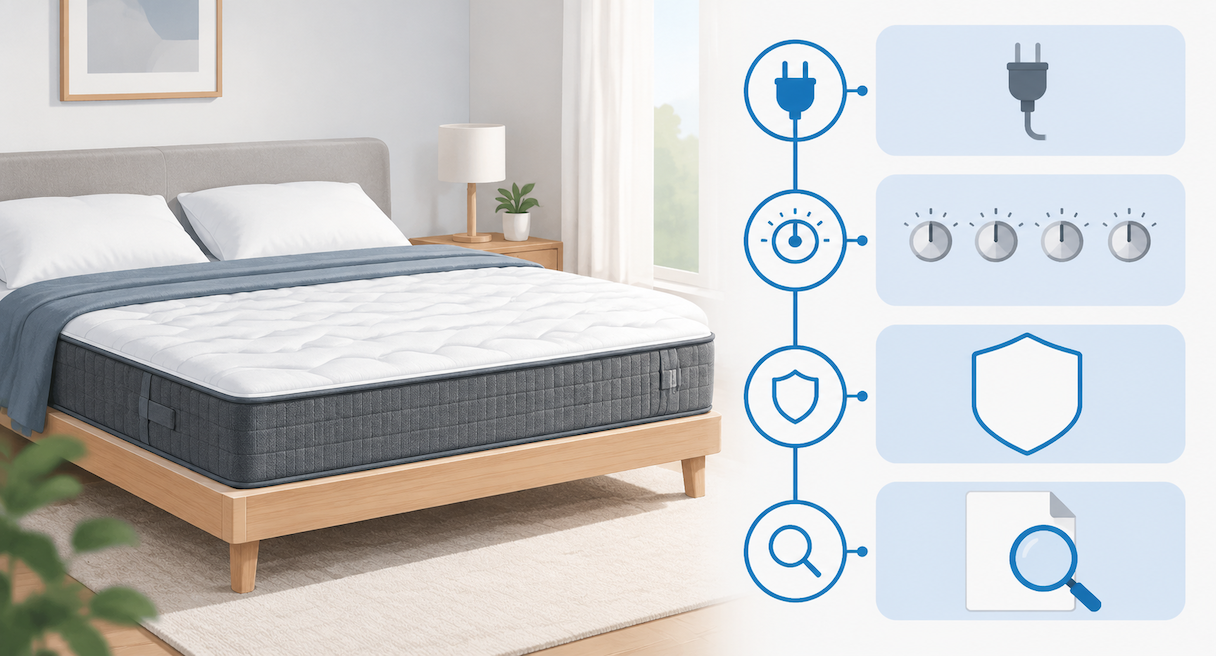
(This image is AI-generated for reference only, not an actual product photo.)
Overheating and Electrical Design: The Numbers to Check Before You Buy
Two segments carry the numbers. Overheating asks whether heating steps down on its own: timer options, automatic shut-off, and the gap between set and surface temperature. Electrical design asks four separate questions, voltage level, leakage current, rated power, and radio emission, and each concept deserves its own definition before any comparison.
Run the first two segments against any candidate's documentation.
| Segment | Check item | What it answers | Where to check |
|---|---|---|---|
| Overheating | Timer with automatic shut-off | Whether heat can run unattended indefinitely | Manual, heating chapter |
| Overheating | Set-to-surface temperature gap | Skin reading versus display number | Manual or spec page |
| Overheating | Rated power | Thermal load and energy draw | Spec page, electrical block |
| Electrical | Internal voltage level | The supply architecture inside the bed | Spec page or nameplate |
| Electrical | Leakage current | Insulation margin versus human threshold | Spec page or test report |
| Electrical | Radio emission type and power | Transmit type and strength | Equipment label, ID position |
The voltage level states what the internal circuitry runs at and how the design divides wall power from bed power. Leakage current measures what escapes the insulation while the bed runs, and beside a human-safety threshold the pair is the margin. Rated power states the sustained draw of the whole unit, anchoring heat and the electricity bill. Radio emission covers the wireless link; its type and transmit power place the bed among the connected devices already in your home, a transfer from the same device class that holds whenever the radio families match.
Two reading notes keep the numbers honest. A set-to-surface gap depends on the quilting between element and skin, so ask for the offset with the set figure. Documentation quotes either a whole-unit rating or a heating-line rating, and the two answer different questions.
Statuses differ across the table. Automatic shut-off is a required item, a design line every candidate should carry; numeric answers count as measured figures when a brand publishes test values and as reported figures when they arrive through certification paperwork. New to the category? What Is a Smart Mattress? covers the layers.
Which Safety Certifications Should You Verify — and How Far Can You Check Them?
A certification file earns trust through named schemes in three families: electrical compliance, radio type approval, and laboratory accreditation. A bare "safety certified" label without a named scheme answers little. Regulatory standards sit one layer deeper, and honest checking stops at the official texts, where the current version governs.
The three families divide the work. Electrical compliance covers the safety of the powered design itself, radio type approval covers what the wireless module emits, and laboratory accreditation covers the competence of the testing labs. Sort any candidate's certificate list into those families and gaps show quickly; a document pile that names no scheme in any family is itself a finding.
The regulatory layer sits behind the certificates. The United States publishes federal flammability standards for mattresses, 16 CFR 1632 and 1633, in the Code of Federal Regulations, and UL Standards & Engagement publishes electrical safety standards. Those texts live on official sites, eCFR and CPSC for the federal rules, UL's own pages for theirs, and the version current on the day you look governs. This page stops at the door.
One distinction protects you while reading spec sheets. A regional flame-retardant fabric configuration is a material fact about a version sold in a specific market; a federal-standard compliance statement is a regulatory finding about a tested product. A spec sheet that blurs them deserves a second read.
Close the segment in three moves: read the shipped certificate list, sort each entry into its family, and take the regulatory questions to the official domains yourself.
The Checklist Applied: What the DeRUCCI T11 Safety Record Says
The T11 record fills the checklist in. Inside, the supply runs at 24 volts through a 5-volt converter, the T11 PRO's maximum leakage current reads 0.25 milliamps at 24 volts, and rated power spans 20 to 85 watts by model. Heating on the PRO shuts off at 1, 2, or 4 hours, and the certification file names three schemes.
The low-voltage design answers the electrical segment first. Per DeRUCCI's official documentation for the T11 series, the internal supply runs at a 24-volt safety level, the converter works at 5 volts, the whole mattress forms an insulated assembly carrying no live current, and metal parts pass corrosion, flame, and heat-resistance checks. The documentation cites roughly 36 volts as the human-safety threshold, placing both working figures well below it. The T11 PRO specification adds the insulation reading: a maximum leakage current of 0.25 milliamps at 24 volts against a threshold pair of 10 milliamps at 36 volts. The control hub sits inside the mattress tail, out of children's reach.
The power figures answer the energy worry. The same documentation rates the line at 20 watts for the T11 SE, T11+, T11 z+, and T11 z SE, and 85 watts for the T11 PRO, and puts eight hours of continuous whole-unit running at about 0.3 kilowatt-hours per night; heating, where fitted, adds at most 0.05 kilowatt-hours per hour while on. The two figures follow separate conventions, whole-unit consumption and the heating line. For scale, both ratings sit in bedside-lamp territory.
Heating behavior gives the overheating segment its sample answer, and heated mattress pad questions land here too, since pads and built-in heating share the auto-off question. The T11 PRO's leg-zone heating uses graphene far-infrared elements, set per side between 25 and 55 degrees Celsius through the app. The quilting layer keeps the surface about 15 degrees below the set figure. The timer offers 1, 2, or 4 hours and shuts the heating off at the deadline. Maintenance keeps one boundary: heavy wet washing traps moisture in the layered build and leads to deformation or mold. The feel of sleeping warm has its own page in Smart Mattress Temperature for Hot Sleepers.
The test and certification record closes the segment. DeRUCCI's published record runs through 30 quality and safety tests under CNAS accreditation, with the flexible adjustment units completing 30,000 load cycles at 1,200 newtons without failure and a bend test running 10,000 cycles at 280 kilograms without abnormality. The certification file lists an electrical safety certification, SRRC, China's radio type approval, and EU CE. The control box carries CE and transmits in the 2.4000 to 2.4835 gigahertz band at about 70 milliwatts maximum, a radiation type the documentation describes as the same as home Wi-Fi and Bluetooth equipment; the SRRC file reports radiation below 8 microwatts per square centimeter against a national limit of 40. The router and speakers already in the house supply the familiar-object anchor, a declared transfer held because the radio families match. The mechanics behind those units have their own explainer in How Adaptive Firmness Technology Works.
One regional fact rounds the file out: the T11+ lists a flame-retardant knitted fabric for its Hong Kong version, a material configuration for that market and separate from any federal-standard statement.
How to Verify Safety Claims and Recall Records Yourself
Verification runs on official pages, four of them. The FCC's equipment database answers radio compliance from the ID on the label. UL Standards & Engagement publishes the electrical safety background. The FCC's Radio Frequency Safety page and the WHO's electromagnetic fields Q&A carry the exposure positions, and recall databases answer model history.
For radio compliance, enter the FCC ID from the equipment label in the FCC's official equipment authorization database; the filing behind it covers the radio's compliance testing. For electrical safety background, UL Standards & Engagement maintains publicly readable materials on safely powered homes. For exposure positions, the FCC's Radio Frequency Safety page and the World Health Organization's electromagnetic fields Q&A hold the agencies' current statements. For recall history, regulator databases search by product category and brand, and category-level searches such as certain smart bed models or heated mattress pad categories return dated records with scope.
The boundary sits nearby. Covered: the three-part checklist and the four doors above. Left out: retellings of specific recall cases, which the databases render better than any article can, and the classification of sleep-tracking beds as regulated health devices, which belongs to the agencies' pages. Entries change over time, so read each page as of the day you check it.
Frequently Asked Questions
---
A checklist run this way ends with the object in front of you, labels legible and documents in hand. To read the certification file in person, find a store and check global showroom addresses. The wider path from sleep problems to mattress choices continues in the series hub.