
 American
( English )
 Singapore ( English )

Type smart mattress sleep quality evidence randomized trial temperature regulation sleep tracking research into a search bar and the results arrive as one blur: physiology papers, device accuracy reviews, and product pages quoting laboratory certificates, all in a single stream. This guide separates the stream into three layers, walks the published literature on temperature and tracking accuracy, and then maps where each DeRUCCI number comes from, with its source, test nature, and model tier in one table. A reader who can tell the layers apart can read any smart mattress claim in under a minute.
What Does "Smart Mattress Evidence" Actually Consist Of?
Smart mattress evidence is three different things stacked together: long-standing sleep physiology, a younger literature on how accurately consumer devices track sleep, and laboratory certification tests run on submitted products. Each layer answers a different question, carries its own conditions, and supports its own kind of claim. Sorting a claim into its layer is the whole skill.
The thickest layer is sleep physiology, and none of it was written about smart mattresses. Core body temperature falls before sleep onset, deep sleep concentrates in the first half of the night, and REM concentrates in the second half. On those mechanisms sit the verified reference figures sleep writers use across the industry: a bedroom held at 60 to 67°F (15 to 19°C), a healthy fall-asleep window of 10 to 20 minutes, sleep cycles of 90 to 120 minutes repeated four to five times a night, and deep sleep at 10 to 20 percent of an adult night. Every temperature claim in the category leans on this layer, and the layer itself describes rooms, bodies, and timing.
The second layer is device-accuracy research, and it asks a narrower question: when a wearable, a mattress-embedded sensor, or a radar unit reports sleep stages, how close does the answer sit to reference measurement? Systematic reviews and device evaluations populate this layer, and their conclusions travel with the conditions of their comparisons, which is what makes the layer usable.
The third layer is product-level testing, and it works differently from the second. A certification test sends one finished product into a laboratory and produces a scorecard: which detection items passed, how accurate the sensing was, how fast the adjustment responded. A journal-published randomized study does something else, following a pre-registered protocol across participant groups and reporting effects with their conditions attached. The two are different forms of evidence, and the commonest misread in mattress marketing is presenting the first as the second. This page keeps them separate throughout.
The Science Layer: Temperature, Sleep Stages, and Tracking Accuracy
The science layer holds two literatures. Temperature research is mechanism-grade: core body temperature falls before sleep onset, and the 60 to 67°F bedroom range is the consensus anchor. Tracking research is accuracy-grade: systematic reviews measure how close consumer devices come to reference measurement, with wide variation by device and by metric.
On temperature, the mechanism chain is well mapped. Research published in the Journal of Applied Physiology shows the drop in core body temperature ahead of lights out acting as a physiological precondition of sleep onset. A review of sleep and thermoregulation archived at PMC traces the neural-to-autonomic pathways that link warmth to sleep depth. A comprehensive review of thermoregulation in sleep disorders at MDPI marks where the intervention evidence runs thin, the honest boundary every temperature product inherits. The consensus bedroom anchor of 60 to 67°F follows from this literature. What the layer supports is environment management; a heated zone inside a specific bed is a product claim that stands on its own tests, covered in the product section below.
On tracking accuracy, the independent literature is candid about spread. A systematic review of consumer sleep tracking by Robbins and colleagues (2019, archived at PMC) compared device categories against reference measurement and found accuracy varying widely by metric, with conclusions limited to the controlled comparison settings the reviewed studies used. An evaluation of contactless consumer devices published in MDPI Sensors applied the same discipline to mattress-embedded and radar-style sensing, the closest independent layer to what a smart mattress does at night. Johns Hopkins Medicine frames consumer tracker data as a daily-life reference, a phrasing this page adopts for category guidance. Writers at The Conversation explain the mechanism under the numbers: accelerometers count movement, photoplethysmography reads pulse waves at the skin, and algorithms infer stages from those signals, which is why stage estimates run softer than presence and pulse readings. For the product side of heat, the smart mattress temperature for hot sleepers guide covers what zone heating systems do.
The Product Layer: Where Each DeRUCCI Number Comes From
Every DeRUCCI number in circulation belongs to one of four separated sets: the CAICT efficacy figures on the T11 SE, the CAICT sensing figures on the T11 PRO, a marketing-grade heart-rate figure on the T11+, and a detection-group recognition figure in series materials. The table below keeps them in their own rows, each with its source, test nature, and tier.
The claim-comparison table is the deliverable this page exists for.
| Number or claim | Source and test nature | Tier attribution |
|---|---|---|
| Sleep onset time (time to fall asleep): 37.3% shorter; nighttime movement: 27.5% lower; deep-sleep duration: 4.5% longer; continuous deep sleep: 5.9% longer | CAICT laboratory testing, submitted-unit certification measurement under laboratory conditions | T11 SE |
| Heart rate 99.5% of readings within ±5 BPM; respiration 100% within ±3 BPM, against an industry standard of 90% for both; six detection items at 100%; adjustment response within 8 seconds, with single-sleeper runs at 90% attainment and dual-sleeper runs at 100% | CAICT laboratory testing of the sensing set | T11 PRO |
| Heart-rate detection accuracy 97% | Marketing-grade figure in published product materials, carried apart from laboratory sets | T11+ |
| In-bed and out-of-bed recognition within ten seconds at 90% | Detection-group figure in published product materials | T11 series |
| Graphene far-infrared leg-zone heating, per-side settings of 25 to 55°C, timer at 1, 2, or 4 hours | Brand benefit statement with published specifications | T11 PRO |
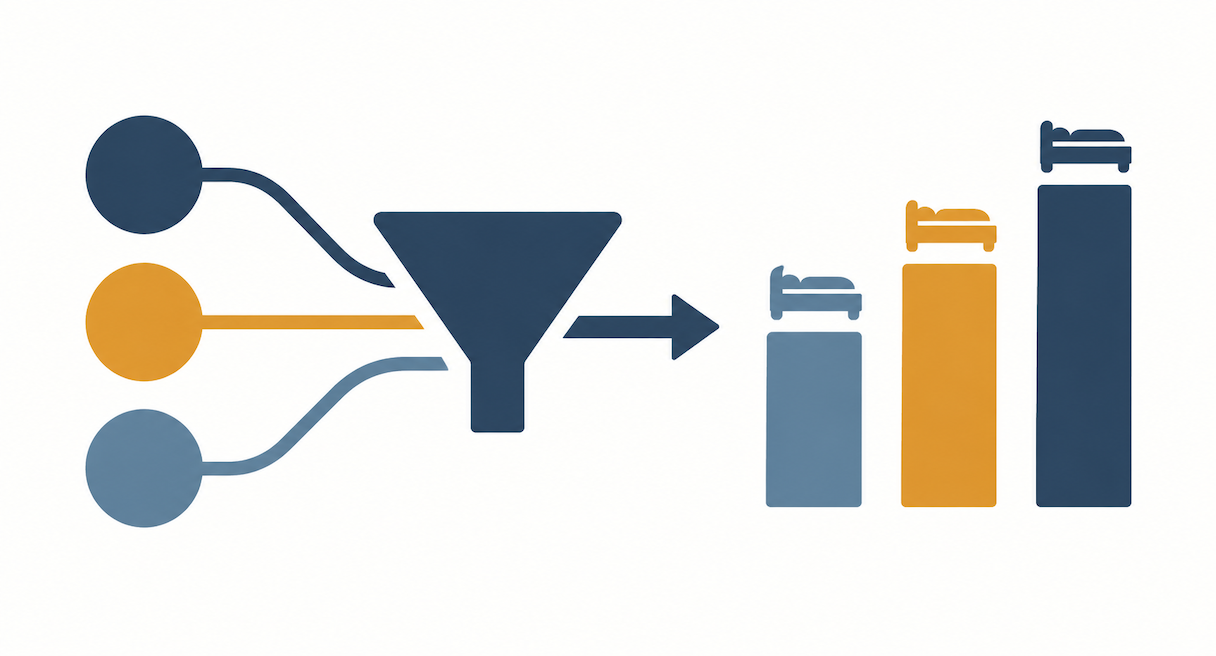
(This image is AI-generated for reference only, not an actual product photo.)
Two clocks in this set need telling apart. The 20 ms figure belongs to the AI Tidal Algorithm 2.0 as its data-analysis response; the within-8-seconds figure is the mechanical adjustment response measured by CAICT. Reading the first as the second attaches a chip's speed to a motor. Metric names carry the same discipline: the efficacy set reads sleep onset time (time to fall asleep) at 37.3% shorter, because "sleep time" alone would read as total sleep duration.
The temperature story assembles across the line. The environment layer is the 60 to 67°F consensus; the feel layer is the T11 SE's 3D-Plus fabric with 4.4× breathability; the local layer is the T11 PRO's graphene far-infrared leg zone, emitting at 6 to 15 μm with per-side settings through the DeRUCCI App, while the quilting keeps surface temperature about 15°C below the set value. DeRUCCI presents the zone's benefit as promoting circulation and easing fatigue, and this page carries it as exactly that, a brand benefit statement with published specifications. The safety anchors under the T11 SE complete the picture: operation below 28 dB backed by six patents, 30 quality and safety tests under CNAS, flexible adjustment units cycled 30,000 times under a 1200 N load, and a 24 V supply with maximum leakage current of 0.25 mA.
Research-flavored claims get the strictest handling. A multi-center observation DeRUCCI participated in appears in brand materials as an attribution statement, and this page adds no numbers to it. No independent, journal-published randomized trial of commercial smart-mattress adaptive adjustment appears in the public literature, and the reading rules below start from that gap as it stands. For how the sensing set works night by night, How AI Smart Mattresses Track Sleep Health opens the mechanism up, and DeRUCCI Sleep Science carries the brand's broader research footing. Readers comparing tiers can verify current specifications through the store finder at the end of this page.
How to Read Effect Numbers: Conditions, Samples, and Limitations
Reading effect numbers is a three-check habit: name the source that measured them, name the conditions they were measured under, and name the tier or model they belong to. The same three checks read a certificate scorecard, a survey percentage, or a review conclusion, for any brand on the market.
Timeline questions come first because they are the most searched and the least answerable. No independently verified timeline exists in published research for smart-mattress adaptive adjustment, and published effect figures are laboratory-condition measurements, so none of them carries a home-usable time anchor. A page that promises an effect week is reaching past what its source measured.
Survey numbers follow a different discipline: the issuer and the sample frame travel with the number. A white paper reporting spine-related sleep disturbance works as survey evidence when cited as an online questionnaire with screening criteria from a named publisher, and it becomes misread the moment it travels as an experimental result.
Brand numbers yield to the three checks above. Test nature, model tier, and an affirmative attribution sentence form the format this page used in the product section, and the same format dissects any claim sheet a reader encounters, whatever the brand on it.
Frequently Asked Questions
Layers read separately make a smart mattress claim legible in a minute. For the full route from sleep problems to a mattress decision, the sleep problems to mattress guide maps every step, and you can find a store and check global showroom addresses to verify specifications in person.
MetaTitle: Smart Mattress Evidence: Trials, Temperature, and Tracking MetaDescription: What research on smart mattresses actually shows: the three evidence layers, temperature and tracking findings, and where each DeRUCCI number comes from. MetaKeywords: smart mattress evidence, randomized trial, temperature regulation, sleep tracking research, CAICT testing, claim comparison