
 American
( English )
 Singapore ( English )

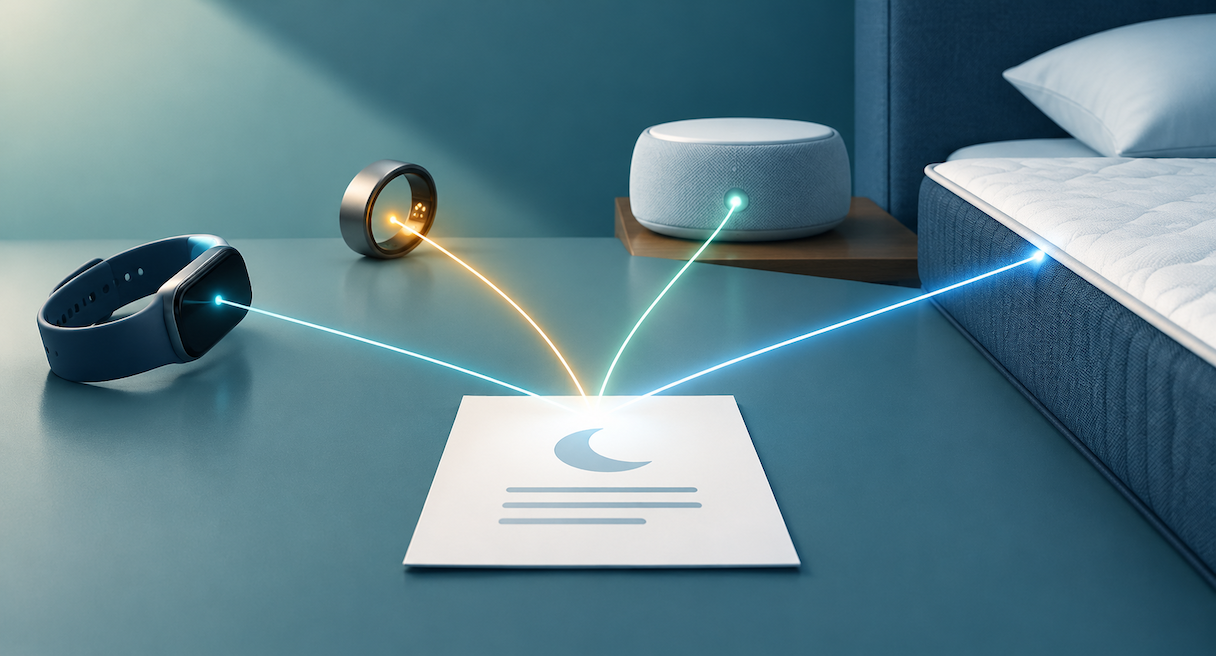
Type best sleep tracker accessories compatible with wearable sleep trackers 2026 into a search bar and the results arrive as gift-guide roundups. Each entry promises gear that works with what you own, and the load-bearing word is compatible. DeRUCCI publishes the connection and reporting conditions for its own ecosystem in full, and this page applies the same questions to every maker, DeRUCCI's included.
That one word hides three promises, a radio handshake, a data exit, and a route into the health platform where your records live. This page separates the layers, turns them into questions for any manufacturer, and closes with the route that moves the tracker into the mattress. It rates no third-party brands and names none.
What Does "Compatible" Actually Mean? Three Layers Behind the Word
The word compatible carries three separate promises: a radio connection that pairs, data you can export in a named format, and a path into the health platform where your records already live. A spec sheet can satisfy the first and still miss the other two, so the layers get checked one at a time.
An accessory that cannot pair never reaches the deeper questions. The connection layer holds the radio facts, the Bluetooth version, the 2.4 GHz or 5 GHz band, and the dock connector.
Pairing is only the door. The data layer asks what comes out, in which named format, CSV, an API, or a proprietary export, and in which direction, one-way or two-way.
The third layer is where HealthKit and Google Health enter. HealthKit is the store Apple devices route health records through, and Google Health appears as Health Connect on current Android; both are the aggregation points where readings from separate apps meet one timeline.
| Layer | What you are checking | The question that checks it |
|---|---|---|
| Connection | Bluetooth version, 2.4 GHz or 5 GHz band, dock connector | Does it pair with my device, and on which band? |
| Data | Export in a named format, and the direction of flow | Can I export my data, in what format, one-way or two-way? |
| Ecosystem | A path into your health platform's aggregation point | Does it write into my health platform, or only into its own app? |
Category evidence sharpens the order. Sleep researchers reviewing consumer wearables describe stage estimates as computed from averages, and a widely shared expert reply advises owners to "just entirely ignore" deep-sleep readings, because the devices "base it on averages" and measure that stage indirectly. A documented ninety-day log of every sleep variable closes with the line that people "want a measurement that leads to a decision." Ask what decision the data supports before anything else.
For the landscape itself, a companion roundup on this site covers which sleep tracker accessories exist and what each measures; this page checks whether a candidate connects to what you already use.
The HealthKit and Google Health Compatibility Checklist: Seven Questions Before You Pay
Seven questions, asked to the maker or read against the product page, decide the purchase. Each one has a pass line and a red flag. A single red flag means pause and collect the answer in writing first, and the questions cost nothing to send in a support email.
The categories run from replacement bands and charging docks to smart rings, bedside sensors, smart alarm clocks, and blackout masks, and the checklist treats them alike. Category names carry this page.
| # | What to verify | The question to ask | Pass line | Red flag |
|---|---|---|---|---|
| 1 | Export | Can I export my sleep data? | A named format: CSV, an API, or a stated proprietary export | No format named |
| 2 | Destination | Where does the data go? | A named exit: the maker's app, a listed platform, or your health platform | "Cloud sync" with nothing behind it |
| 3 | Direction | One-way export or two-way sync? | Direction stated | Deflection, or "view it in the app" alone |
| 4 | Portability | If I switch devices, does my history survive? | History downloads or transfers | History dies with the device |
| 5 | Report conditions | What does it take to generate a daily report? | Thresholds plus a recording window, stated | A daily-report promise with no conditions attached |
| 6 | Pairing prerequisites | Which band, which Bluetooth version, what range? | Band, radio, coverage, and offline behavior written down | Prerequisites missing |
| 7 | Privacy controls | Where is my data stored, who can see it, can I delete it? | All three parts answered | No privacy policy in reach |
On the ecosystem layer the question turns specific, whether the product writes into HealthKit (Apple Health) or Google Health (Health Connect), and it stays a question the maker answers in writing.
Replacement parts get their own pass. When a new band, dock, or sensor strip takes an old one's place, questions one and six repeat the work, because connectors and pairing prerequisites change across generations.
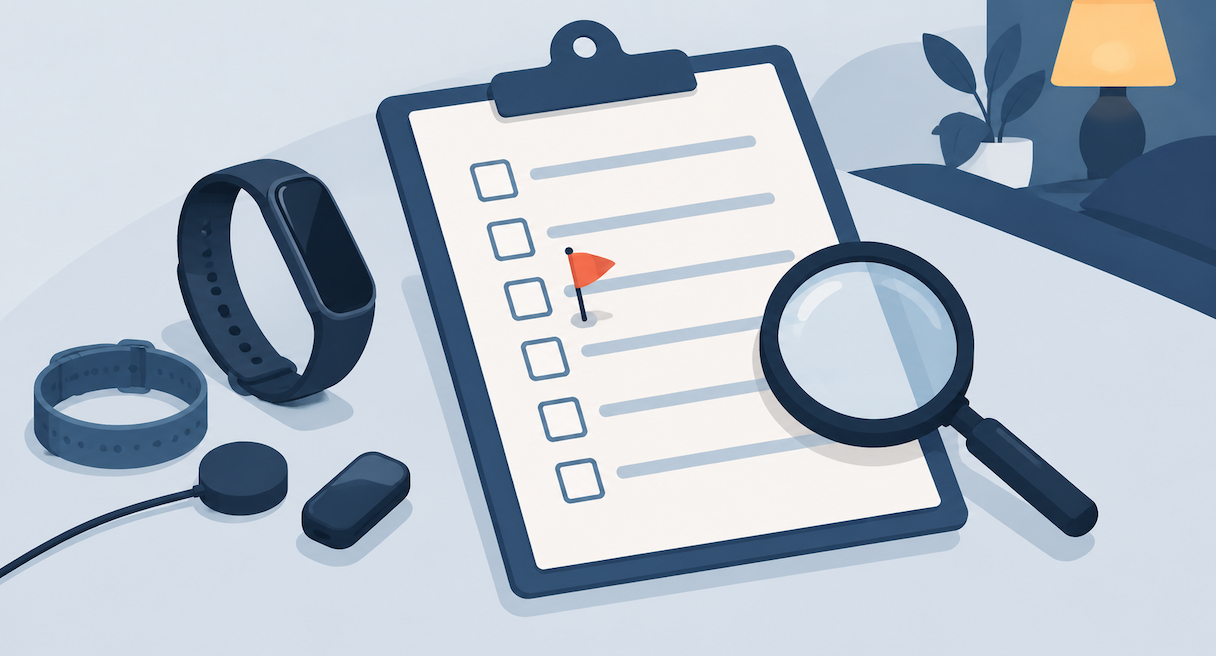
(This image is AI-generated for reference only, not an actual product photo.)
Pass, Fail, or Ask Again: Reading Your Checklist Results
Results come in three shapes. All seven answered in named terms clears the accessory for purchase. A single red flag pauses it until the maker answers in writing. Marketing phrases standing where an answer belongs get one follow-up, then count as a red flag themselves.
With all seven answered in named terms, buy, and file the written answers with the receipt. They become the reference when a phone change raises the portability question again.
A red flag marks a promise without its conditions, so the next move is a written question, and the pause ends when a concrete answer arrives. A reply naming the format, the destination, and the thresholds puts the product back on the pass side.
The third shape is the marketing answer, "smart sync" or "ecosystem-ready" offered where a format name belongs. One follow-up asks for the named format and platform; a second round of adjectives earns red-flag handling.
Order matters. Questions one, two, and four form the data-sovereignty three and come first, because nothing downstream compensates for readings with no exit. Five and six come next, since thresholds and radio prerequisites shape every morning after. Seven closes the set.
How Sleep Tracking Data Actually Flows: Reports, Conditions, and Limits
Under the compatibility questions sits a physical chain: a sensor, a radio link, an app, a cloud account, and a report with generation conditions. Accuracy numbers travel in tiers, from brand-page figures to peer-reviewed studies, and each tier carries a different weight of conclusion.
Every accessory sits at the front of a pipeline. Researchers writing for The Conversation describe the wearable version, accelerometers logging movement, optical sensors reading pulse at the wrist, an app converting both into the numbers on a morning report. A break can hide at the sensor, the radio link, or the account holding the history.
Reports arrive with generation conditions. A nightly summary that requires three hours in bed, two hours of sleep, or a fixed recording window is a product behaving honestly, and the conditions belong on the product page, where question five finds them. Offline behavior sits in the same family.
Accuracy numbers arrive in tiers, and the tiers set the weight each carries. A percentage on a brand page is a marketing-tier figure, valid inside the indicator it measures and silent outside it. Peer-reviewed work forms the research tier; an evaluation of eleven consumer-grade devices, a comparison review, and a 2025 review of home sleep monitoring all place stage estimates farther from reference measurement than the steadier basic signals. The expert tier agrees, and in a 2026 white paper on spine-care consumption and sleep investment, Professor Gao Yuhong positions consumer-watch data as a daily-life reference. Treat stages as trends and lean on the steadier signals.
The reading side has its own page in what is a sleep score, which takes over once the numbers arrive, and the mattress-sensing route has one too in how AI smart mattresses monitor sleep health.
Privacy closes the set with three parts, where the data lives, who can see it, and the path that deletes it. Those parts are question seven.
The Contactless Alternative: When the Mattress Is the Tracker
One route removes the accessory question entirely: a sensor strip built into the mattress, paired to a single app, with no band to charge, nothing to wear, and no second device to remember. DeRUCCI's T11 line runs this route, and its published conditions answer the same seven questions asked of any wearable.
Charging a band, wearing it, and remembering it before bed are three small tasks, and dropping all three is what lets a tracking habit survive its first month. On tiers carrying the sleep-sensing package, the T11 line keeps its instruments under the mattress surface, reading heart rate, respiration, and movement with nothing on the body.
According to the overseas setup documentation, the DeRUCCI AI App is listed on both the App Store and Google Play under the name DeRUCCI AI. Pairing opens with Add Device, then a power cycle on the mattress, on five seconds and off, three times, with phone Bluetooth on.
The published conditions answer the checklist plainly. Connection runs over Bluetooth and 2.4 GHz Wi-Fi, the 2.4 GHz band only, so 5 GHz networks cannot complete pairing, and a repeater or a phone hotspot on 2.4 GHz stands in as fallback. Documented range reaches about ten meters in open air and five through a wall. The daily report asks for at least three hours in bed and two hours of sleep, recorded inside the 20:00 to 10:00 window for overseas users, on tiers from the T11+ upward.
The offline boundary carries the same plainness. With no connection, the automatic firmness adjustments keep running, and report generation, algorithm updates, and the vitals view wait for the network.
The data exit is the app itself. Reports generate and live inside the DeRUCCI AI App, and no connection to third-party health platforms, HealthKit and Google Health included, appears in the published materials. The privacy policy runs to four points, bank-grade encryption on cloud storage, visibility limited to the account holder, use limited to the personal sleep program, and in-app switches that stop collection or delete history.
Showrooms carry the contactless line for an in-person pass of the checklist.
Frequently Asked Questions
---
The compatibility check is one station on a longer route, and the sleep problems to mattress guide holds the full map. To run the checklist against a floor model, find a store and check global showroom addresses.