
 American
( English )
 Singapore ( English )

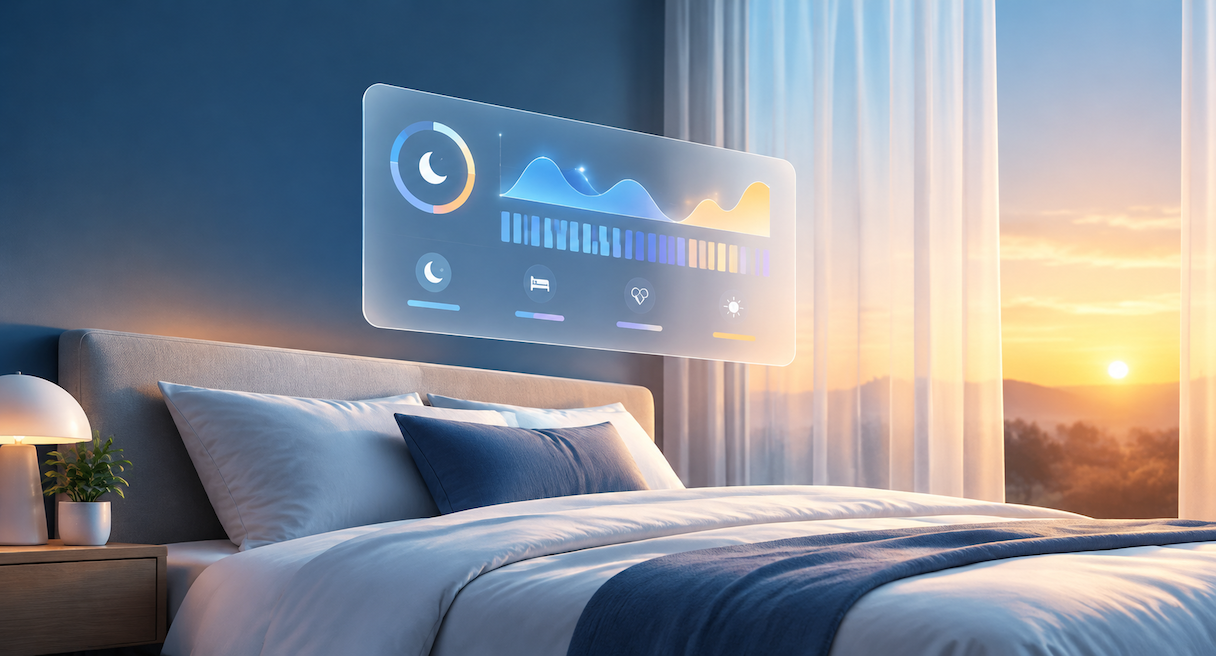
Which sleep-tracking mattress metrics can actually lead to a useful action? The ones wired into the bed's adjustment path, the readings that can change what your mattress does tonight. Reading sleep report metrics as daily report thresholds and action prompts is the habit this guide builds. DeRUCCI's product documentation gives the daily report explicit entry conditions, and the structure here follows that lead, from the thresholds behind a missing report, through the two-column reading that separates tonight's actions from slower trends, to the tuning protocol and the documented parameters of a DeRUCCI T11.
Why Your Sleep Report Didn't Generate: The Two Thresholds
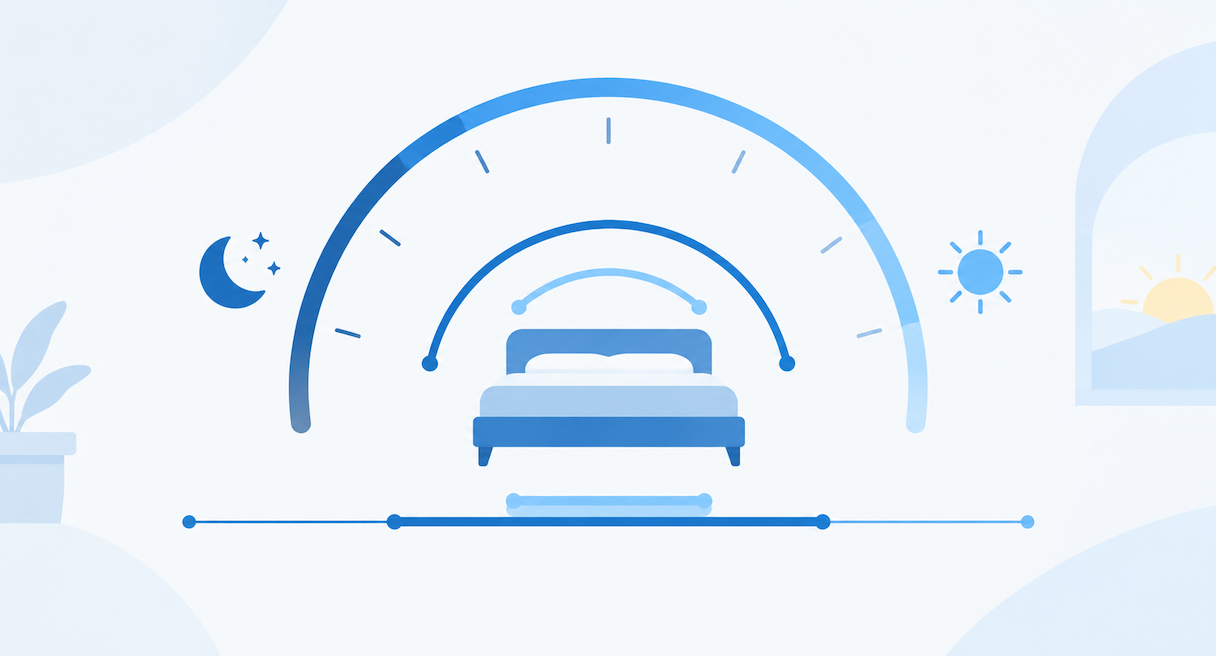
A missing report usually comes down to entry conditions. Official documentation for one smart-mattress line asks for at least 3 hours in bed plus at least 2 hours asleep, a pairing that spans more than two 60-to-90-minute sleep cycles, all inside a recording window running 20:00 to 10:00. Report generation and viewing also need a live connection.
When the app shows no report, the hardware is typically fine and the night fell short of the documented entry conditions. According to official product documentation, a qualifying night needs two time thresholds met together. Three hours in bed gives the sensors a full arc of the night, and two hours of actual sleep within it yields enough completed cycles for a structure worth reading, a pairing spanning more than two of the 60-to-90-minute cycles sleep moves through.
The window is the second condition and the quieter one. For overseas users the statistics window runs 20:00 to 10:00 local time, and sleep logged outside it stays out of the report. A 2 a.m. bedtime that runs past noon pushes a stretch of the night past the cutoff, one way a long sleep still produces a thin report.
The check itself is three yes-or-no questions.
- Bedtime and wake time inside the window. Compare the start and end stamps on your latest report with the 20:00 to 10:00 span; a night that ends at 11:30 a.m. gives part of its morning away.
- At least 3 hours in bed. Read the time-in-bed figure against the 3-hour mark, keeping in mind that the mattress reads one continuous session.
- At least 2 hours asleep. Time in bed and time asleep are separate lines. The hour spent with a phone in hand counts toward the first and skips the second. Check the asleep-duration line on its own.
The third boundary is the connection itself. Report generation and viewing run over a live network, so a night spent offline leaves the report waiting for the router to return. What these systems keep doing offline is a separate topic later in this series.
(This image is AI-generated for reference only, not an actual product photo.)
Which Report Metrics Can Lead to an Action Tonight
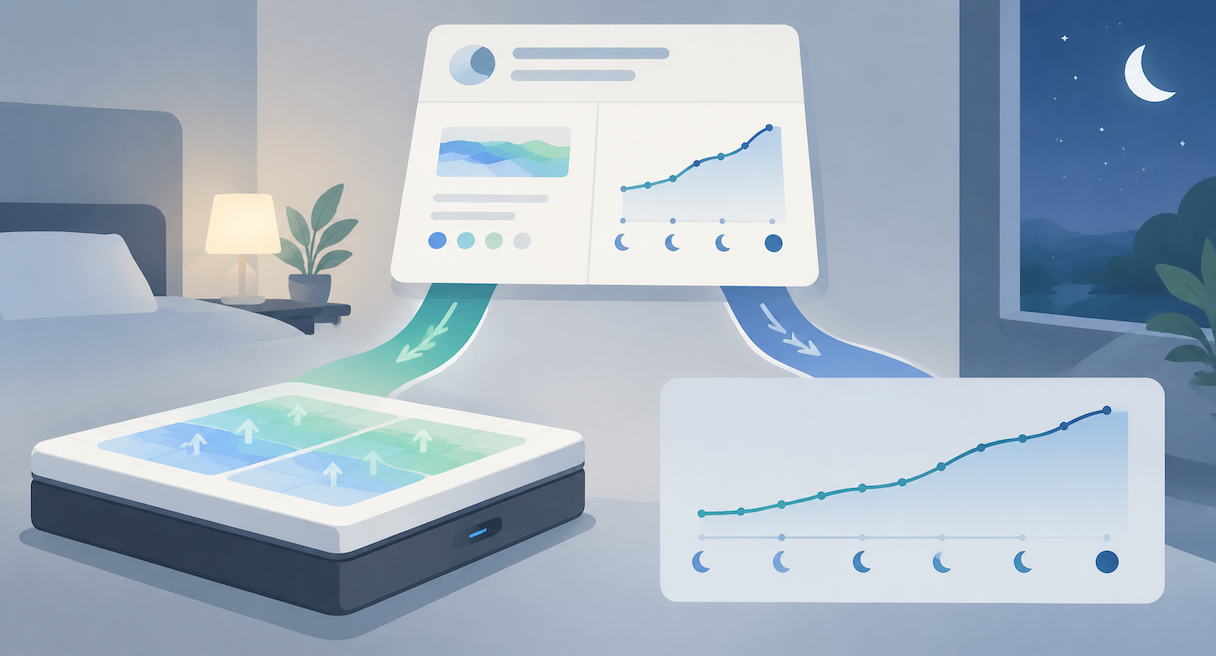
Split the report into two columns before reading it. Column one holds the readings wired into the adjustment path, movement and turning signals tied to zone support, and each closes into an action the same evening. Column two holds heart rate, breathing, and stage transitions, readings whose value builds across many nights.
The split answers a frustration from collected owner feedback, mornings that deliver a page of numbers and no obvious next move. A widely discussed public record, from a user who tracked every sleep variable for 90 days, puts it in a sentence: "people do not want measurement for its own sake; they want a measurement that leads to a decision."
The reasoning decides what earns your attention. A tracking metric justifies its place when it drives something you can feel the next morning, a firmer lumbar zone, a softer shoulder zone, a different quality of support. The proof standard for any tracking mattress is what the number lets the bed, or you, do differently tonight. The readings that clear it connect to the adjustment path; the rest of the report is context.
| Readings you can act on tonight | Readings to watch across nights |
|---|---|
| Movement and turning signals | Heart rate trend |
| Zone-support feedback | Breathing readings |
| Bedtime-window fit | Sleep-stage transitions |
The first column is concrete and same-evening. Switch the adjustment experience before bed and compare how the support feels overnight. Set the zone firmness in the app, softer under the shoulders, firmer under the lower back, and let the next report tell you what changed. Move your bedtime into the recording window and check whether the next report arrives complete. Each reading carries a verb, and the loop closes before the next night begins.
The second column works on a longer clock. Heart rate, breathing, and stage transitions shift night to night for ordinary reasons, a late workout, a heavy meal, a stressful week, so a single night stays in context. For stage estimates, reviewing a compilation of 14 sleep-laboratory accuracy studies, experts rated the stage performance of consumer wrist-worn and ring devices as "generally not great", and advise readers to "just entirely ignore" deep-sleep figures, because the devices "base it on averages". That view covers wearable trackers, offered here as category context. For a mattress report, the translation is to read these numbers as relative changes on your own timeline. Heart rate variability belongs to this column too. Once you change one variable, how many nights before changing your sleep routine covers the observation window in detail.
These apps stop short of publishing a one-to-one metric-to-action table, so treat the two-column reading as a method assembled from documented behavior, with your app's settings as the final word.
(This image is AI-generated for reference only, not an actual product photo.)
Tuning the Conditions: Window, Time in Bed, and Sleep Onset
Each of the three conditions responds to a small adjustment. Move bedtime and wake time inside the 20:00-to-10:00 window first, because sleep outside it goes unrecorded. Protect a continuous block of at least 3 hours in bed, since fragmented naps stay separate. Then confirm at least 2 hours of actual sleep, counted separately from time in bed.
Start with the window, because it explains most missing reports on late schedules. A 2 a.m. bedtime with a wake time past noon hangs the tail of the night past 10:00, and the uncounted stretch is the part deep in the morning. Confirm where your night sits from the stamps on your last report, then shift the block earlier by half an hour at a time.
Time in bed comes next. Three continuous hours is the documented floor for a complete sleep structure, and fragmented short naps register as separate sessions, each on its own under the threshold. An afternoon doze plus an evening lie-down can total five hours of rest and still produce no report. Where your sleep comes in pieces, pick one block to lengthen and let the following report show whether the structure followed.
The third condition separates resting from sleeping. Two hours of actual sleep is the mark, and the hour spent scrolling counts toward time in bed while adding nothing to the asleep total, so check the asleep-duration line on its own. Where it runs thin while time in bed runs long, the wind-down before lights-out is the place to work.
With all three conditions met, the next morning is for reading the report against the night before. With any of them unmet, adjust the condition first and leave the readings for later, because a thin night reads like a thin sample. Three boundaries keep expectations calibrated. A night offline pauses report generation while automatic adjustment keeps working. A single qualifying night covers a touch more than two 60-to-90-minute cycles, which keeps single-night readings small. And no official count of nights exists for drawing conclusions, so the working rule is multiple nights with one changed variable at a time. For how the trends roll up into one figure, What Is a Sleep Score is the companion read.
What This Looks Like on a DeRUCCI T11
On the T11 series the method lands on documented parameters. T11+ and above generate the daily report at 3 hours in bed plus 2 hours asleep inside the 20:00-to-10:00 window. Two selectable adjustment experiences close the loop for tonight's readings, the monitoring layers are tiered, and offline the automatic firmness adjustment keeps working.
The thresholds from the earlier sections are the documented conditions for the T11 series at T11+ and above, per DeRUCCI's official product documentation. At least 3 hours in bed and at least 2 hours asleep generate the morning report, inside the overseas statistics window of 20:00 to 10:00 local time.
The adjustment path is where tonight's readings close their loop. The series carries two adjustment experiences the sleeper can choose between, Intelligent Deep Adjustment and Sensorless adjustment, and the DeRUCCI AI App adds manual control, where you pick a firmness and the bed holds it. Column-one readings end their evening here. Switch the experience before bed, set the zone firmness, and read the result in the morning.
The monitoring layers are tiered. On the T11 PRO, the SleepCare layer generates the daily reports for heart rate, breathing, and sleep stages. On T11+, the sensing layer reads the night through the mattress surface and detects heart rate with 97% accuracy, with no wearable involved. On other tiers, check the sleep-report row of your model's specification sheet.
The offline boundary states what keeps working. Disconnect the network and the automatic firmness adjustment continues, while report generation, the latest adaptive algorithms, and viewing heart rate and breathing data wait for a connection. A 2.4 GHz phone hotspot serves as the documented backup, keeping the bed usable while the report waits. The mechanics of sensing without wearables are laid out in how AI smart mattresses track sleep health.
Heart rate, breathing readings, and sleep stages describe the night, and the adjustment path turns the useful parts of that description into tonight's setup. For readings that stay outside your usual pattern over an extended stretch, the guidance of established health organizations is the right reference. To see how your own mornings compare, open the DeRUCCI AI App and set the report beside the conditions above.
Frequently Asked Questions
---
The mornings change once the report has conditions you can meet, columns you can act on, and a loop that closes the same evening. The wider ground, from sleep problems to mattress choices, continues in the series hub, and to compare the tiers in person, find a store and check global showroom addresses.