
 American
( English )
 Singapore ( English )

What Are the Sleep Stages?
Sleep is not one uniform state but a sequence of cycles, each moving through three non-REM (NREM) stages and one REM stage, with deep sleep and REM serving entirely different purposes for your body and brain.
A single cycle takes roughly 90 to 120 minutes, and most people move through four or five cycles in a full night. You typically drop into light N1, settle into N2, descend into the deep slow-wave N3, then rise into REM before the cycle starts over. The first half of the night is deep-sleep heavy, while REM stretches longer toward morning. Understanding which stage does what is the first step to knowing whether your sleep is actually restorative.
What Is Deep Sleep (N3)?
Deep sleep, or N3, is the deepest NREM stage, your brain slows to delta waves, your muscles go still, and your body focuses on physical repair, immune function, and tissue growth.
This is when the body heals and regrows, hormones regulate, and energy restores. It is the hardest stage to wake from, and being roused out of N3 leaves a groggy fog that can last 30 to 60 minutes. Because deep sleep concentrates early in the night, the hours before midnight carry most of your physical recovery, which is why cutting sleep short at the back end hurts REM more than deep sleep, while fragmenting the front half erodes the restorative N3 you need most.
What Is REM Sleep?
REM (rapid eye movement) sleep is the stage most associated with dreaming, memory consolidation, and emotional processing, your brain is highly active while your voluntary muscles are temporarily paralyzed.
REM typically makes up about 20% to 25% of a healthy night, and its episodes grow longer with each cycle, peaking in the final hours before waking. Where deep sleep restores the body, REM sorts and files what the brain absorbed during the day, reinforcing learning and stabilizing mood. Skipping REM, by waking early or fragmenting late cycles, leaves people feeling mentally foggy and emotionally flat even when their total hours look adequate.
How to Know Which Stage You're In: Measuring Your Sleep Cycles
Telling deep sleep from REM by feel is nearly impossible, since both leave you unaware, which is why objective, contact-free stage tracking is the only reliable way to see how your night splits between N3 and REM.
DeRUCCI's sensing technology is built to provide exactly that stage-by-stage clarity. The T11+ AI smart mattress carries a third-generation piezoelectric ceramic sensor array that detects heart rate with 97% accuracy, letting it distinguish deep, light, and REM stages through the night without anything worn on the body. That sensing layer renders each night as a readable sleep-stage report rather than a single "hours slept" number. For a closer look at how the stages are defined, the Cleveland Clinic sleep basics guide walks through NREM and REM in detail. To see how DeRUCCI approaches AI sleep monitoring, visit the DeRUCCI smart sleep system page, or explore the T11 series AI mattress. (The T11 SE AI mattress is now available at the DeRUCCI New York store.)
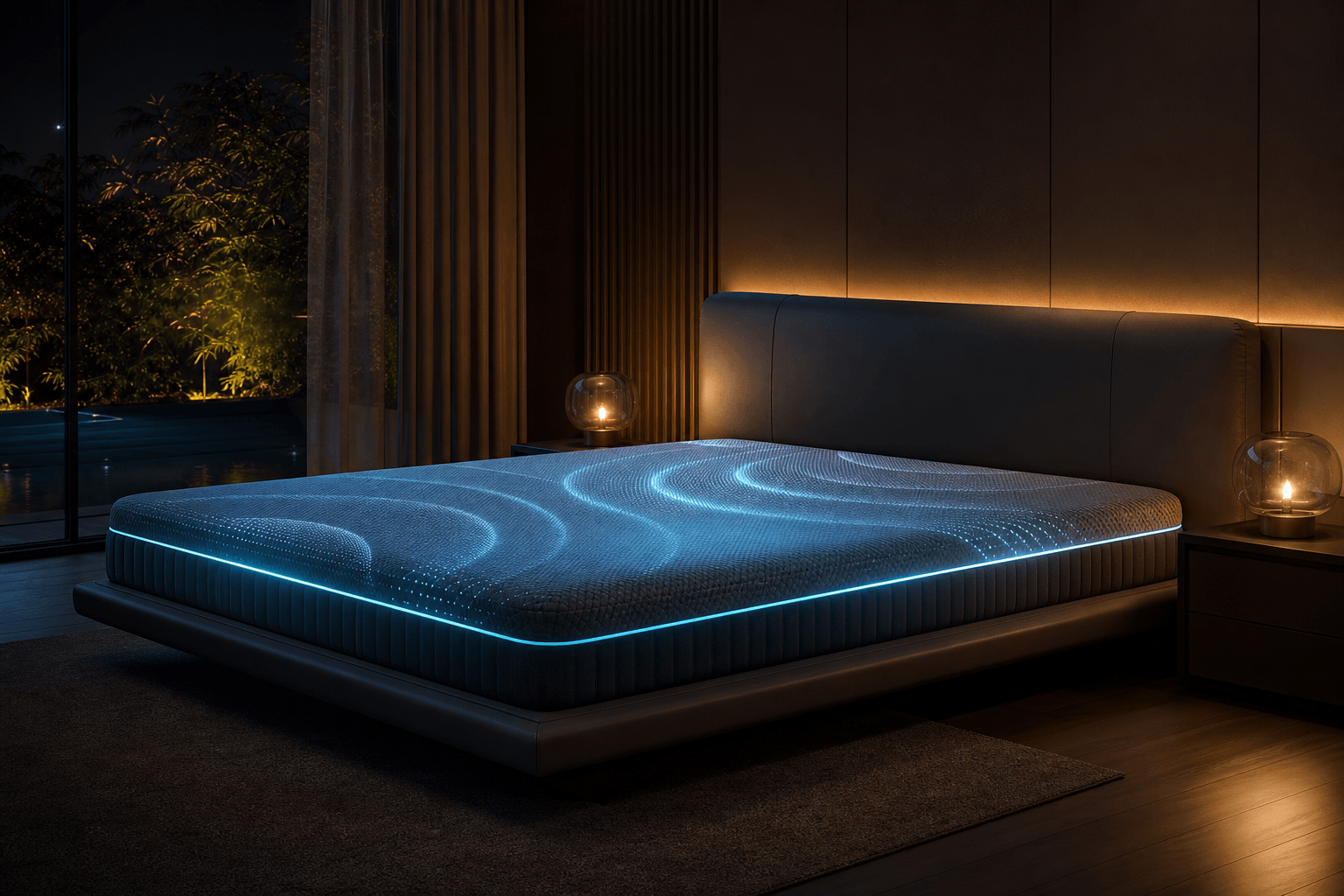
(This image is AI-generated for reference only, not an actual product photo.)
Tips to Protect Both Deep Sleep and REM
Because deep sleep and REM cluster at opposite ends of the night, protecting both comes down to protecting the full cycle, consistent timing, a cool dark room, and a surface that does not pull you out of either stage.
Hold a steady bedtime so your cycles settle into place, keep the room cool, and avoid alcohol and late caffeine, since both fragment the stages they touch most. A mattress that relieves pressure and limits motion transfer helps you stay in N3 and REM rather than surfacing between cycles. Over a week of tracking, you can see whether a change lifted your deep-sleep minutes, your REM, or both, and adjust from there.
Frequently Asked Questions
Which is more important, REM or deep sleep? Both are essential and do different jobs, deep sleep restores the body, while REM consolidates memory and regulates emotion. You cannot trade one for the other; a healthy night needs adequate time in each.
How much REM and deep sleep should you get? Most adults spend about 10%–20% of the night in deep sleep and 20%–25% in REM. For an eight-hour night, that means roughly 50–100 minutes of deep sleep and 90–120 minutes of REM, though the exact split varies by age and individual.
Why do I feel tired after a full night of sleep? Total hours do not guarantee restorative sleep. If deep sleep or REM is fragmented, by heat, alcohol, motion, or a poor surface, you can spend eight hours in bed and still wake unrefreshed. Tracking your stages often reveals the gap.
Can you increase REM sleep? Yes. Protect the back half of the night, when REM episodes are longest, by keeping a stable wake time and avoiding substances that fragment late cycles. Reducing stress and improving overall sleep continuity tends to lift REM over time.
Find a DeRUCCI Showroom Near You
Better sleep is easier to choose in person. Explore DeRUCCI's mattresses and smart sleep systems, then find a store and check global showroom addresses to experience them firsthand.