
 American
( English )
American
( English ) Singapore ( English )

How Does Adaptive Firmness Technology Work in a Smart Bed?
If shoulder pressure, lower-back tightness, or a partner's movement keeps breaking up the night, the useful question is not only whether a mattress feels soft or firm in a showroom. The more practical question is how does adaptive firmness technology work in a smart bed, and whether DeRUCCI can make the sleep surface respond when the body turns, settles, or changes posture during the night.
Adaptive firmness is easiest to understand as support that does not remain locked in one setting. A conventional mattress asks the sleeper to work around one fixed feel. A smart bed with adaptive firmness works more like a controlled support system: it reads pressure conditions in real time, then adjusts quietly before discomfort becomes strong enough to cause a full wake-up.
What Is Adaptive Firmness in a Smart Bed?
Adaptive firmness is the ability of a smart mattress to detect body pressure and adjust support automatically as the sleeper moves between side, back, and stomach positions. Rather than forcing one fixed comfort level across the whole bed, it changes firmness by zone so heavier areas receive lift while pressure-sensitive areas receive relief.
In a fixed-firmness mattress, comfort is mostly determined by foam density, spring construction, or a manual setting selected before sleep. That can be acceptable for one body type, one preferred posture, or a sleeper who rarely changes position. It becomes less effective when the body moves during the night. Side sleeping often needs more give at the shoulder and hip. Back sleeping usually needs steadier support under the waist and pelvis. Stomach sleeping generally works better with a firmer center section to limit sinking.
Adaptive firmness technology treats the mattress as an active support system rather than a passive surface. Built-in sensors identify how the body loads the mattress, the control system reads the pressure pattern, and internal adjustment units change firmness in selected areas. The intended result is not a bed that keeps drawing attention to its mechanisms. In normal use, the better outcome is a surface that feels stable because it is keeping pace with the sleeper.
For high-net-worth households comparing premium sleep solutions, the main value is personalization without repeated manual adjustment. The sleeper should not need to wake up, find a remote, and test several settings in the middle of the night. A better experience is automatic comfort that helps maintain posture while reducing pressure points that commonly build around the shoulders, waist, hips, and legs.
How Does Adaptive Firmness Technology Work in a Smart Bed?

(This image was generated by AI and is for illustrative purposes only; it is not a real product image.)
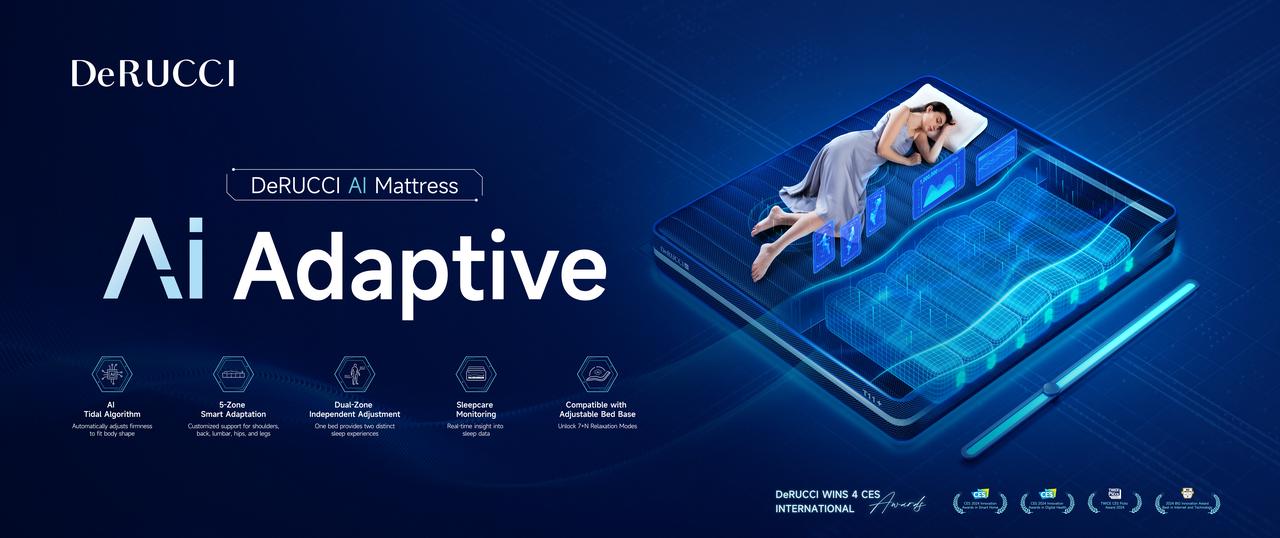
Adaptive firmness technology works through three connected parts: built-in sensors, an AI decision system, and flexible adjustment units inside the mattress. Sensors read pressure, the algorithm decides where support should soften or firm up, and the adjustment system responds quickly enough that the change should feel natural during ordinary sleep.
The first part is sensing. DeRUCCI T11 PRO uses built-in sensors, so the sleeper does not need to wear a separate device to let the bed understand how the body is pressing into the mattress. In practical terms, the system is measuring load distribution while the person is already lying down. It reads where weight is concentrated, where the body is sinking more deeply, and where the mattress may need to change support.
The second part is decision-making. The T11 PRO SleepCare System includes the AI Tidal Algorithm 2.0, which brings together adaptive adjustment, sleep monitoring, and sleep analysis functions. The algorithm interprets pressure patterns and posture signals, then decides whether specific areas should soften for pressure relief or become firmer for alignment. Harvard CPC is associated with the T11 PRO SleepCare System, supporting the product's positioning around intelligent sleep research and applied comfort design.
The third part is physical adjustment. T11 PRO's AutoFit system uses flexible adjustment units, arranged as 9 units on each side and 18 units in total, to change support across the mattress. These units work with an AI optimization chip and high-precision sensors to deliver targeted support changes. DeRUCCI describes the response as 20 milliseconds, which is fast enough that the sleeper is unlikely to register the adjustment as a separate action. In day-to-day use, the point is for the bed to respond before the person starts consciously searching for a new position.
This is where adaptive firmness differs from a typical electric bed frame. An adjustable frame changes the angle of the bed, usually through manual control or preset positions. Adaptive firmness changes the feel of the mattress itself by zone. A frame may lift the head or legs; a smart mattress can soften around the shoulder, support the waist, or stabilize the hip area based on how pressure is distributed.
For buyers in Australia, Singapore, Malaysia, and Vietnam, the current T11 series positioning is especially relevant because these markets support AI smart mattress availability. Consumers in those regions can explore adaptive firmness smart mattress technology as a category where comfort adjustment, posture support, and sleep data are designed to work within the same system.
How Different Sleep Positions Get Different Support
Different sleep positions create different pressure maps, so adaptive firmness should not treat the whole body as one flat shape. Side sleepers need pressure relief around the shoulder and hip, back sleepers need more balanced lumbar support, and stomach sleepers need firmer center stability to reduce sinking through the pelvis.
Side sleepers usually place more pressure on narrower contact points. The shoulder and hip carry a larger share of body weight, so a surface that is too firm can create concentrated pressure. Adaptive firmness can soften those targeted areas while keeping the waist supported, helping the spine stay closer to a neutral line instead of bending around the mattress.
Back sleepers need a different balance. If the hip area sinks too far, the lower back may lose support and feel strained by morning. If the surface is too firm from head to toe, the back may feel held up rather than properly supported. A smart bed can respond by adding support where the torso presses down while still allowing comfortable contouring around the shoulders and legs.
Stomach sleepers need extra control around the midsection. Too much softness can let the pelvis dip, which may place the lower back in an uncomfortable curve. Adaptive firmness helps by firming the center area while keeping the rest of the surface comfortable enough that it does not feel rigid or flat across the entire body.
DeRUCCI T11 PRO addresses these differences through 6-Zone support across the shoulders, back, waist, hips, and legs. Instead of treating the body as one single weight block, the bed divides support into practical comfort regions. The logic is similar to fitting a garment properly: the shoulder, waist, and sleeve do not need the same cut, and a well-designed smart mattress should not apply the same support everywhere.
Couples add another layer of complexity. One partner may sleep mostly on the side while the other sleeps on the back. One person may prefer a firmer feel, while the other needs more pressure relief around the shoulder or hip. T11 PRO's dual-drive independent adjustment allows each side to respond separately, reducing the chance that movement or firmness changes on one side disturb the other side. That matters because nighttime movement is not only an individual comfort issue; it can become a shared sleep interruption.
Why Adaptive Firmness Can Improve Sleep Quality
Adaptive firmness can support better sleep by helping the spine remain closer to neutral, reducing pressure buildup, and lowering the need to toss and turn for comfort. Sleep monitoring also gives the system more context over time, so support can become more personalized across repeated nights of use.
The core sleep-quality benefit starts with alignment. When the mattress supports the body in a more balanced way, muscles do not need to compensate as much for poor posture. For a side sleeper, that may mean less compression around the shoulder. For a back sleeper, it may mean steadier support under the lower back. For a stomach sleeper, it may mean less sinking through the midsection.
Pressure relief matters because discomfort often appears first as movement. A sleeper may not fully wake every time pressure builds, but the body still reacts by shifting. Reducing pressure points can reduce tossing and turning, which may help both the sleeper and their partner experience a quieter night with fewer noticeable disturbances.
Independent CAICT lab testing on DeRUCCI T11+ provides useful context for the broader smart sleep category. According to independent CAICT lab testing, sleep onset time, meaning time to fall asleep, was 37.3% shorter. In practical terms, that means falling asleep nearly 40% faster; if a person normally takes 30 minutes, that is about 11 minutes saved. The same testing reported 27.5% fewer nighttime turnovers, meaning the sleeper tossed and turned almost 30% less, which can also help a partner experience less disruption.
CAICT testing on T11+ also reported 4.5% longer deep, restorative sleep and 5.9% longer continuous deep, restorative sleep. Put simply, those results point to more time in the phase of sleep people commonly associate with waking up refreshed, and longer uninterrupted stretches that may feel less fragmented. These results belong to T11+, while T11 PRO should be discussed through its own SleepCare System, AutoFit architecture, AI Tidal Algorithm 2.0, and Harvard CPC association.
The consumer takeaway is straightforward: adaptive firmness is not about adding technology for display. It is about reducing the effort required to sleep comfortably. A regular mattress makes the sleeper adapt to one fixed surface. A well-designed AI mattress adapts the surface to the sleeper's pressure pattern, posture, and movement during the night.
For market accuracy, the T11 series AI smart mattress is currently positioned for Australia, Singapore, Malaysia, and Vietnam. It should not be presented as currently available for purchase in the United States or Canada. North American consumers can follow DeRUCCI's global channels for traditional products and future AI mattress updates.
These answers address common consumer questions about adaptive firmness, including movement, position changes, couple use, adjustable frames, and current regional availability. Each answer focuses on what the feature means during daily sleep rather than relying on technical language alone.