
 American
( English )
 Singapore ( English )

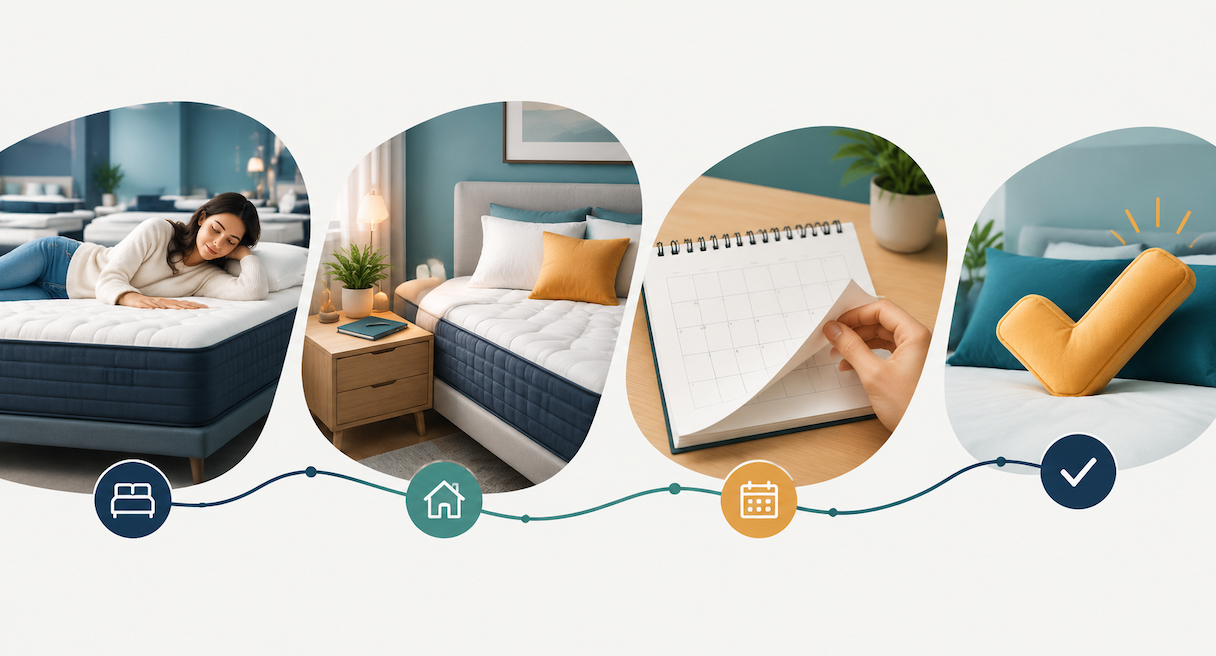
Type how to choose a mattress firmness sleep position body weight into a search bar and nearly every guide ends at the order button. The harder half starts when the mattress reaches your bedroom. This guide keeps both halves: a shortlist stage that turns sleep position and body weight into a written expectation list, and an at-home protocol built around the six checks DeRUCCI uses at delivery, closing with warranty terms on paper. A bed that felt right in twenty showroom minutes can still be the wrong fit.
| Stage | Window | What you do | How to read it |
|---|---|---|---|
| Store shortlist | Before ordering | Three entry variables, four weighted standards, a written expectation list | Output expectations, keep verdicts for later |
| Baseline week | Days 1 to 7 | Copy the expectation list, fill a five-column morning log, note non-mattress variables | Record only, no verdicts in week one |
| Adjustment window | Days 8 to 30, delivery-day check first | Run the six-point check, then keep the log | Read trend direction; log steady declines with dates |
| Verdict | Around day 30 | Score expectation hit rate, convergence, each sleeper separately | Fit or not fit; short evidence extends one review cycle |
| Paper trail | Anytime | Read the warranty on four points; put two questions in writing | File the answers with the order record |
How Do You Choose a Mattress Shortlist in the Store?
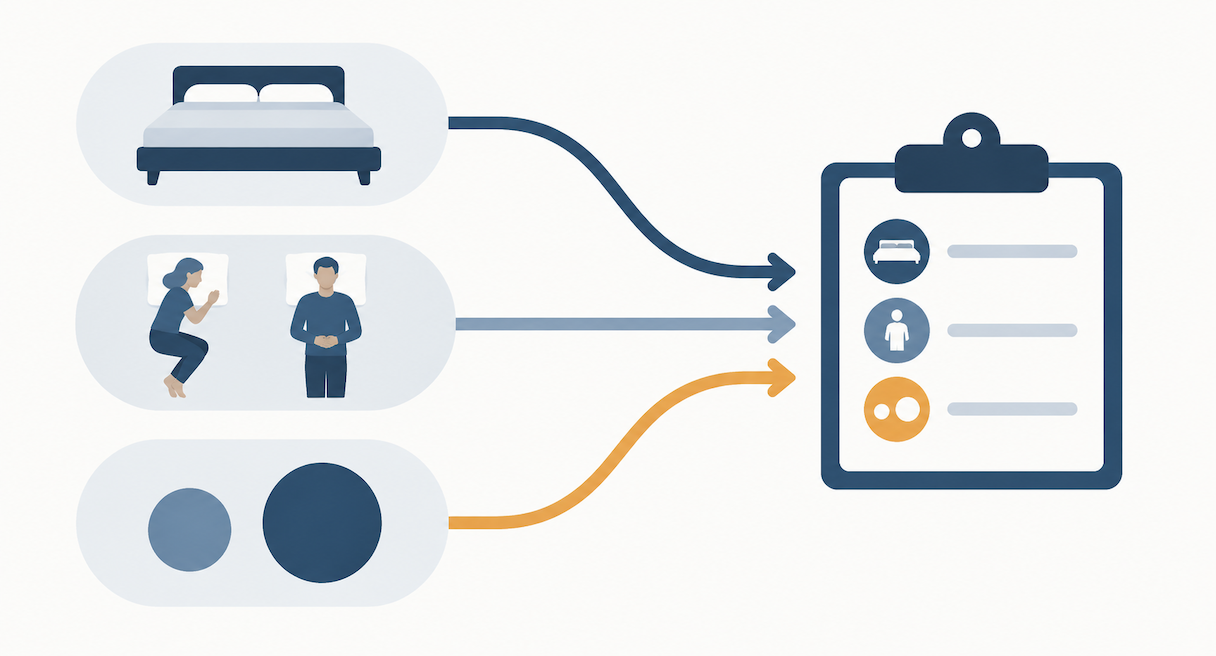
A shortlist is a written decision built on three entry variables: how you sleep, the position you sleep in, and your body weight. The store stage ends with a short expectation list and leaves the final answer to the weeks at home.
The first layer separates a comfort complaint from a structural need: either the night did not fit you, or the bed must hold a posture steady. The second layer sorts by sleep position, which sets the support shape, because too firm a bed loads a side sleeper's shoulder and hip, and too soft a bed lets a back sleeper's lower back sink. The third layer sorts by weight, and the category-level direction is all the published data: heavier frames lean toward steadier support, lighter frames toward contouring. No threshold maps kilograms to a firmness grade.
Four posture profiles from the 2026 spine and sleep white paper make the position layer concrete: side sleepers who curl through the midsection want precise contouring that fills the curve, back sleepers who prefer a planted feel want a pillow under the knees and steady lumbar support, heavier side sleepers can put a pillow between the knees to spread the load, and tight-ball sleepers are advised to ease the posture open and let the mattress follow. Stomach sleeping is the one position the paper leaves unendorsed. The same survey found 59 percent naming spine-related disturbance their top sleep disruptor, 92 percent acting on it, 61 percent of them on the sleep side, and 2025 monitoring-study summaries put adult side sleepers above 60 percent.
Weigh the shortlist against four standards from the same paper: precise fit, steady support, distributed pressure, and personal adaptation; your ranking of them is the decision. Four permitted actions carry the shortlist in the store: lie down in your real sleep position for a few settled minutes, feel whether support and contour arrive where the profile says, ask staff how firmness adjusts to body type, and read independent reviews that name their method. The deeper store-visit checklist is its own guide. For the full path start with how to choose a mattress, and for the position layer, what is the best sleeping position breaks the branches down.
(This image is AI-generated for reference only, not an actual product photo.)
Leave with the list written down. Every later stage of the protocol scores against it.
Days 1–7: What Baseline Should You Set Before Judging a New Mattress?
The first week at home is for paper, and the discipline is record only, judge later. Move the expectation list into a five-column morning log, note non-mattress variables alongside, and treat every reading as baseline. First-week swings after a bed change carry no verdict yet.
On delivery morning, finalize the three to five checkable items, no side-sleeping pressure points at the shoulder and hip, back-sleeping lower-back support holding, an acceptable cap on night wakings, one item per sleeper, and give the log five columns: how rested you feel on waking, how many times you woke, which direction the morning feel trends, a separate line for each sleeper, and a hit-or-miss mark per item. Two people sharing a bed keep two logs. Note the non-mattress variables that could explain a bad night, a late schedule, a warm room, a new pillow, so judgment day can strike false causes first.
Where the mattress carries sensing, an app-side daily report can back the log; at category level it counts a day with at least three hours in bed and two asleep, inside a 20:00 to 10:00 window. Week one stays off limits for interpretation: a new surface changes how the body settles for a few nights, so the only task is a complete, honest page each morning. By day seven the baseline shape exists, and the next weeks show which way it drifts.
Days 8–30: The Adjustment Window — and a Delivery-Day Check
Run the delivery-day check before the first night, then let the log run. Six points, adjustment behavior through motor noise, and anything that misses gets written down with date and item. From week two the question becomes which direction the trend points.
The home version below adapts the walk-through DeRUCCI runs on the shop floor.
1. Adjustment behavior. On the T11 PRO, the top tier, left and right sides adjust in synchronization; the entry and mid tiers adjust one side at a time by design.
2. Three modes. Cycle Depth, Silent, and Manual; each must arrive and hold.
3. App feedback. The adjustment should show live in the app.
4. Motor noise. The standard sits below 28 dB; an audible motor misses specification.
5. Sensing status. On tiers from the + upward, the report needs three hours in bed and two asleep inside the 20:00 to 10:00 window to render, and in-bed sensing should show live status the first evening.
6. Bed frame and base. Confirm presets match the ordered configuration.
Anything that fails gets recorded the same day, item and date, and goes to the after-sales address below. From day eight the reading discipline shifts to trend: a rough Tuesday after a late Monday is noise, and three descending weeks in a row is a signal that goes in the log with dates, in plain feel-words. Small swings inside a fortnight are common at category level, a personal adjustment period has no published length, and the window is a method choice with no biological claim. A smart mattress is sensing plus adjustment in one structure, and this protocol is the checkable use of both halves.
Reading the Pattern: How Do You Call the Verdict?
Around day thirty the log becomes a decision on three readings: how many expectations were met, whether good mornings converge against bad ones, and whether each sleeper passes separately. One comfortable partner is a partial result, and a thin log extends the observation one cycle to a fixed review date.
Read a month of pages three ways. Expectation hit rate counts each item met, partly met, or missed. Convergence asks whether good mornings gain on bad ones; trend beats average. The dual reading is the harder question: both sleepers must pass, and a bed that suits one body while failing the other is a half-fit. The protocol judges fit and promises no sleep-quality outcomes.
The dual reading is where zones earn their keep. A side sleeper needs room for the shoulder and hip to settle, a back sleeper needs the lower back held, and one firmness cannot serve both. Zoned adjustment splits the bed at shoulder, back, lumbar, hip, thigh, and calf, each band with its own setting: the T11 line carries 3 zones on the SE tier, 5 on the + tier, and 6 on the PRO tier, and the T11 PRO's 18 air cells synchronize left and right so two sides settle independently. The cells are rated at 280 kg and cycle-tested under CNAS certification. For what follows the verdict, the mattress fit guide picks up where this protocol ends.
| Verdict | Evidence pattern | Next action |
|---|---|---|
| Pass | Most expectations met, mornings converging, both sleepers over their own line | Move to normal ownership and file the paper trail |
| Not a fit | Expectations missed with no convergence, false causes struck out | Check warranty status first, then contact after-sales and weigh replacement timing |
| Evidence short | Log gaps or an unresolved non-mattress variable | Extend one baseline-length cycle with a fixed review date |
Warranties and After-Sales: What Should You Verify in Writing?
The warranty is the part of the purchase most people read after delivery and should read before ordering. Four points decide its worth: how the coverage years layer, which day counts as day one, what the exclusions cover, and where a claim goes. Ask two questions in writing before you order.
Layering asks how the free years and the paid years divide. The start date asks whether day one is the purchase date or the delivery date, and the gap can cost weeks. The exclusions ask what the document carves out. The claim path asks which address accepts a claim and which vouchers it wants, normally the order record, the delivery record, and a dated problem description. Before ordering, put two questions to the retailer in writing and keep the replies in the order thread: one on the warranty start date and claim vouchers, one on delivery and service arrangements. A spoken answer has no shelf life.
DeRUCCI's published framework runs in three layers: a 365-day window in which qualifying units go straight to replacement, a three-year free warranty, and a ten-year paid service tier with labor free and parts plus logistics billed, all counted from the delivery date. Exclusion details follow the official terms alone, claims go to productdepartment@derucci.com as the single entry, and after-sales questions route through the store locator at the end of this page. For North American readers, the published note states that the T11 SE AI mattress is now available at the DeRUCCI New York store. Mattress lifespan has its own companion pages.
Frequently Asked Questions
The protocol turns a feeling into a file. The sleep problems to mattress guide walks the full route from sleep problems to a mattress decision step by step, and find a store and check global showroom addresses covers the hands-on half.
MetaTitle: How to Choose a Mattress and Verify the Fit at Home MetaDescription: Choose by sleep position and body weight, then verify at home: baseline week, adjustment window, day-30 verdict, and warranty terms checked in writing. MetaKeywords: how to choose a mattress, mattress firmness, sleep position, body weight, at-home fit verification, mattress warranty