
 American
( English )
 Singapore ( English )

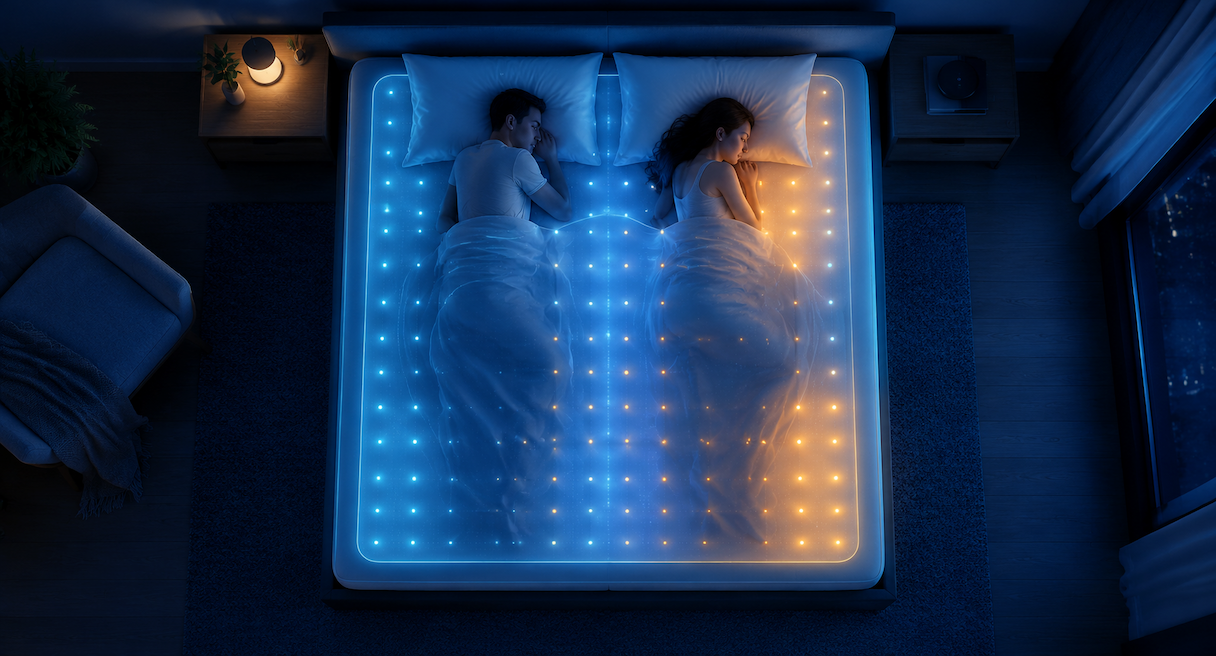
The question "do smart mattresses adjust all night" usually arrives after the bed has had a few quiet nights to itself. DeRUCCI's official product documentation answers it directly for the T11 series: automatic firmness adjustment runs continuously through the night, responding zone by zone as each body shifts. The follow-up questions are practical ones: what the bed is actually doing at 3 a.m., whether each partner's half behaves on its own, and how the app fits into the rhythm. This page works through those questions in order: where the adjustment happens, how two sleepers share one surface, how fast and how quiet the changes are, and how daily use lines up with the DeRUCCI AI App.
Does a Smart Mattress Keep Adjusting All Night Long?
Yes, it keeps adjusting. On a smart mattress with continuous adaptive adjustment, firmness changes continue through every hour of the night, zone by zone, as the body shifts position. According to the official product documentation, each T11 model pairs a fabric cover with one layer of flexible adjustment units, and the all-night work happens inside that zoned layer.
Setup night is where pairing and the first settings happen. The adjusting itself continues from there, through every stage of the night. The documentation calls the behavior continuous adaptive adjustment: the surface keeps track of the body on it and keeps answering in the zones where changes show up.
In plain terms, a flexible adjustment unit is a small air chamber under the sleep surface that can push on its own. Each zone sits above its own group of chambers, so the mattress can fine-tune one region while the neighboring regions hold steady, which is what lets the surface keep pace with a moving sleeper.
The engineering underneath this behavior has its own deep-dive for readers who want the mechanism spelled out, in how adaptive firmness technology works. The sections below stay on the practical side of the same question, following the order owners ask it in: where the zones are, what two sleepers experience, how fast and quiet each change is, and how the app fits the nightly routine.
Where the Adjustment Happens: Support Zones by Model
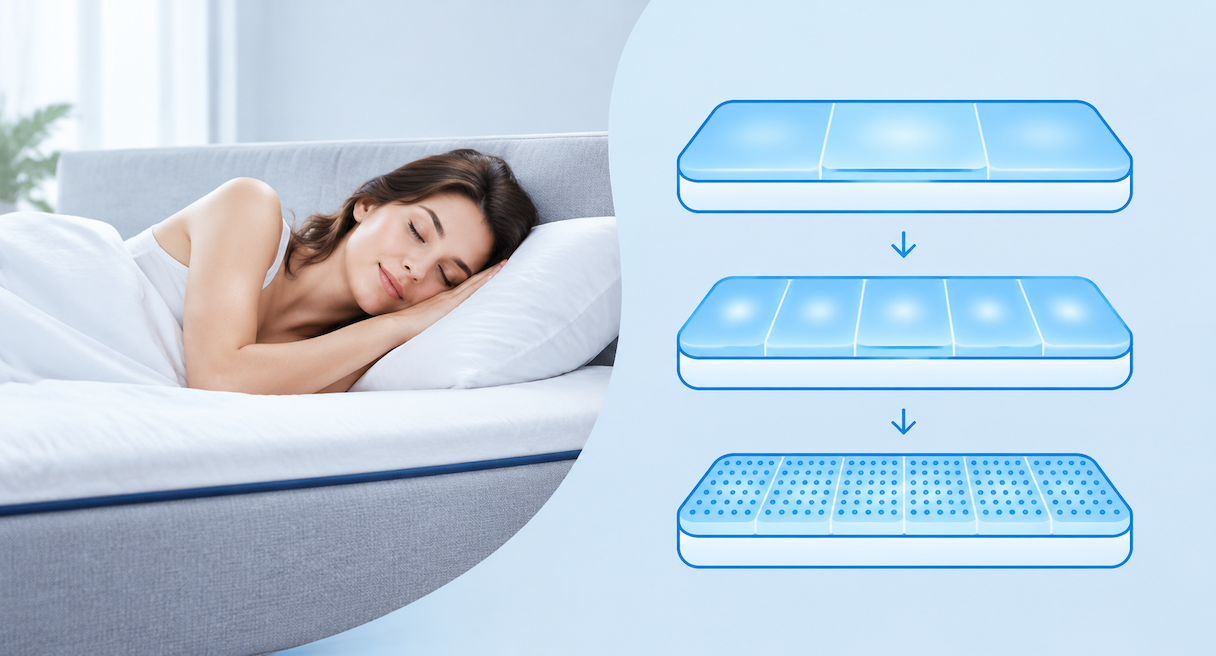
The adjustment works through support zones, and the zone count follows the model. The T11 SE and T11 zSE carry three zones, the T11+ and T11 z+ carry five, and the T11 PRO carries six built on 18 flexible adjustment units, nine per side. Each tier maps its zones to named regions of the body.
An if-then table keeps the tiers straight:
| If the model is | Adjustable zones | Where they map |
|---|---|---|
| T11 SE, T11 zSE | 3 zones | Shoulders, lumbar, hips |
| T11+, T11 z+ | 5 zones | Shoulders, back, lumbar, hips, legs |
| T11 PRO | 6 zones, 18 units (9 per side) | Shoulders, back, lumbar, hips, thighs, calves |
Read the table as a map of attention. The three-zone tier follows the heaviest load points of side sleeping, shoulders, waist, and hips; in this layout a back sleeper's lower back leans on the zones beside it. The five-zone tier adds a back region and a leg region, the areas where back-sleeping load concentrates, and with them in place the lumbar area gains a dedicated division. The six-zone tier splits the lower body further into thigh and calf regions, the finest body-region division in the series, with its 18 units spread nine to a side across both halves.
The all-night behavior from the first section happens inside these zones: each region can be fine-tuned on its own while the others hold, so the response follows the body region by region, with the rest of the surface staying steady.
(This image is AI-generated for reference only, not an actual product photo.)
Two Sleepers, Two Halves: How Dual-Side Adjustment Behaves
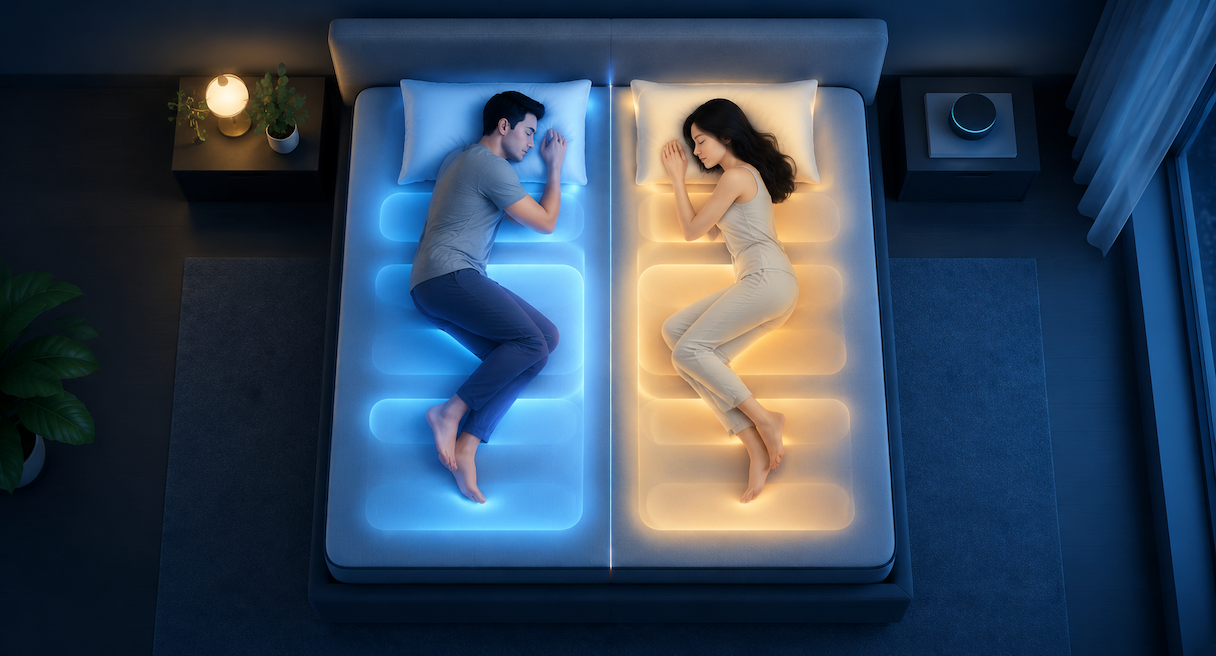
Two sleepers get two adjustment stories on one surface. On the T11 PRO, 18 units split nine and nine between two control hubs, and each half adjusts its own six zones, both support maps in effect at the same time. On the other tiers, the mattress completes one side's adjustment first, then turns to the other.
The flagship layout treats the two halves as two beds that happen to share a frame. Eighteen flexible adjustment units, nine to a side, run under two control hubs, one per half. Each side tunes its own six zones, and the two support maps take effect together, a side sleeper's shoulder-and-hip pattern on one half alongside a back sleeper's lumbar pattern on the other, both live at once.
The other tiers in the series work in a set order: the mattress finishes one side's adjustment, then takes care of the other. Both halves reach their settings and then hold them steady through the night.
Quiet runs through both layouts. Across the whole series, adjustment operates below 28 decibels, a series-level figure for the adjusting hardware. Couples can check it in person: one partner rests while the other adjusts their own half, and the resting partner listens for whether the adjusting side stays quiet enough to ignore. The check works the same way in a showroom and in the bedroom at home.
For couples still comparing models before buying, the dual-firmness question has its own guide in best AI mattress for couples with different firmness, and the contrast between partner disturbance and separate firmness is unpacked in motion isolation vs separate firmness.
(This image is AI-generated for reference only, not an actual product photo.)
How Fast and How Noticeable: Response Time and Adjustment Behavior
Speed has a certified figure. According to CAICT certification for the T11 PRO, smart adjustment responds in 8 seconds or less, achieved in 90 percent of single-sleeper tests and 100 percent of dual-sleeper tests. The series carries two named adjustment behaviors: Intelligent Depth for continuous adaptation, and Intelligent Sensorless for adjustment designed to go unnoticed.
The response figure belongs to the flagship and travels with its attribution. The certification testing comes from CAICT for the T11 PRO, with the 8-second ceiling met in 90 percent of single-sleeper test runs and in every dual-sleeper run. For an owner, the number translates simply: when the surface decides to change, the change completes in about the time of one slow breath.
On the behavior side, the documentation settles two names. Intelligent Depth is the continuously adaptive behavior: the surface keeps reading the body and keeps answering, all night, zone by zone, the engine behind the first section's answer. Intelligent Sensorless is adjustment built to stay out of the sleeper's awareness while it works. That unnoticed feel is a design goal; the under-28-decibel figure in the previous section is the measured number for the series, and each fact stands on its own terms.
Living With It: The App, Daily Use, and Offline Nights
Daily life with the bed follows a four-step rhythm: watch the zones respond in real time in the DeRUCCI AI App, set a firmness by hand when wanted, align expectations with the report's thresholds, and trust the adjustment through offline nights. The T11 PRO adds per-side leg heating, 25 to 55 degrees Celsius on a 1, 2, or 4-hour timer.
Watch it live. On models that support the live view, the DeRUCCI AI App shows each zone's adjustment as it happens. The mattress pairs over Bluetooth and accepts two phones, one per partner, so each person can watch and tune their own half from their own device.
Set it by hand when you want to. The app also works as a manual control: pick a firmness, and the bed holds that choice until you change it. It runs alongside the automatic behavior as another function of the same app.
Align expectations with the report. A night produces a daily sleep report when two thresholds are both met: three full hours in bed and two full hours of actual sleep. Reporting sits on the named tiers of the series, the T11+, T11 z+, T11 zSE, and T11 PRO; on other models, the spec sheet's sleep-report row is the place to check. For overseas owners, the recording window runs from 20:00 to 10:00 local time, a regional difference worth knowing before a morning read. The report's own metrics, and how to act on them, have a separate guide in this series.
Trust it through offline nights. When the home network drops, automatic firmness adjustment keeps working. Sleep reports and the latest algorithm updates need an active connection; the boundary between what keeps working and what needs a connection has its own page later in this series.
For the partner who runs cold, the T11 PRO's leg zones carry graphene far-infrared heating. Each side sets its own temperature from 25 to 55 degrees Celsius in the app, on a timer of one, two, or four hours that switches itself off at the end, so the warmth arrives on each half's own schedule.
Frequently Asked Questions
---
All-night adjustment is one station on a longer route. The from sleep problems to mattress choices guide collects the whole line, from choosing a mattress to living with it. To hear how quiet the zones are in person, find a store and check global showroom addresses.