
 American
( English )
 Singapore ( English )

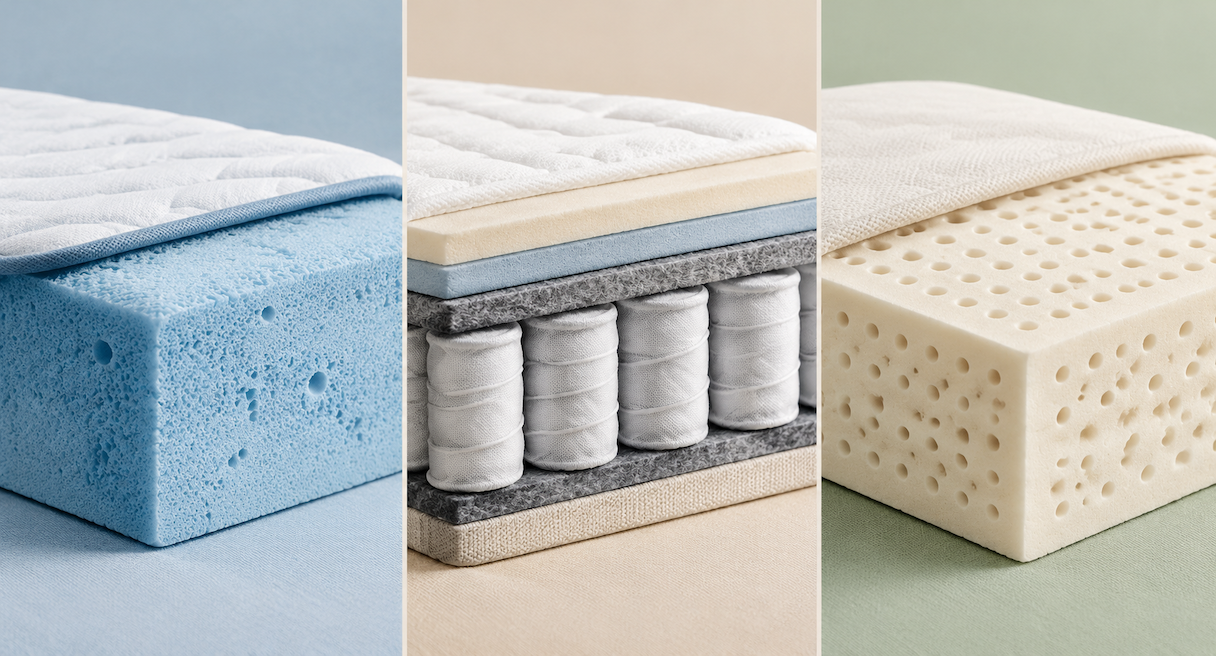
The search phrase that lands here, memory foam vs hybrid mattress differences cooling support motion isolation durability reputable guide, leaves out the third material; the workable answer, once latex joins the list, is an order of operations, and this DeRUCCI guide applies it to material fit: define your sleep feel and your four needs first, and let the material type follow from them. The differences that matter, in cooling, support, motion isolation, and durability, are differences of construction, and a reputable guide can walk each one back to a structure you can see on a cutaway or spec sheet. The four steps below run from self-rating to claim-checking, then to a real buyer and a published materials list, ending on a showroom floor.
Start With Sleep Feel, Not Material Names
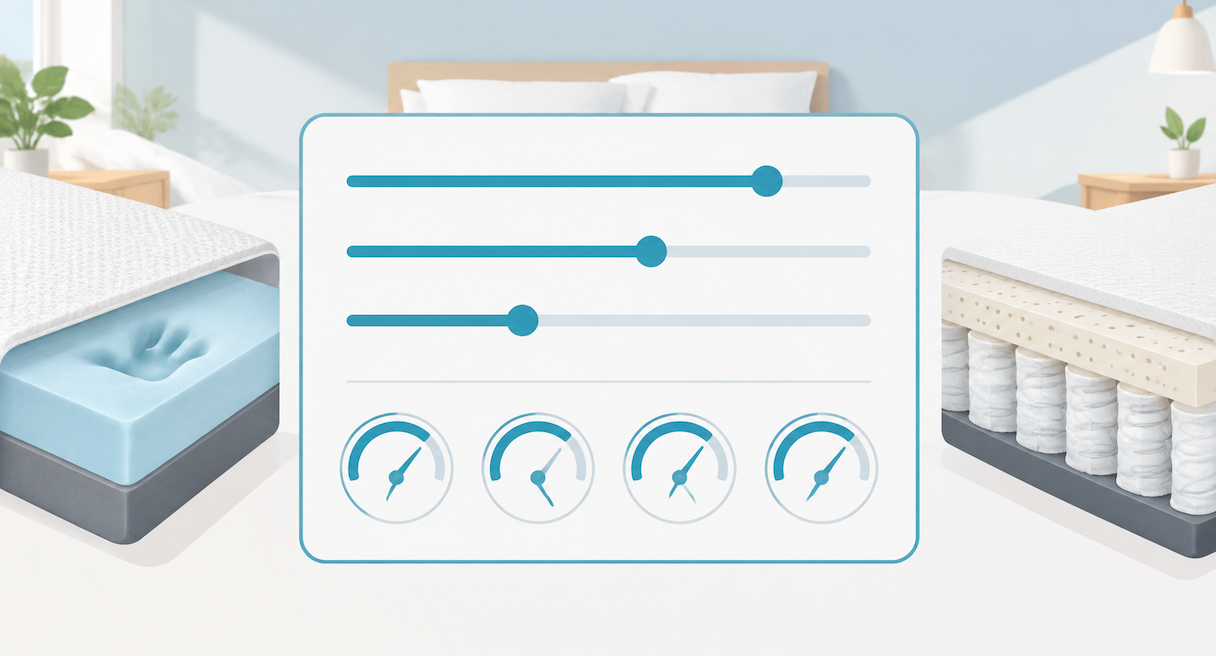
Material names answer nothing on their own. The workable order runs the other way: rate your sleep feel on three axes, contour, rebound, and spring push, then rank your four needs across cooling, support, motion isolation, and durability. With that groundwork laid, the words memory foam, hybrid, and latex start carrying meaning for your situation.
The three axes are simpler than they sound. Contour is how much you want the surface to give where your body presses, shoulders and hips for side sleepers, and hold you there. Rebound response is how quickly the surface returns your push when you turn over. Spring support feel is the firmer push of a coil structure working under a comfort layer. Sleeping position shapes the mix; the firmness scale has its own entry in this series.
The four needs come straight from the comparison vocabulary. Cooling is how much heat the build holds near your body overnight. Support is how the build distributes weight and keeps your spine line level. Motion isolation is how much of a partner's turning reaches your side. Durability is how many years the first three survive. Rating your own four, in order, narrows the field more than any ranking can.
One boundary belongs up front. The published evidence base around mattress materials runs strongest in materials chemistry and durability research, while review-level coverage of what a material type does for pressure outcomes has yet to accumulate. Claim checking in the third section handles those promises; the series' materials evidence map carries the coverage picture.
(This image is AI-generated for reference only, not an actual product photo.)
How Each Material Type Answers Those Four Needs
Each type answers the four needs through its construction. Memory foam contours and absorbs movement within the foam itself. Hybrids pair a coil core with comfort layers, trading some isolation for airflow and push. Latex answers with an elastic, open-celled foam that rebounds quickly. The useful question is which mechanism serves the need you rank first.
Cooling is where construction shows fastest. A dense foam comfort layer holds warmth close to the body; when cooling leads your ranking, the specification should name its ventilation, open-celled formulations, channelled cores, spacer fabrics. A hybrid moves air more readily, since the coil core leaves open volume a full foam build cannot offer. Latex sits between, its round, open pores letting air move through each compression. For the layer-by-layer contrast between the two most-compared types, the series' earlier piece on memory foam vs hybrid mattresses carries the construction detail this page leaves out.
Support divides by where the push comes from. Memory foam supports by shaping itself around the sleeper. Coils push back from below, and zoned builds vary that push along the body. Latex pushes from its whole elastic cell structure, a buoyant lift that recovers quickly. If support ranks first, look for zoned construction in a hybrid, density figures in a foam, and a firmness band that fits your sleeping position.
Motion isolation depends on what sits between you and your partner. Foam absorbs a turning motion inside itself, so the slow-rebound characteristic doubles as an isolation one. Coils can carry a vibration across the surface unless each one is pocketed and moving independently, with the comfort layer doing part of the damping. Latex responds quickly, transferring a little more energy while recovering faster. Check pocketing in any coil build, and the comfort layer's thickness in a shared bed.
Durability shows up in the numbers a maker publishes and the signals a bed gives with age. Foam longevity tracks density and formulation; latex's uniform cells resist lasting body impressions; a hybrid ages with whichever layer gives out first. Sleep-education organizations publish lifespan guidance that treats replacement as usage-dependent, and independent testing organizations list replacement signals, visible sagging, softened edges, worse mornings. When years matter most, compare compression-cycle counts and favour certifications with published protocols.
| Need | Memory foam | Hybrid | Latex |
|---|---|---|---|
| Cooling | Dense layer holds warmth; named ventilation features do the counterwork | Open coil core lets air move through the build | Round open pores circulate air with each compression |
| Support | Shapes to the sleeper, spreading load by contact | Coil push from below, variable by zones | Buoyant elastic push with fast recovery |
| Motion isolation | Absorbs movement within the foam | Pocketed coils plus comfort layer do the damping | Quick response, transfers slightly more energy |
| Durability | Tracks density and formulation | Ages with its fastest-aging layer | Uniform cells resist lasting impressions |
Checking the Claims Behind Each Type
Material marketing sorts into three families, and each has its own check. Number claims stand or fall on who measured them and under what conditions. Comparison claims need a source before they touch your decision. Grade-flavoured labels deserve the same two questions, applied to the label itself.
A number keeps its meaning when its test conditions travel with it. A compression-cycle count says little until you know whose testing stood behind it and to what standard; a performance figure on a fabric belongs with its method, ISO 18184:2014 for one widely used antiviral fabric test, and the window the test ran in. Official pages state figures themselves, one tier; figures tied to a publicly documented protocol or a producer's auditable record sit on a sturdier one.
Comparative claims, the second family, say one type beats another by a margin. Without a named source, a margin is just a number. The deeper limitation sits in the evidence base: review-level coverage of material-type pressure outcomes has yet to accumulate, so a confident percentage on that front has no literature standing behind it. The series' earlier comparison of latex and memory foam in pressure relief works through that specific pairing, and this page hands the discussion to it.
The third family is the label that borrows authority, grade-style naming that sounds certified. Handle these the same way: ask for the source and the test conditions behind the label. A label that survives those two questions has earned its place on the tag.
Where does this leave the choice? All three types can be built into a mattress worth owning. The difference that matters is personal: the dimension you rank first decides which construction serves you. Handing the decision to a ranking hands it to a stranger who has never met your sleep.
A Worked Example: Matching Feel to a Materials List
Here the method meets a real list. A side sleeper who runs warm, sharing the bed with a partner of a different build, rates the three axes, ranks cooling and motion isolation first, then reads the DeRUCCI materials page line by line, attaching to every figure its tier, official statement or documented protocol.
Take a buyer who sleeps on her side, heats up easily, and shares the bed with a heavier partner who turns at night. She rates contour high, rebound medium, and spring push low, which points away from a firm, coil-forward feel. She ranks cooling first, motion isolation second, durability third. That profile narrows three types to a shortlist and turns shopping into comparing specifications.
The list she reads is the one published for DeRUCCI's mattress range, six registered materials: five comfort-layer materials plus the German AGRO spring system as the support structure. The springs carry 300,000-cycle compression testing, the internationally patented A.TiCu-S titanium-copper alloy system, and three international certifications, from a maker with over 65 years of pocketed-spring production and exports to more than 50 countries. DEFORM Fine Revo lists 480,000 compression cycles and a honeycomb ventilation structure. The Dutch Talalay latex entry describes a physical foaming process that sets an open, round-celled structure in natural rubber-tree latex. INVISTA antibacterial cotton states an antibacterial rate above 99%.
The BekaertDeslee VIRASE® fabric states that viral activity falls by more than 99%, a 2-log reduction measured within two hours under ISO 18184:2014, from a mill whose textile history reaches back to 1892. The 3D-Plus spacer fabric states more than 1.4 million support points in an X-structured build and 4.4× breathability, figures the official page publishes as its own. That pair is the two-tier discipline in miniature: one figure arrives with a named protocol and window, the other is an official statement. Per the supplementary research review of the six materials, the research findings and the official figures sit without conflict.
The list also carries a history: a washable 3D mattress in 2007, 360° ergonomic support defined in 2016, solid-liquid dual-phase materials in 2017, VIRASE® integrated in 2023, with materials sourced from Germany, Japan, Italy, and Belgium. Her method still ends with her own body: she and her partner lie on each candidate in their real sleep positions, because a materials list tells her what is in the bed, and her shoulder tells her how it feels. The full parameter set sits on the official DeRUCCI materials page, and the series' at-home verification entry picks up after purchase.
Frequently Asked Questions
---
The choice among memory foam, hybrid, and latex settles once sleep feel and ranked needs do the narrowing and verified claims do the confirming. The series hub carries the wider path from sleep problems to mattress choices, and to put the three sleep feels against your own shoulder, find a store and check global showroom addresses.