
 American
( English )
 Singapore ( English )

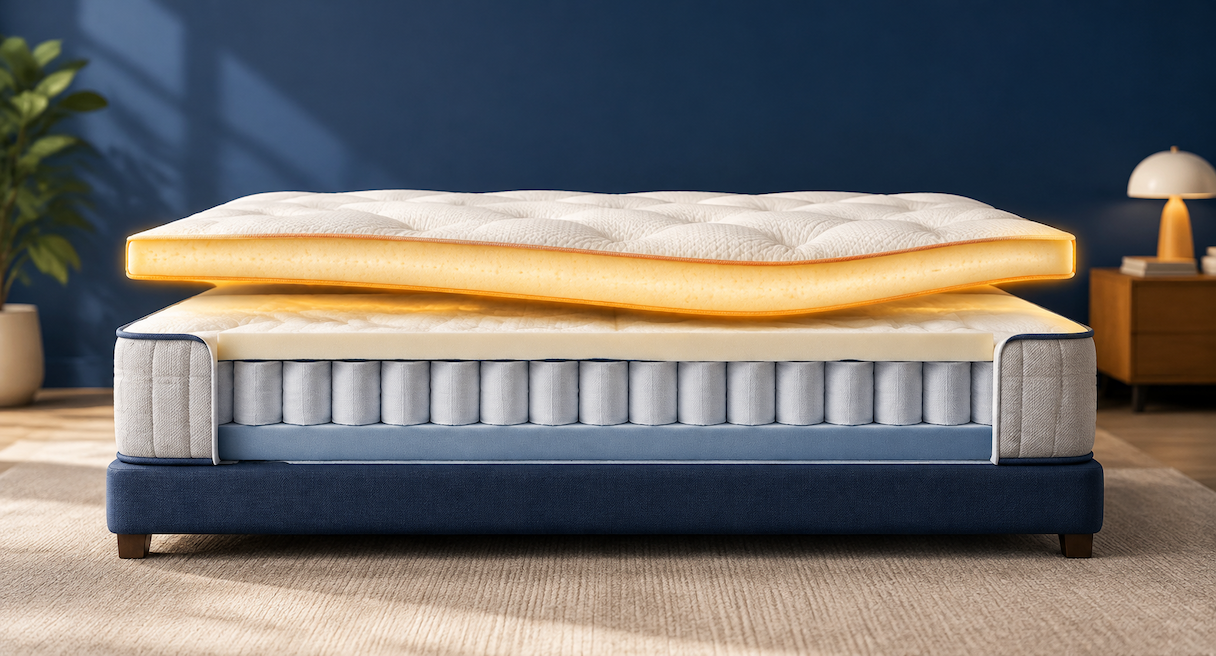
The typed question "mattress topper vs new mattress consumer advice" usually arrives from someone whose bed feels wrong and who hesitates at the cost of a whole replacement. This page gives that decision three axes: which layer has the problem, how the two spends compare, and whether the timing has arrived. The verdict comes from the rows, one at a time. DeRUCCI's published ownership figures appear on the replace side as the worked example, because the brand sells the mattress and carries no topper line at all.
Topper or New Mattress? It Depends on Which Layer Has the Problem
The verdict follows the problem's layer, and the first axis names it. Surface-level issues, firmness fine-tuning, a worn feel, warmth and airflow preferences, sit in the topper's reach. Structural issues, sagging, fading support, failed springs, zoned-support needs, sit past it. Two more axes follow: how the two spends compare, and whether the timing has arrived.
A mattress is two systems stacked: a comfort surface on top, and a support structure underneath doing the holding up. A topper joins the first system alone, which is why the layer question comes before any shopping. The rows sort themselves cleanly:
| If the problem is | Where it lives | Verdict on layering |
|---|---|---|
| Firmness feels slightly off | Comfort surface | Conditional relief, within reach |
| The top feels worn or stale | Comfort surface | Conditional relief, plus care routines |
| Warmth or airflow preference | Comfort surface | Tunable through material choice |
| Sagging or body impressions | Support structure | Outside the reach of layering |
| Support feels faded overall | Support structure | Outside the reach of layering |
| Failed springs or zoned-support needs | Support structure | Outside the reach of layering |
According to Sleep Foundation's guidance on sagging mattresses, a sag points at the structure underneath, and its handling is a topic of its own; a layer added on top changes how the surface feels while the structure underneath keeps its own condition. The same organization's replacement guidance counts visible sagging among the primary replace signals, which previews the third axis below.
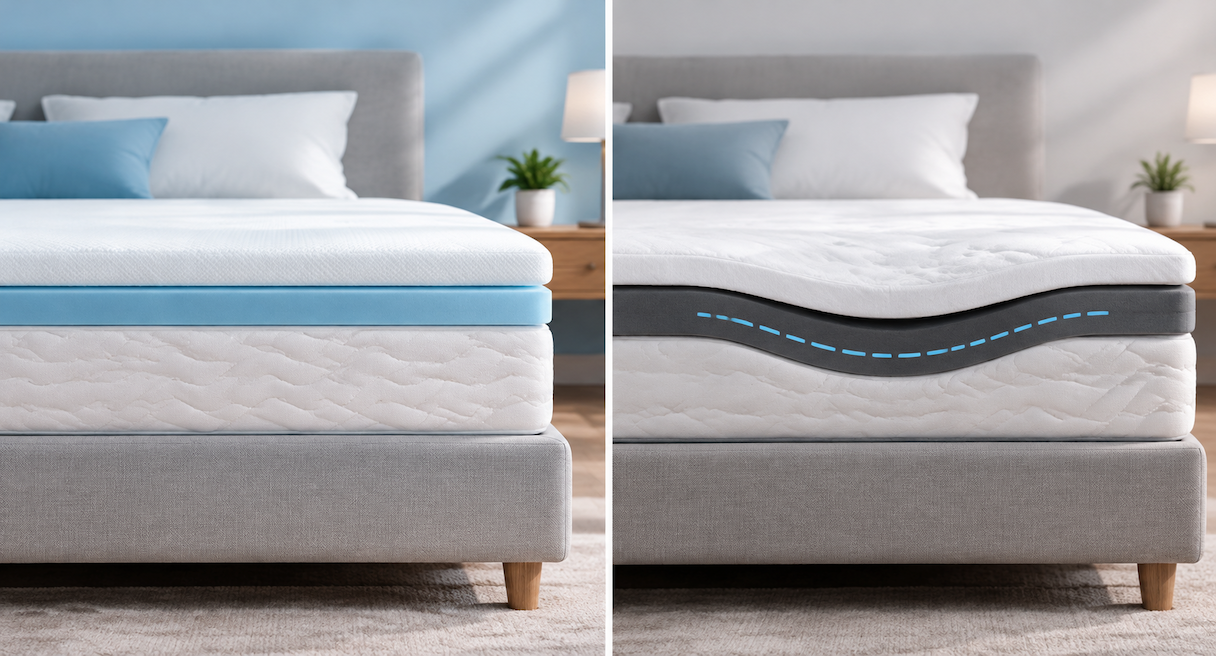
(This image is AI-generated for reference only, not an actual product photo.)
What a Topper Can Help With — and the Cost Test Attached
On the surface branch, relief stays conditional. If the support core is intact, a topper can fine-tune firmness, refresh a worn feel, and tune warmth or airflow. The cost test runs alongside: a topper spend is a small fraction of a replacement spend, and that fraction is well placed when the first axis has cleared the problem as surface-level.
Each item on the reachable side carries its condition with it. Firmness: a topper shifts the surface feel toward softer or firmer, and it does that work when the layer underneath still holds the body properly. Comfort outcomes at the shoulders and hips, a cooler or warmer sleep climate, a fresher hand-feel: these are surface results, and each one stays conditional. Material choice sets the feel, and the category keeps its own map: foam families, latex, wool, and fiber fills each carry their own firmness range, airflow behavior, and care requirements, so material advice stays at the category level.
Surface aging also has a care path that skips new purchases entirely. Prevention comes first: a protector, a fitted sheet, a protective pad against stains. Cleaning favors dry processes, water stays within the mattress's tolerance, and pads rest on breathable bases. For beds with powered components, the safety line is short enough to quote whole: "No damaged or substituted power components." Deeper routines live in how to clean a mattress and keep it fresh longer and antibacterial mattress protection.
The spend side of this branch is a ratio, stated in general terms because sticker figures vary by market: a topper typically costs a small fraction of a replacement. Treated as a test, that fraction buys comfort and information when the first axis has cleared the problem as surface-level. Pointed at a structural problem, the same spend prepays comfort on a bed that still needs replacing, which is where the next section begins.
What a Topper Cannot Fix — and the Timing Signals to Read
Structural problems end the topper question. Sagging, faded support, failed springs, and zoned-support needs live in the support structure, and a layer on top leaves the mechanics untouched. Any structural signal doubles as a timing trigger: when one appears, the timing axis has answered itself, and the decision moves to the replace side.
A topper shapes what the body feels first; the structure underneath decides what holds the body up. Support fade is mechanical: materials compress, springs tire, and the surface follows the structure down, so a fresh layer on top re-upholsters the ride while the suspension stays tired. Zoned support asks for engineering, and a uniform layer answers every region the same way: a side sleeper's shoulder-and-hip pattern and a back sleeper's lumbar pattern need different support in different places, and that difference lives in the structure, above the reach of any topper.
The signal lists come from institutions that track them. According to Sleep Foundation's replacement guidance, visible sagging and a mattress past its published lifespan range are primary replace signals. CHOICE, the Australian consumer organization, publishes a five-sign checklist from the buyer's seat. WebMD's coverage adds the body's own readouts: morning soreness that fades within the hour, and allergy flare-ups that track the hours spent in the bedroom. Read those as signals to investigate; signals that persist deserve a qualified professional's attention. Lifespan stays a range, and the trustworthy figure is the one on the organization's own current page.
The timing axis runs on two dials and a cross-check. Structural signals are the hard dial: any one of them settles the timing question on the spot. The lifespan range is the soft dial: it says how much runway the mattress likely has, in range form, from institutional pages. The warranty position is the cross-check: reading your own warranty terms costs minutes, and it changes what replacement means, since a long coverage figure and free replacement are two different promises, a check the next section runs in full. What happens to the old bed after the verdict, trade-in programs and disposal paths included, is its own topic on this series' replacement-timing page.
The Replace-Side Decision: Costs, Warranty Language, and the Three-Axis Verdict
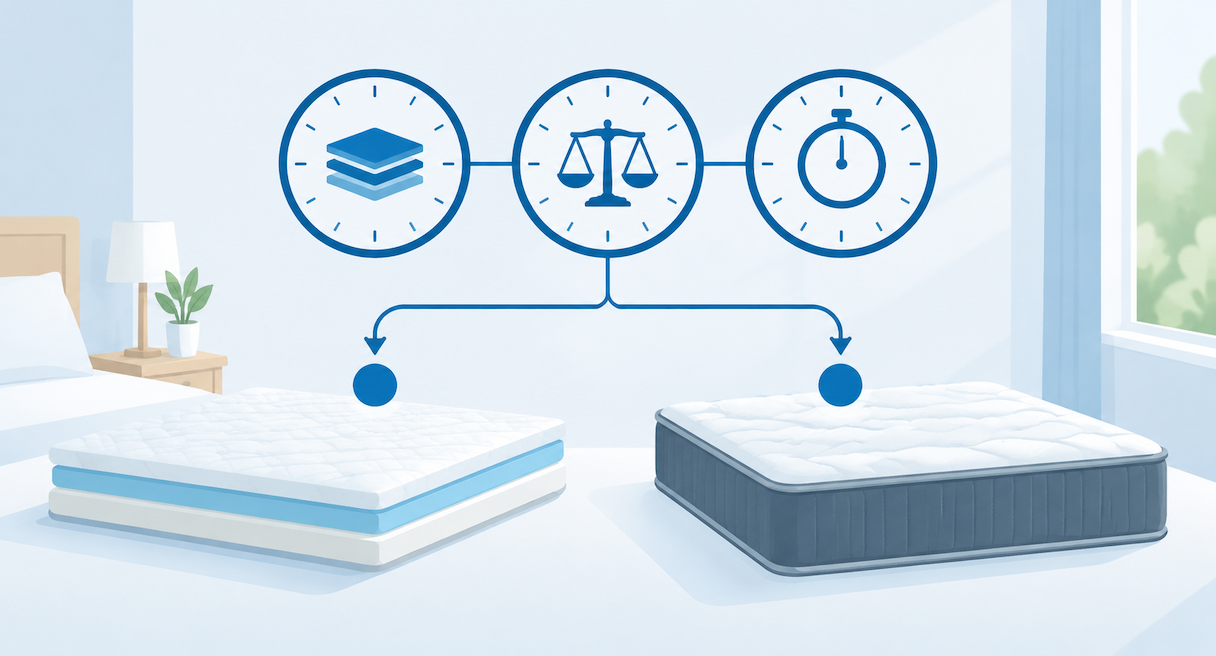
The replace side is a ledger, and the matrix closes it. Count four costs beyond the sticker, accessories, service, depreciation, and energy, read the warranty language for what it actually promises, and weigh quality the way buyers already do. The three-axis matrix then gives one verdict per row, with a branch for each answer and an overall winner for none.
Buyers already weight quality over waiting. According to the 2023 China Healthy Sleep White Paper, a DeRUCCI-commissioned survey of 2,305 adults with research fieldwork by CTR and academic support from the China Sleep Research Society, mattress buyers named quality first at 56.2 percent, firmness second at 50.7 percent, and breathability third at 50.3 percent, with price in ninth place at 26.0 percent. The same white paper put bedding factors behind 36.5 percent of adult sleep troubles, the second-largest external factor it measured. On this decision, comfort and support quality carry more weight than saving by waiting.
The replace-side ledger starts before the sticker. "Covered for X years" is warranty language, and warranty language promises repairs and terms, with free replacement as its own separate question; the line worth checking is what a claim actually delivers. Four costs ride beyond the sticker: accessories that fit the new bed, service visits inside and outside coverage, depreciation across the ownership years, and the energy a powered bed draws. Set beside a topper's small fraction on the same ledger, the comparison turns honest: both spends, every cost line, one timeframe.
One worked example, from DeRUCCI's published figures. The T11 line runs three tiers by support zoning, three zones on the SE, five on the T11+, six on the PRO. Recurring fees sit at zero, with the core adaptive adjustment carried free of subscriptions. Energy use runs about 0.3 kilowatt-hours per day, near 10 per month, on rated power of 20 watts for the SE and T11+ tiers and 85 watts for the PRO. The warranty reads in three stages: a 365-day replacement policy, where a confirmed quality issue is solved by replacing parts, and a part swap that misses escalates to a whole-unit replacement at zero cost; a three-year free warranty after that; and a paid-service stage through year ten, carrying materials and logistics costs with labor free.
| Axis | The check | Topper branch | Replace branch |
|---|---|---|---|
| One, problem type | Surface comfort or support structure | Surface problems proceed to cost | Structural problems land here |
| Two, cost ratio | Topper fraction against the full ledger | Small fraction as a first test, for surface problems | Full ledger as the baseline, four beyond-sticker costs included |
| Three, timing | Signals, lifespan range, warranty position | Timing untriggered, range remaining | Any structural signal triggers replacement |
That table is the consumer advice in working form: one verdict per row, no overall winner, and the branch chosen by the rows themselves. A replace verdict continues in how to choose a mattress, and the old bed's next steps, trade-in programs and disposal included, sit with this series' replacement-timing page. A topper verdict ends on this page, with the conditions and care routines of the surface branch.
(This image is AI-generated for reference only, not an actual product photo.)
Frequently Asked Questions
---
The choice between a layer and a whole bed is a layer question first. The sleep problems to mattress guide collects the full decision path, and to feel the support tiers in person, find a store and check global showroom addresses.