
 American
( English )
American
( English ) Singapore ( English )
What Is Deep Sleep (Slow-Wave Sleep)?
Deep sleep, also called slow-wave sleep or N3, is the deepest of the three non-rapid eye movement (NREM) stages, when your brain fires slow delta waves and your body shifts into full repair mode, regrowing tissue, building bone and muscle, and strengthening the immune system.
Sleep unfolds in cycles of roughly 90 to 110 minutes that repeat four to five times a night, cycling through light N1 and N2 stages, deep N3, and REM. Deep sleep concentrates in the first half of the night, when it is hardest to wake someone and grogginess can linger for 30–60 minutes if they are roused. Because this stage drives physical recovery and memory consolidation, the amount you get each night matters more than many sleepers realize, which is why researchers track it separately from total time in bed.
How Much Deep Sleep Do You Need by Age?
Most adults spend about 10% to 20% of the night in deep sleep, roughly 40 to 110 minutes for someone sleeping the recommended seven to nine hours, and the share stays fairly stable across adulthood even as total deep-sleep time slowly declines with age.
The Centers for Disease Control and Prevention (CDC) advises adults aged 18–60 to aim for at least seven hours of sleep per night. Deep sleep typically accounts for about 10% to 20% of that total, so a seven- to nine-hour night usually holds roughly 40 to 110 minutes of it. Younger adults and children naturally log more deep sleep because their developing bodies demand extra repair, while adults over 60 often see their deep-sleep portion shrink as lighter stages expand. Rather than chasing a single "correct" number, it helps to think in ranges: if you sleep seven to nine hours and feel rested, your deep-sleep total is likely within the healthy band.
Signs You May Not Be Getting Enough Deep Sleep
When deep sleep runs short, the clues are usually felt the next morning, waking groggy despite a full night in bed, daytime sleepiness, slower reaction times, and trouble focusing or remembering new information.
Because N3 governs physical restoration and memory consolidation, skimping on it tends to surface as fatigue that lingers past the first coffee, mood dips, and a foggy sense that sleep "didn't do its job." Cravings and a short temper can also trace back to fragmented deep sleep. These signals are worth noticing, but they are lifestyle cues rather than a diagnosis, persistent, severe sleep trouble is best discussed with a clinician. The practical takeaway is simpler: if the signs show up often, the deep-sleep portion of your night is the first place to investigate.
How to Know If You're Getting Enough: Tracking Deep Sleep
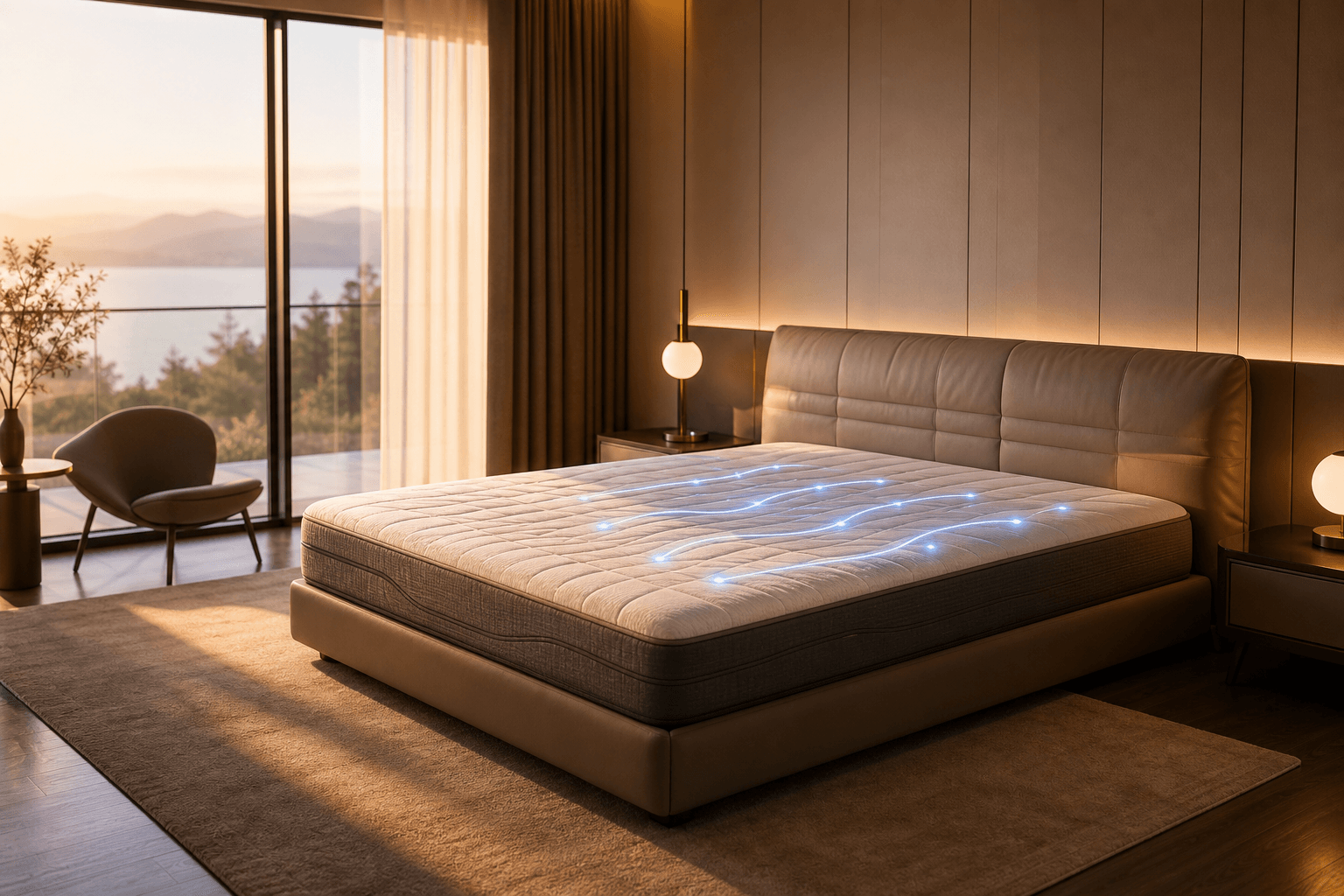
(This image is AI-generated for reference only, not an actual product photo.)
Guessing deep sleep from how you feel is unreliable, which is why objective tracking matters, and contact-free monitoring built into the mattress itself can quantify sleep stages without the wristband most people abandon within weeks.
That contact-free approach is the foundation of DeRUCCI's sleep technology. The T11+ AI smart mattress carries a third-generation piezoelectric ceramic sensor array that detects heart rate with 97% accuracy, letting it distinguish deep, light, and REM stages through the night without anything worn on the body. That sensing layer turns each night into a readable sleep-stage report. To see how DeRUCCI approaches AI sleep monitoring, visit the DeRUCCI smart sleep system page, or explore the T11 series AI mattress. (The T11 SE AI mattress is now available at the DeRUCCI New York store.)
Tips to Improve Your Deep Sleep Tonight
A handful of small adjustments, steady timing, a cool room, and a calmer pre-bed routine, tend to lift deep sleep more reliably than any single gadget, and they cost nothing to try tonight.
Keep your bedtime and wake time consistent, even on weekends, so your circadian rhythm can settle into a predictable deep-sleep window. Drop the bedroom temperature into a cool, comfortable range, since core body temperature needs to fall to enter slow-wave sleep. Dim screens an hour before bed or shift to warm light to protect melatonin, and trade late heavy meals and alcohol for a brief wind-down, reading, breathing exercises, or gentle stretching. A mattress that relieves pressure and regulates temperature also helps you stay in deep sleep rather than shifting restlessly, which is why surface comfort and stage tracking work better together than either alone.
Frequently Asked Questions
Is 45 minutes of deep sleep enough? For most adults, 45 minutes sits at the low end of the typical range. Sleep Foundation places adult deep sleep at about 10%–20% of the night, or roughly 40–110 minutes across seven to nine hours. If you consistently land near the bottom and feel unrested, it is worth reviewing your sleep habits or tracking your stages.
Do you need more deep sleep as you age? Not exactly, older adults often get less deep sleep as lighter stages expand, but the biological need for restorative sleep does not disappear. The share of N3 declines gradually with age, so consistency and sleep quality become more important, not less.
Can a mattress really affect deep sleep? Yes. Pressure points, heat buildup, and motion transfer can prompt micro-arousals that pull you out of N3. A surface that disperses body pressure and regulates temperature helps you stay in deep sleep longer, and contact-free stage tracking can show whether the change is actually working.
How is deep sleep different from REM sleep? Deep sleep (N3) is the most physically restorative stage, with slow brain waves and minimal muscle activity. REM sleep is lighter and more active, it handles dreaming, emotion, and memory consolidation, and usually makes up about 20%–25% of the night. You need both, in sequence, across multiple cycles.
Find a DeRUCCI Showroom Near You
Better sleep is easier to choose in person. Explore DeRUCCI's mattresses and smart sleep systems, then find a store and check global showroom addresses to experience them firsthand.