
 American
( English )
 Singapore ( English )

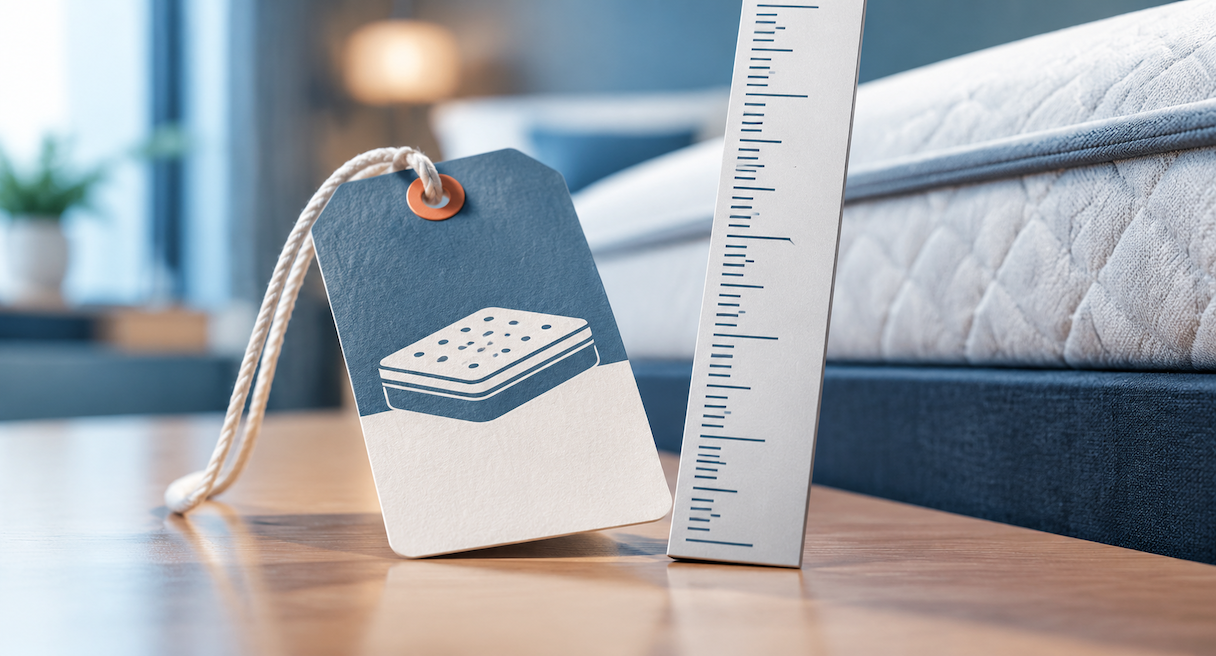
Medium-firm sits on showroom tags, in research summaries, and across the roundups that likely built your shortlist, and the same two words carry a different meaning each time: brands draw their own scales, studies describe groups under test conditions, roundups rank what their authors tried. This guide does the step after all three, checking a medium-firm label against your own body, on the priority the bedding standards DeRUCCI publishes state plainly: fit the sleeper's body and usual sleep position first.
The routine runs in three parts: what firmness evidence settles, a conversion from label language onto your four-anchor scale, and a showroom check on any tag claim where it is sold.
What Does Firmness Research Actually Settle — and What Doesn't It?
Firmness research settles less than headlines suggest: a personal number never arrives from a group average. The evidence ladder climbs from expert opinion through observational studies and randomized controlled trials to systematic reviews, each rung a group question under its own conditions. Two outputs reach the showroom: a direction, and an applicability check.
Start with the ladder, because research-backed earns its meaning once you know the rung a claim stands on. At the base sits expert opinion, one specialist's judgment, untested as a comparison. Observational studies climb a rung, charting what large groups already do. A randomized controlled trial climbs further: participants are randomly assigned to one option or another, keeping the comparison level. At the top, a systematic review gathers the trials on a question and weighs them together, a study of studies.
What the ladder settles is method, which is why two findings can disagree. Studies run on particular body-weight ranges, sleep positions, time windows, and samples graded on whichever scale the researchers defined, so a result lives inside its conditions and every firmness claim deserves the same three questions: to whom, lying how, measured on what scale.
For a buyer, two outputs make it to the showroom. The first is a direction of travel. Some published guidance suggests paying attention to mattress support and sleep position — specific advice varies by person. Quoted whole, that is the ceiling: guidance goes as far as attention and variation, and anything firmer owes you its conditions, sample, and limitations first. The second is the applicability habit, those three questions asked of every claim that follows.

(This image is AI-generated for reference only, not an actual product photo.)
From "Medium-Firm" to Your Own Scale: The Conversion Step
The conversion happens on your scale, and that scale has four anchors: weight, usual sleep position, body frame, and perception. Labels travel brand by brand because no industry-wide ruler exists, the middle setting earns its place through a support mechanism, and comfort outcomes are mostly self-reported, so the last instrument is you.
The conversion begins with the fact that makes it necessary: no industry-wide firmness scale exists. A brand's medium-firm sits on its internal ladder, a study's on the samples the researchers graded, a review site's number on one outlet's index, and the same label lands at different points on those three rulers. Labels travel poorly across brands, so the first showroom question is about the ruler.
Your local baseline comes from how support behaves, and here the guide leans on a brand-published standard, labeled as such. DeRUCCI's 2026 spine and sleep white paper states its expert-panel view in three lines: too soft, the body sinks until the spine loses its support; too firm, load collects on the bony points, shoulders, elbows, knees, ankles, and the lower back can hover; a balanced middle contours the body while still holding it. The same panel files the belief that the harder the bed, the better the support as a misconception: the pressure collects at hips and shoulders.
Landing that middle on your body is the four anchors' job. Weight sets how deep you sink: one surface reads firmer to a lighter frame. Usual sleep position sets the regions that matter: side lying loads shoulder and hip, back lying loads the seat of the lower spine. Body frame sets the widths: shoulder span and hip width decide how much contouring a side position asks. Perception is the final judge, and sleep-position guidance from major health institutions agrees in scope: Houston Methodist answers whether one position suits everyone with a plain no, resting on individual differences; Harvard Health walks through how position changes the load the body carries overnight; Mayo Clinic's guidance on sleeping positions that reduce back pain runs position by position.
The white paper types sleepers into four frames: the side-bending frame, on the side with the gap between neck and shoulder filled; the stiff frame, on the back with a pillow under the knees; the load-bearing frame, on the side with a pillow between the knees; the curled frame, on the side, over a surface that holds the body up. The frames are a starting grid; side sleepers can go deeper in the companion guide Best Smart Mattress for Side Sleepers.
In firmness research, low back pain names a study outcome, what participants reported about their own backs, so the guidance-level sentence above is the firmest form that topic takes here. Comfort outcomes are mostly self-reported, which is why the routine ends in person, on a mattress, with your own perception as the instrument.
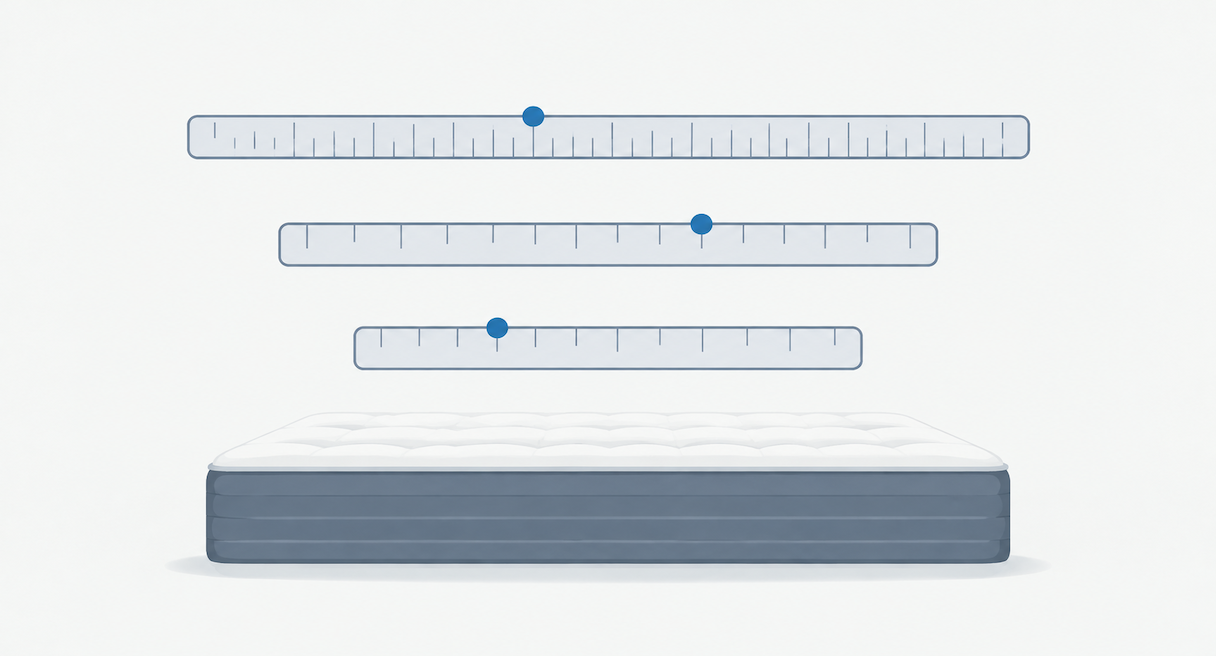
(This image is AI-generated for reference only, not an actual product photo.)
The Showroom Label Check: How to Verify a "Medium-Firm" Claim In Store
A showroom label check has four moves: ask what the firmness grade is measured against, read the spec row for zones and adjustment, lie down on your own baseline for minutes per posture, and sort every claim by source tier. One visit screens the label; several nights deliver the verdict.
1. Ask what the grade is measured against. What does this firmness label reference? A usable answer names the ruler: the brand's graded ladder, a declared convention, or an honest admission that the word is descriptive. Passing looks like a ruler you can convert from.
2. Read the specification row. The tag talks; the spec sheet counts. Check whether firmness is one fixed value or divided into zones, and whether adjustment exists. A fixed value leaves the four anchors as your whole path; a zoned or adjustable design can be checked region by region on the floor, and the mechanics sit in How Adaptive Firmness Technology Works. Passing looks like zone counts and adjustment ranges in writing.
3. Lie down on your own baseline. Body feel needs minutes to settle, so hold each usual posture three to five minutes and score the anchors: side sleeping, shoulder and hip held with sink you can still move in; back sleeping, lower back meeting the surface; sink in proportion to your weight; overall feel matching what you walked in with. Passing looks like postures held long enough for first impressions to fade.
4. Sort every claim by its source tier. The spec row is the documented tier. Guidance-level statements, published advice from health organizations, form a softer tier and sound like it. Unsourced absolutes, the ones promising the perfect surface for everyone, you can drop on the spot, and the filing applies to every brand's talk equally. Passing looks like each claim you act on carrying a tier you can name.
One limit earns its own line. A store session is a screening input: it shows whether a label survives your four anchors on first contact, and the verdict that matters arrives across several nights at home.
From Fixed Labels to Zone-Level Calibration: What Adjustable Support Changes
When a label misses, zoned support designs turn firmness into a per-region setting, and the T11 series expresses it in checkable numbers: 10, 14, or 18 adjustment units, 3, 5, or 6 zones, 20 adjustment levels per unit on the T11 SE, up to 5,500 configurations, and simultaneous left-right tuning on the PRO.
The check ends in one of two places. When the label converts and the anchors confirm, the next step is patience, the multi-night confirmation covered separately. When it misses, re-test another tier or model, or look at the category that made the scale adjustable: zoned designs in which firmness is set region by region, so the shoulder zone and the hip zone each carry their own level.
Here the T11 series enters, as engineering with numbers to hold against the spec row. Across its three tiers, DeRUCCI's series documentation lists 10 flexible adjustment units on the T11 SE, 14 on the T11+, and 18 on the T11 PRO. The zones scale with the units: 3 zones, shoulders, lumbar, and hips, on the SE; 5 zones, adding back and legs, on the T11+; 6 zones, splitting the lower body into thighs and calves, on the PRO. On the T11 SE, each unit offers 20 levels of fine adjustment, and on the standard 1.8 m format the settings combine into up to 5,500 distinct comfort configurations. The T11 PRO runs both sides simultaneously through its two control hubs, so two sleepers tune their own halves at once. The full specification rows sit on the T11 series product page.
Set against the check you now carry, the engineering reads simply. When the floor test says the shoulder zone runs firmer than your side posture wants while the hip zone could hold more, zone-level calibration gives each region its own answer on one surface, this year and after years of change. That is support you can adjust, per region, per side.
Bring the checklist when you go: the four anchors meet the labels they were written for, and the medium-firm tag either earns its place on your scale or shows you which zone needs its own setting.
Frequently Asked Questions
---
The three steps fit on one card: read the evidence at its true altitude, convert the label through your own four anchors, and verify the tag where it is sold. For the wider arc from sleep problems to mattress choices, the hub gathers the series in one place. The T11 SE AI mattress is now available at the DeRUCCI New York store. To run the label check in person, find a store and check global showroom addresses.