
 American
( English )
 Singapore ( English )


Type best mattress pressure relief specifications into a search bar and the answers split in two: rankings that name favorites, and spec sheets whose numbers arrive without instructions. A pressure figure with nothing around it cannot be compared with anything. DeRUCCI's materials page publishes the kind of spec rows this article teaches you to read, and the method below treats every maker's page the same way.
One boundary up front. This page handles the two check families a buyer can run personally: structural spec rows, which live on paper, and body signals, which answer in person. Laboratory measurement keeps its own lane, and the mmHg section explains where that lane runs.
What Does "Pressure Relief" Mean on a Spec Sheet — and What Can You Actually Verify?
Pressure relief on a spec sheet describes how a mattress spreads the load of a lying body. Every claim lands in one of three families: laboratory-measured numbers, structural spec rows, and body signals a shopper can feel. The first family seldom reaches a retail page, so verification lives in the other two.
Pressure checks fall into three families. Number measurement belongs to laboratory equipment, the pressure-mapping systems that image load distribution under a lying body and emit figures in mmHg. Structure belongs to paper, the spec rows describing comfort materials, springs, and fabrics. Body checks belong to you, through the signals your shoulders and hips report on a candidate mattress.
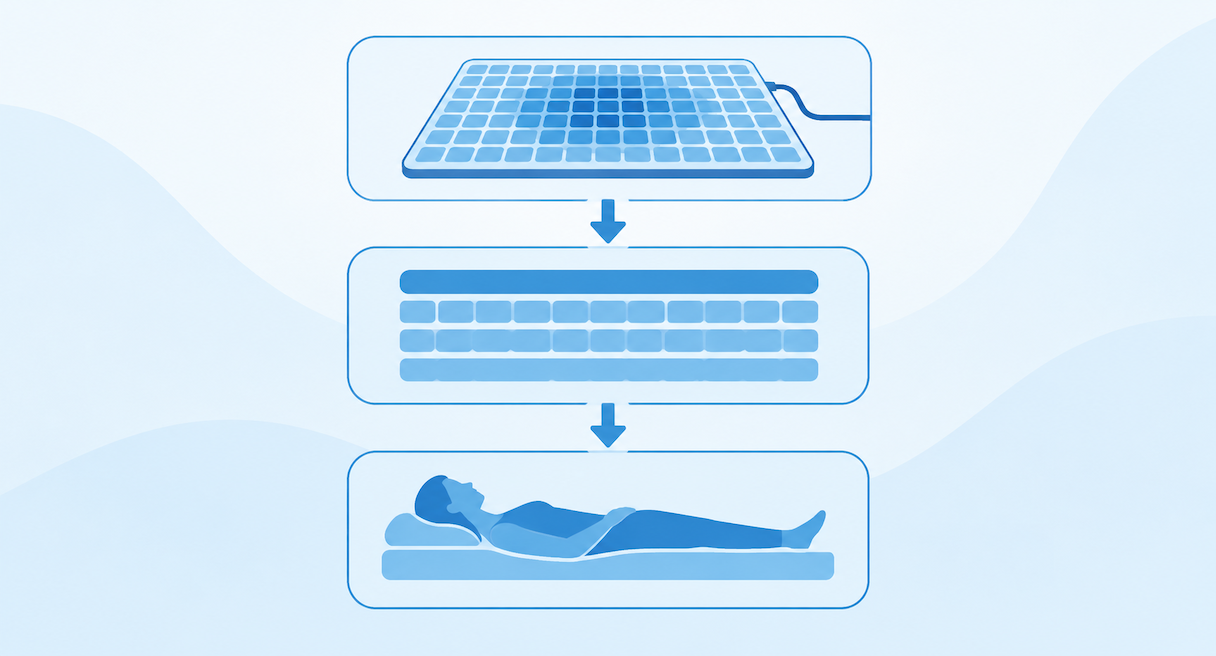
The mechanics explain the vocabulary. A mattress firmer than the body on it concentrates load at the bony points, shoulder, elbow, knee, and ankle, without spreading weight across the surface. Concentrated load reads as localized pain, pain prompts shifts of position, and frequent unconscious shifting fragments the night. A pressure-relief design exists to spread that load.
A note on words, fixed once. Pressure relief is the working term here for what engineers call pressure dispersion. Support is a separate property, how well a surface holds a resting body's natural line, and it stays inside structural rows here, never a synonym for relief.
Shoppers tend to arrive holding a percentage from an advertising headline. Readers coming from a ranking of favorites can put each name through the checks below; this page supplies verification tools in place of a second ranking. Neighboring questions have their own pages in this series, for firmness labels, posture-alignment self-tests, and post-delivery confirmation; this page handles the pressure track.
(This image is AI-generated for reference only, not an actual product photo.)
How to Read mmHg Numbers When Marketing Uses Them
mmHg stands for millimeters of mercury, the unit laboratory equipment uses to measure pressure under a lying body. Retail spec sheets almost never carry it, because no unified disclosure format exists at retail, and a quoted figure is only as good as the context traveling with it: which body part, which conditions, which baseline, and who ran the measurement.
The unit belongs to the laboratory in a second sense as well: the figures come from pressure-mapping mats inside sleep and materials laboratories, and retail pages rarely publish them. A spec sheet can look complete while saying nothing measurable about pressure.
When marketing quotes a pressure figure, four context elements decide what it means.
- Which body part was measured? A reading at the shoulder tells one story, an average across the surface another, and a figure with no location nothing comparable.
- Under what conditions? Back or side position, the sleeper's weight band, and how long it was held all move the result.
- Against what baseline? Against the maker's previous model, against another product, or against nothing at all each mean different things, and the last flatters whoever prints it.
- Who ran the measurement? An independent body with a published method, the brand's own laboratory, or no named source, in ascending order of earned trust.
All four present, the figure is one reference input, still short of a purchase decision on its own. Any one missing, the number is a marketing figure, inadmissible as evidence. This article quotes no thresholds, no ranges, and no example readings.
Mattress aging belongs in the same frame. Replacement guidance from the Sleep Foundation and from Choice, the Australian consumer organization, counts visible sagging among the signs a mattress has reached the end of its service life.
The Pre-Purchase Claim Checklist: Verify Before You Pay
A pressure-relief claim survives five checks: who makes it, which structural rows back it, whether test figures carry method and result as well as a count, what to do when no source exists, and how to log each claim in a tier so comparisons stay fair. The checks apply the same way to every brand on the shortlist.
Who is making the claim? A parameter published on the maker's own page sits in the officially stated tier. A figure traceable to a public test or certification file sits in the independently checkable tier. Phrases like the lowest pressure figure in the industry, arriving with no source, sit in the discard tier, and a sourceless claim leaves the shortlist.
Which structural rows stand behind the claim? Four rows carry most of the pressure story, and the table below reads each for what it describes and leaves out. The pass condition is one pressure-relevant row at minimum, present and specific.
Does the test figure travel with its method and its result? A compression count is the common case, and a count alone is half a figure. The full form names how the test ran, how many cycles the material endured, and the end result, attributed to brand documentation.
What happens when no source appears? Ask for one, in the store or in writing. If none exists, the number drops out of the decision, and the body-signal track carries the whole weight instead.
Where does each claim get logged? Keep the shortlist on one page, each candidate's claims marked with their tiers, and compare like with like, officially stated rows against officially stated rows, checkable sources against checkable sources. Mixing tiers is how a marketing figure wins an argument it lost.
The five run identically on a flagship page and on a comparable solution from another maker; a checklist never changes hands between brands.
A comfort material deforming in vertical, horizontal, and lag directions behaves like a honeycomb of tiny springs mounted in every orientation at once, giving way along whichever axis a body loads. Independently pocketed springs work like a hall of separate suspension units, each answering the one zone pressing on it while its neighbors hold theirs.
| Spec-row question | What the row describes | What it leaves out |
|---|---|---|
| How many directions can the comfort material deform in? | Whether the material gives way vertically, horizontally, and with lag to follow a shifting body | Feel stays personal; a count proves comfort for nobody |
| Do the springs move independently? | Whether each coil is sealed and responsive on its own, letting one zone sink without dragging neighbors | Coil counts and gauges need this row first |
| What order of magnitude of support points? | The scale of contact structure in a spacer fabric | A magnitude describes construction and says little without the structure behind it |
| How many compression cycles were tested? | Durability vocabulary, the repeated loading a material withstood | A count without method and result stays a half figure |
The foam families have their own comparison page on this site, Latex vs Memory Foam in Pressure Relief: materials compare there, and claims get checked here.

(This image is AI-generated for reference only, not an actual product photo.)
How to Verify In Store: Body-Check Signals and a Worked Example
The store visit settles what paper cannot. Lie down in the usual sleeping position for three to five minutes, then read three signals at the bony points: pressing discomfort, an urge to keep shifting position, and marks left on shoulder, hip, or elbow after rising. Ask for the source of every quoted parameter before leaving, then weigh both tracks together.
The qualitative benchmark on record reads: distribute the body's local pressure evenly, especially at the bony points, so that load spreads away from the bone. That standard comes from the bedding guidance in the 2026 spine and sleep white paper, and it converts into things a person can feel.
The store version is three signals, read after settling in for three to five minutes. Pressing discomfort at any bony point, because a spreading surface keeps those points quiet. An urge to keep shifting after lying still, the behavioral echo of concentrated load. And the marks a short lie leaves on shoulder, hip, or elbow, checked on rising; deep marks point to pooled load. Side sleepers read the shoulder and hip points closely, and body weight matters: a heavier frame sinks deeper and moves the pressure points, a lighter one rests higher, so the same mattress reports differently across two bodies.
DeRUCCI's published rows run through the same checklist.
| Published claim | Structural row behind it | Test figure with its context | Tier |
|---|---|---|---|
| DEFORM Fine Revo, developed with Aisin's Fine Revo resin technology, deforms vertically, horizontally, and with lag for body pressure dispersion, in a honeycomb structure | Three-direction deformation | 480,000 compression cycles | officially stated |
| German AGRO Springs seal each coil in its own pocket to move independently, pairing resilient support with even pressure distribution, on the A.TiCu-S titanium-copper alloy spring system, an international patent | Spring independence | 300,000 compression cycles | officially stated |
| 3D-Plus spacer fabric builds an X-structure with over 1.4 million fine support points and 4.4 times the breathability | Support-point magnitude | Page-published figures | officially stated |
Every row above sits in the officially stated tier, published on the brand's own materials page; the tier label tells the reader what kind of statement each cell is. The full parameter set lives on the DeRUCCI Materials Guide page, the place to verify any row quoted here, and the making of those materials has its own long-form piece in DeRUCCI mattress materials and craftsmanship.
Both tracks close together before any payment. The paper track asks whether the spec rows carry their tiers honestly, and the body track asks whether three signals stayed quiet for five minutes. Three actions end the visit: signals read, sources requested, tiers written down.
Frequently Asked Questions
---
Claim checking is one station on a longer route; the sleep problems to mattress guide collects the full line. To run the body-signal checks in person, find a store and check global showroom addresses.