
 American
( English )
 Singapore ( English )

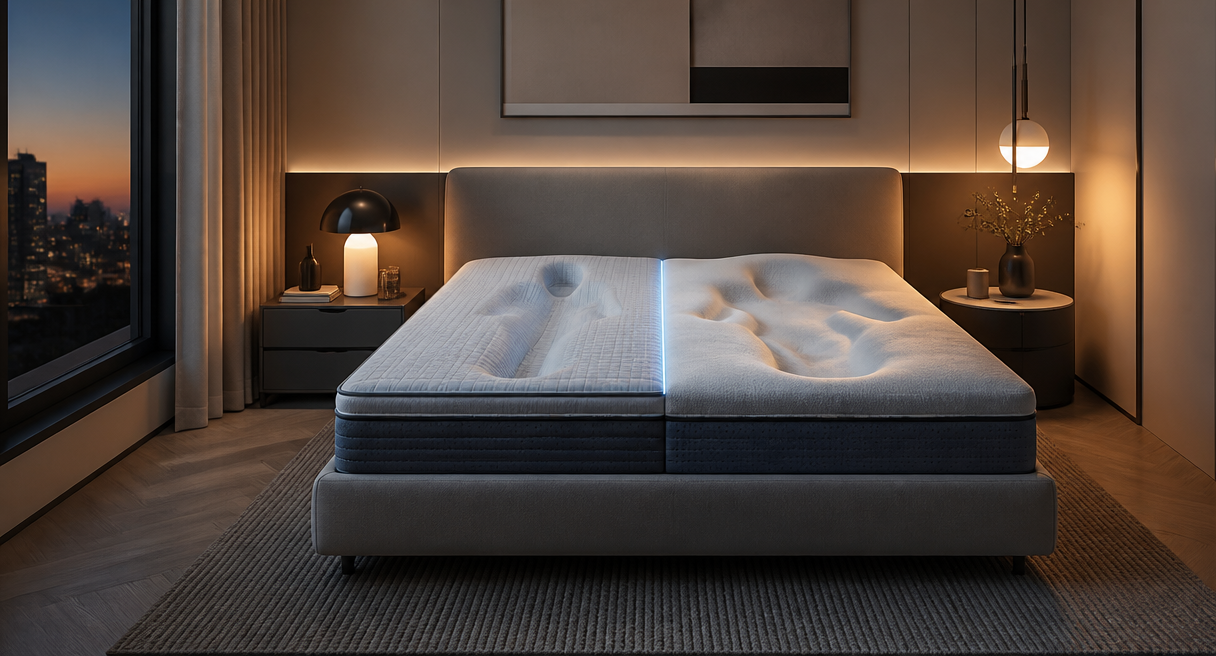
When two partners want different firmness from one bed, the real question is which tier fits how differently the two of you sleep. An AI mattress for couples is not one product: within DeRUCCI's T11 line, the practical shortlist comes down to three core models — the T11 SE, the T11+ and the T11 PRO — and what separates them is specifications you can check: adjustment units, zones, left–right operating mode, monitoring tier, heating and comfort memory. Only one tier adjusts both sides simultaneously. After the specs, the last step is confirming what your region sells.
What Are the Three T11 Tiers at a Glance?
The tiers separate on count and mode: 10, 14 or 18 flexible adjustment units; 3, 5 or 6 zones per side; a left–right mode that runs simultaneously only on the flagship. Monitoring goes from absent on the SE to standard on the T11+ to flagship-exclusive on the PRO, and heating plus Comfort Memory appear only on the PRO.
| Dimension | T11 SE | T11+ | T11 PRO |
|---|---|---|---|
| Flexible adjustment units | 10 (5 per side, MOS1-001A) | 14 (7 per side, MOS1-002) | 18 (9 per side, MOS1-003) |
| Adjustable zones, per side | 3 — shoulder–back, waist, hip–leg | 5 — shoulder, back, waist, hip, leg | 6 — shoulder, back, waist, hip, thigh, calf |
| Left–right mode | One side adjusts first | One side adjusts first | Simultaneous left–right |
| Control boxes | 1 | 1 | 2 |
| Sleep report and monitoring | Not included | Included | Included |
| Graphene far-infrared leg-zone heating | — | — | Included, per-side app control |
| Comfort Memory | — | — | Included |
The adjustment units are the parts that actually change firmness, and each side gets its own set — five per person on the SE, seven on the T11+, nine on the PRO. The zones are the body regions those units map to, and the control boxes govern how independently the two halves run; the PRO's two boxes are what let both sides work at once. Monitoring and heating differences come up below.
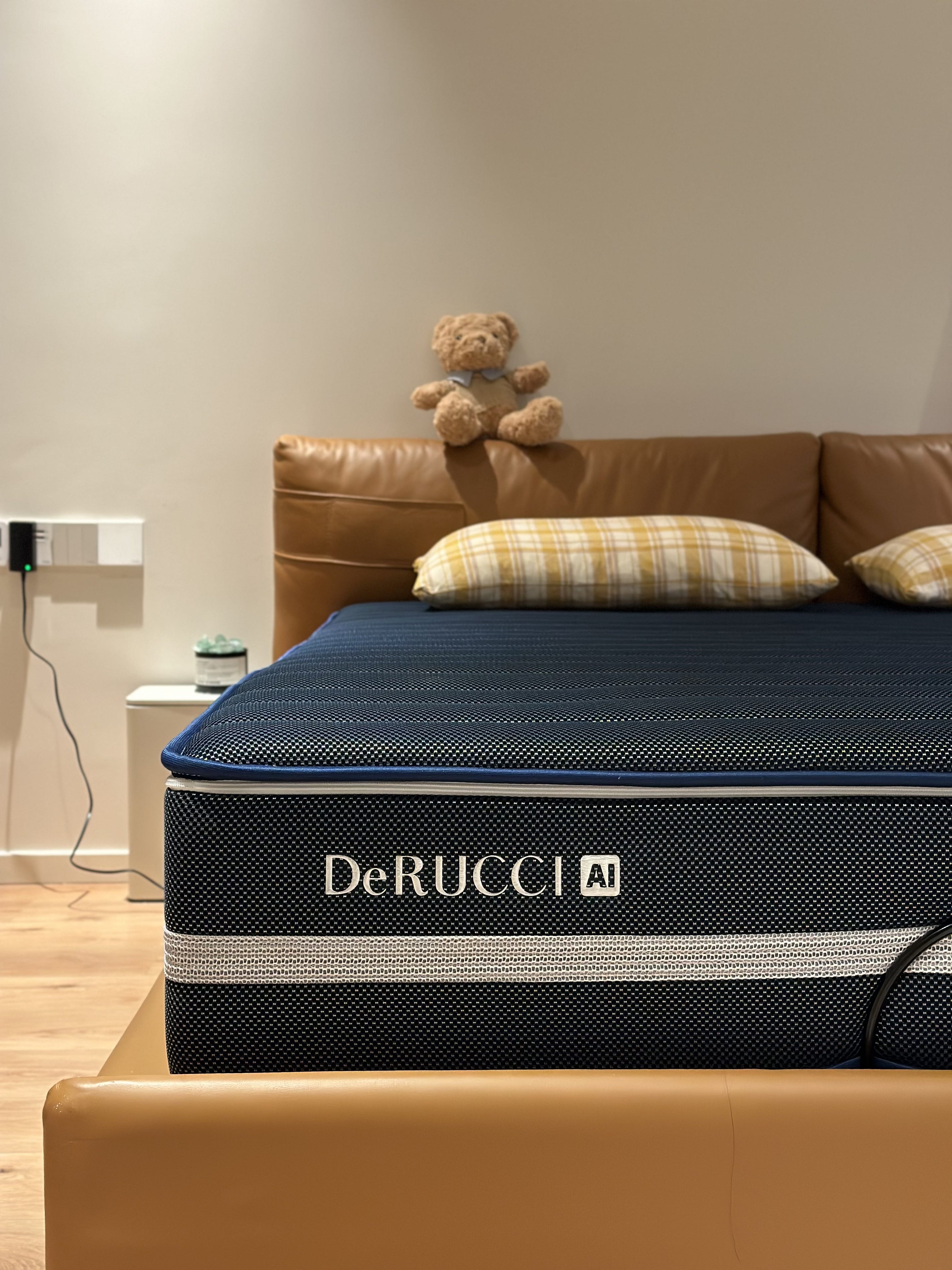
What Does the Table Decide for Couples?
One row outweighs the rest for differing partners: left–right mode. Only the PRO forms both support maps at once — nine units and six zones each side, governed by two control boxes — so nobody waits on a half-formed bed. Below the flagship, sequencing is one-side-first, and the second partner spends early minutes on a surface still shaping.
For partners whose firmness needs genuinely differ, the left–right mode row decides more than any other. On the T11 PRO, each side adjusts its own six zones through nine flexible units, run by two control boxes — a side sleeper's shoulder-and-hip map and a back sleeper's lumbar map both take effect, with no queue. On the two tiers below, the mode is one-side-first: the mattress forms one partner's surface, then the other's. Whoever climbs in second spends the first minutes on a bed still shaping beneath them.
Two PRO-only extras sit outside the firmness core. Comfort Memory returns the mattress to your chosen state when you get back into bed — in the brand's wording, it feels exactly the same when you return. Graphene far-infrared heating warms the leg zone with per-side control in the app: a plus for a partner who runs cold, not a core firmness feature. The most common form of "different firmness needs" is a side sleeper paired with a back sleeper, and the side sleeper's support map is covered in Best Smart Mattress for Side Sleepers.
What Can Each Monitoring Tier Report?
Monitoring is where the three tiers differ most sharply, and it is not a tunable extra: whatever the box ships with is what you get. Two of the three tiers produce a nightly report; the entry model produces none. Every reading in the series is wellness-scoped, never diagnostic.
SleepCare — the system behind the CPC (cardiopulmonary coupling) monitoring — belongs to the T11 PRO. The T11+ has monitoring of its own: a third-generation precision pressure sensor array, heart-rate detection accuracy of 97% in the brand's product materials, producing the nightly sleep report. The T11 SE, at the entry tier, includes neither sleep reporting nor heart-rate monitoring.
All monitoring in this series is wellness-oriented: the sleep reports and vital-sign tracking are not intended for medical diagnosis or treatment. If you are weighing how much a monitoring tier should influence your choice, a recent peer-reviewed review — A Comprehensive Review of Home Sleep Monitoring (PMC, 2025) — offers an independent calibration for what home tracking can and cannot establish.
What Should You Check Before Choosing a Tier?
Four checks before you pay. Does the model adjust both sides at once? Do the zones land on each partner's actual shoulders, waists and hips? Does one partner's adjustment stay quiet enough not to wake the other? And what does the warranty actually cover? Each has an answer you can verify before you commit.
The mode question is settled by the table above; the mapping question is not settled by any spec sheet. Zone count is a number — support is geography. Check that the zones track where each of you actually carries load, at the shoulder, the waist and the hip, because a correct-sounding setting on a poorly matched bed still leaves someone unsupported. That check happens lying down, together, for more than a few minutes.
Quietness is a spec you can hear. In Intelligent Sensorless mode the adjustment mechanism is manufacturer-rated below 28 dB; have one partner rest while the other adjusts a side, and listen.
On service, DeRUCCI's after-sales framework runs three tiers from the delivery date: within 365 days, a verified quality defect is resolved by replacing the affected part — or the whole unit if a replacement does not fix it — at no cost; through three years, quality-issue repairs are free, with no service charge to the customer; through ten years, the mattress stays serviceable at cost, with only material and logistics fees while labor stays free. The detailed exclusion clauses live in the product manual — check the copy supplied in your region before ordering.
What Can the Spec Sheet, the App and the Store Each Confirm?
Each channel confirms a different slice. The spec sheet settles tier facts; the DeRUCCI AI App bridges part of the fit gap with Bluetooth pairing, dual-phone connection, and real-time per-zone displays; the store settles the rest — simultaneous adjustment, sequencing behavior, and whether the adjusting side stays quiet while a partner rests.
A spec sheet confirms the tier facts: zones per side, one-side-first versus simultaneous, monitoring included or not. What it cannot confirm is personal fit — whether the shoulder zone sinks enough, whether the lumbar zone holds the pelvis, whether both preferences converge after tuning. The DeRUCCI AI App helps close part of that gap: it pairs over Bluetooth, can connect both partners' phones at once, and on supported models shows per-zone adjustment in real time.
In the store, three things are testable: simultaneous adjustment on a PRO display unit, one-side-first behavior on the lower tiers, and whether the adjusting side stays quiet while the other partner rests. Not every store displays models capable of the decisive test, so call ahead about which tiers are on the floor.
One public testimonial points the same direction: at the March 2026 launch, TIM — a technology video creator and DeRUCCI's "Smart Sleep Explorer" — tested the Pro H-DESIGN smart bed and said, as relayed by Huaxia Times, that the zone adjustment "precisely addressed" the differing sleep needs of two people. It is a brand-partnered testimonial about a different product line, not a T11 test, and where it describes posture and breathing-rhythm sensing, those functions are wellness-oriented — not intended for medical diagnosis or treatment.
Beside it, one honest trade-off: even at the top of the adjustment range, a small share of users will not find their ideal firmness — sensory mismatch, not defect, since official tiers are designed around general comfort ranges.
So Which DeRUCCI AI Mattress Fits Your Couple?
If both sides must adjust at once, the specs point to the T11 PRO. If a nightly report matters and one-side-first sequencing is acceptable, the T11+ holds the middle. If neither monitoring nor simultaneity is decisive, the entry SE covers essential zoning. The last step is not a spec: confirm what your market actually sells.
Different couples land differently on those three. The PRO fits pairs whose bedtimes collide or whose support maps sit far apart — simultaneity removes the nightly queue entirely. The T11+ suits couples who want the sleep report and rarely overlap their wind-downs, so the sequencing never bites. The SE covers the essential zone adjustment where neither partner cares about reports or timing.
Which models are sold varies by region — DeRUCCI lists the T11 SE at its New York store; for anywhere else, your local store can say what is on the floor. Find a store near you to test the tiers together. And for the question most couples ask next — whether one partner's movements wake the other — read Best Smart Mattress for Couples: Motion Isolation.