
 American
( English )
 Singapore ( English )

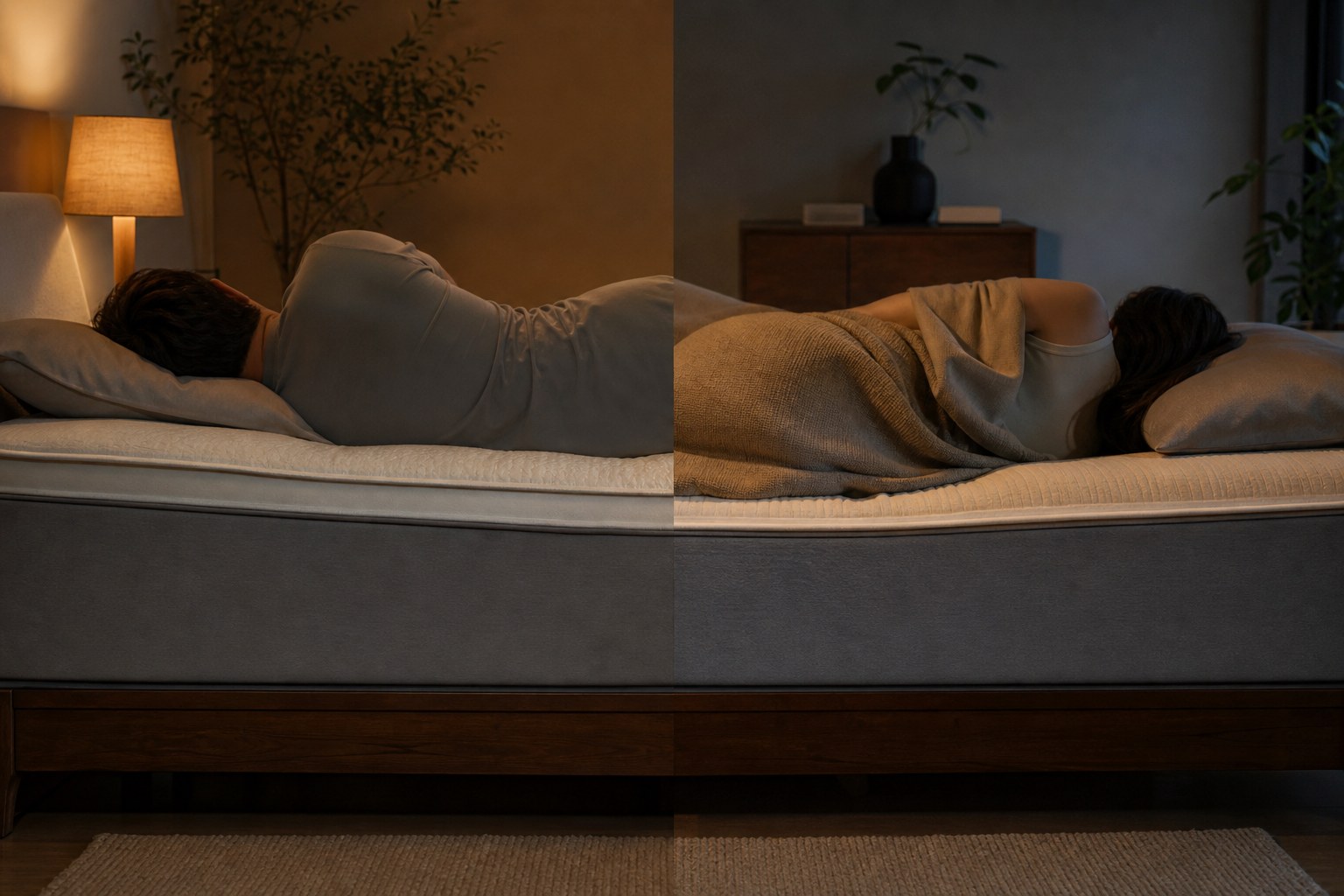
Half past three in the morning. The far side of the mattress dips, a small wave crosses the surface, and you are awake — not because the bed fails you, but because someone else moved. Couples comparing motion isolation and separate firmness usually arrive at that moment with one tangled question, and the straight answer is that there is no universal ranking between the two. They are not two levels of the same performance; they solve two different problems, and priority belongs to whichever one is actually costing you sleep. Within DeRUCCI's range, the traditional and smart lines each answer one of them, and one flagship architecture answers both.
The method takes two steps: name the problem, then match the mechanism.
First, Diagnose: Is Your Problem Interference or Preference?
Motion isolation and separate firmness solve two different problems, so neither outranks the other. Public research suggests about 25% of couples consider sleeping apart at least one night a week — unresolved versions of both problems end up there. Step one is classification: interference or preference. Step two matches the mechanism.
Interference problems are about transmission. Your partner turns over, climbs out for water, shifts into a new position — and the movement arrives on your side as a dip or a bounce. Whether that wakes you depends mostly on which stage of sleep you are in when it lands; light sleep takes the hit. Nothing about the bed's softness is necessarily wrong; the transmission is.
Preference problems are quieter and slower. One partner sleeps on the side and wants the shoulder to sink; the other sleeps on the back and wants the pelvis held. After years of trading concessions, "we compromised on a middle setting" often means neither of you is actually comfortable — you just stopped arguing about it.
That is why the diagnosis comes before any purchase decision: spending on the wrong mechanism fixes half the night and leaves the other half untouched — and the half it leaves is usually the one that wakes you.
The Interference Problem: How Movement Reaches Your Side, and What Isolation Does
A movement crosses the mattress through its structure: connected surfaces transmit it quickly, independently zoned structures slowly — the difference between a wave and a shudder. Two DeRUCCI lines carry this capability: the Century Dream 3D mattress with reliable isolation, and the T11 PRO's Dual-Drive architecture. Both are architecture statements, not rankings.
Every mattress decides how far and how fast incoming energy travels. A single connected surface passes movement along like a drumhead — one strike, the whole membrane responds. A structure divided into independent zones gives the movement nowhere to travel, because each zone responds to the load directly above it and hands off little to its neighbors. For the person lying on the other side, this is the whole difference between being rocked and being still.
Within DeRUCCI's range, two product lines address interference with different construction logic. The Century Dream 3D (MOC1-012), from the classic line, lists reliable motion isolation among its core attributes — a traditional latex mattress built to keep one sleeper's shifts from arriving on the far side. In the smart line, the T11 PRO approaches the same problem through its Dual-Drive architecture: 18 flexible adjustment units, nine per side, governed by two separate control boxes, with left and right sides adjusting independently and simultaneously. The zoned structure doubles as an interference answer — one side's adjustments and movements stay on that side.
For a deeper look at how two sleepers share one surface, see Best Smart Mattress for Couples: Motion Isolation.
What isolation does not do is settle a softness argument. If your nights are quiet but your mornings involve two people with opposite complaints about the same bed, the interference box is already checked, and what remains is the other problem.
The Preference Problem: Why Two People Need Different Firmness, and What Separation Does
Firmness needs diverge because bodies diverge: weight, sleeping position, shoulder width and hip width all change how the same setting feels, so one shared number suits nobody precisely. Left–right independent adjustment answers this — each side tuned to its own body. Its own boundary is just as clear: separate firmness does not by itself stop motion from crossing the mattress.
The source of the disagreement is physical, not temperamental. Two partners rarely match in weight, build or dominant sleeping position, and a mattress surface that keeps a heavier side sleeper comfortable will feel different — sometimes radically different — to a lighter back sleeper on the same night. The old folk advice that back pain demands an extra-hard board is itself a recognized misconception; per the 2026 spine-friendly bedding standard's expert guidance, an overly firm surface concentrates pressure at the hip and back rather than helping lumbar muscles relax. A "meet in the middle" mattress asks both bodies to accept a setting designed for neither.
The engineering answer to genuine preference is left–right separation. On the T11 PRO's Dual-Drive setup, each side adjusts its own nine units and six zones to its own target — a side sleeper's shoulder-release map and a back sleeper's pelvic support map coexisting on one frame. Below the flagship, the T11 series adjusts one side first, then the other, which is worth knowing if your bedtimes collide. For a fuller treatment of how weight differences and independent zoning interact across a shared bed, see Adjustable Mattress for Couples.
One boundary belongs on the record. Adjusting firmness separately does not, by itself, stop transmission — in fact, the act of adjusting one side is its own small disturbance, which is exactly why the dual-control architecture runs the two sides through separate control boxes. If the originating problem is the wave that wakes you at 3 a.m., the answer lives in the structure, not the setting.
For Most Couples the Honest Answer Is Both: One Architecture, Two Problems
Most couples have both: a few wakings per night plus two aches in the morning, and that points to architecture rather than a one-mechanism purchase. The T11 PRO's Dual-Drive answers both at once. CAICT testing recorded 27.5% less nighttime turning for the T11 SE tier.
Run the two-step diagnosis candidly and the typical result is "a bit of both." She is woken by his turns; he wakes with a sore lower back because the compromise setting runs softer than his body wants. When the diagnosis lands there, the real decision is not which mechanism wins but which architecture covers both problems without asking you to choose.
DeRUCCI's flagship answers that with Dual-Drive, both sides adjusting at the same time through separate controls. The independence addresses preference — each partner's units chase that partner's own target, no queue, no waiting. The dual control addresses interference — one side's adjustment and movement stay on that side of the bed. One number from the certification record is worth adding here: for the T11 SE tier, CAICT-certified testing recorded a 27.5% reduction in nighttime turning — a third-party certification figure rather than a clinical study result, and attached to that tier rather than to the flagship.
If interference is your only problem and adaptive adjustment holds no appeal, the classic line covers it: the Century Dream 3D's reliable motion isolation is the whole answer you need, and skipping the smart line is a reasonable saving, not a compromise. Durability deserves one closing note in a two-sleeper context: a shared mattress carries two bodies instead of one, and if the support structure fatigues after a year of doubled load, the firmness you chose in the showroom is no longer the firmness you sleep on. The adjustment airbags — high-elasticity rubber with double-layer TPU composite fabric — were tested at a CNAS-accredited laboratory through 10,000 folding cycles under a 280 kg load.
With the diagnosis done, the next steps are concrete: compare Dual-Drive specifications on the T11 product page, or do the two-person in-store test the brand recommends — one partner resting while the other triggers an adjustment, so you can feel both the isolation and the independence in a single minute. Availability varies by market, so confirm what your region sells; you can find a store and check global showroom addresses.