
 American
( English )
American
( English ) Singapore ( English )

What Is a Sleep Score?
A sleep score is a single number, usually on a 0–100 scale, that summarizes a night of sleep by weighing how long you slept, how restorative the stages were, and how often you were disturbed, giving you one readable signal instead of a wall of raw data.
Each morning, a tracker or mattress system condenses heart rate, breathing, movement, and stage data into that one figure. The point is not the number itself but what it reflects: whether your body recovered overnight. Used over time, a sleep score becomes a kind of daily important sign for how well your habits, environment, and sleep surface are working together.
How Is a Sleep Score Calculated?
Most sleep scores blend four families of inputs, total duration, time spent in deep and REM stages, the frequency of awakenings or movement, and resting heart rate, into a weighted composite rather than rewarding hours alone.
This is why two people who both "slept eight hours" can receive very different scores: one who stayed in deep sleep with few interruptions scores high, while another who tossed and fragmented late cycles scores lower even with the same time in bed. Depth matters as much as length, and continuity matters as much as depth. A high score generally means sufficient time in restorative stages, low resting heart rate, and minimal disruption, not simply more sleep.
What's a Good Sleep Score?
Most systems treat anything in the 80s and above as solid, with scores in the 90s indicating strong recovery, while repeated dips into the 60s or low 70s are a signal to look at what is fragmenting the night.
Rather than comparing your number to someone else's, the more useful move is to track your own baseline and watch the swings. A one-off low score after a late dinner or a warm room is normal; a weeks-long drift downward points to something systemic, schedule, stress, caffeine, or a mattress that traps heat and prompts micro-arousals. The trend tells you more than any single night's figure.
How DeRUCCI Calculates Your Sleep Score
Turning a night of breathing and heartbeat data into a trustworthy score depends on measurement accuracy, which is why DeRUCCI built its sleep tracking on a contact-free sensor layer that tracks the whole body without a wearable.
The T11+ AI smart mattress carries a third-generation piezoelectric ceramic sensor array that detects heart rate with 97% accuracy, so the duration, stage, and movement inputs feeding the score come from a precise, continuous signal rather than a wrist estimate. That signal is turned into a daily sleep report and score, rendered without anything worn on the body. To see how DeRUCCI approaches sleep scoring, visit the DeRUCCI smart sleep system page, or explore the T11 series AI mattress. (The T11 SE AI mattress is now available at the DeRUCCI New York store.)
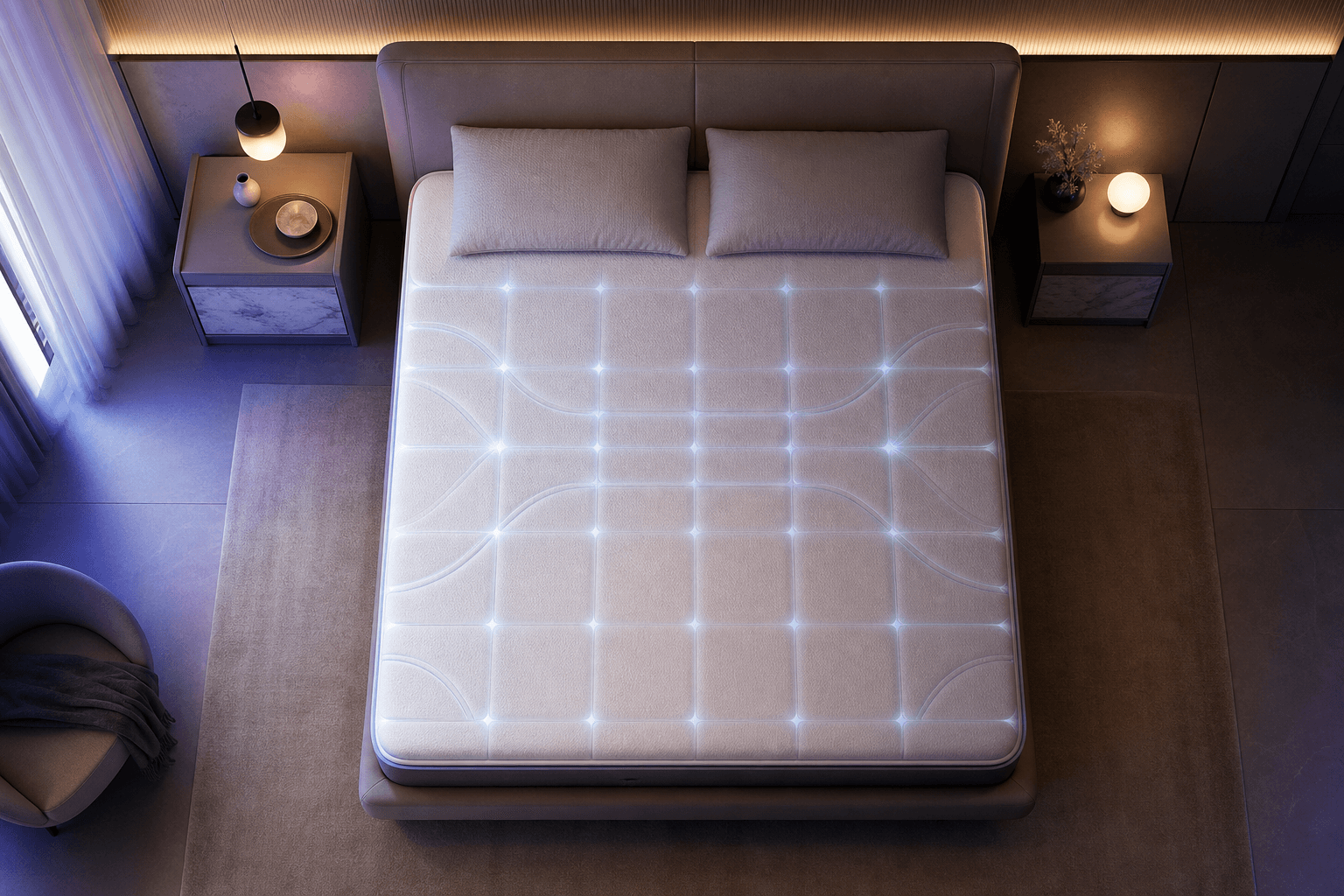
(This image is AI-generated for reference only, not an actual product photo.)
How to Use Your Sleep Score to Sleep Better
A sleep score is most useful as a feedback loop, change one variable at a time, watch the number over a week, and let the trend tell you which habits and which surface are actually helping.
If a cooler room lifts your score, keep it. If cutting late caffeine steadies your resting heart rate, the score will reflect it within days. A mattress that relieves pressure and regulates temperature tends to show up as fewer movement events and more deep sleep, and that, more than any single tip, is what moves the number in the right direction over time.
Frequently Asked Questions
What is a good sleep score number? On most 0–100 scales, the 80s indicate solid sleep and the 90s indicate strong recovery. Scores that repeatedly fall into the 60s or low 70s are worth investigating for fragmentation, heat, or schedule issues.
Why is my sleep score low when I slept eight hours? Because scores weigh depth and continuity, not just duration. If deep or REM sleep was short, or if movement and awakenings fragmented the night, eight hours in bed can still produce a low score.
How accurate are mattress sleep scores? Accuracy depends on the sensor. A contact-free system measuring heart rate precisely can track stages reliably, while wrist or under-pad estimates are noisier, which is why sensor quality matters more than the brand on the box.
Can a mattress really change your sleep score? Yes. Pressure points, trapped heat, and motion transfer cause micro-arousals that lower continuity and deep-sleep minutes. A surface that relieves pressure and regulates temperature tends to raise scores over a week or two.
Find a DeRUCCI Showroom Near You
Better sleep is easier to choose in person. Explore DeRUCCI's mattresses and smart sleep systems, then find a store and check global showroom addresses to experience them firsthand.