
 American
( English )
American
( English ) Singapore ( English )
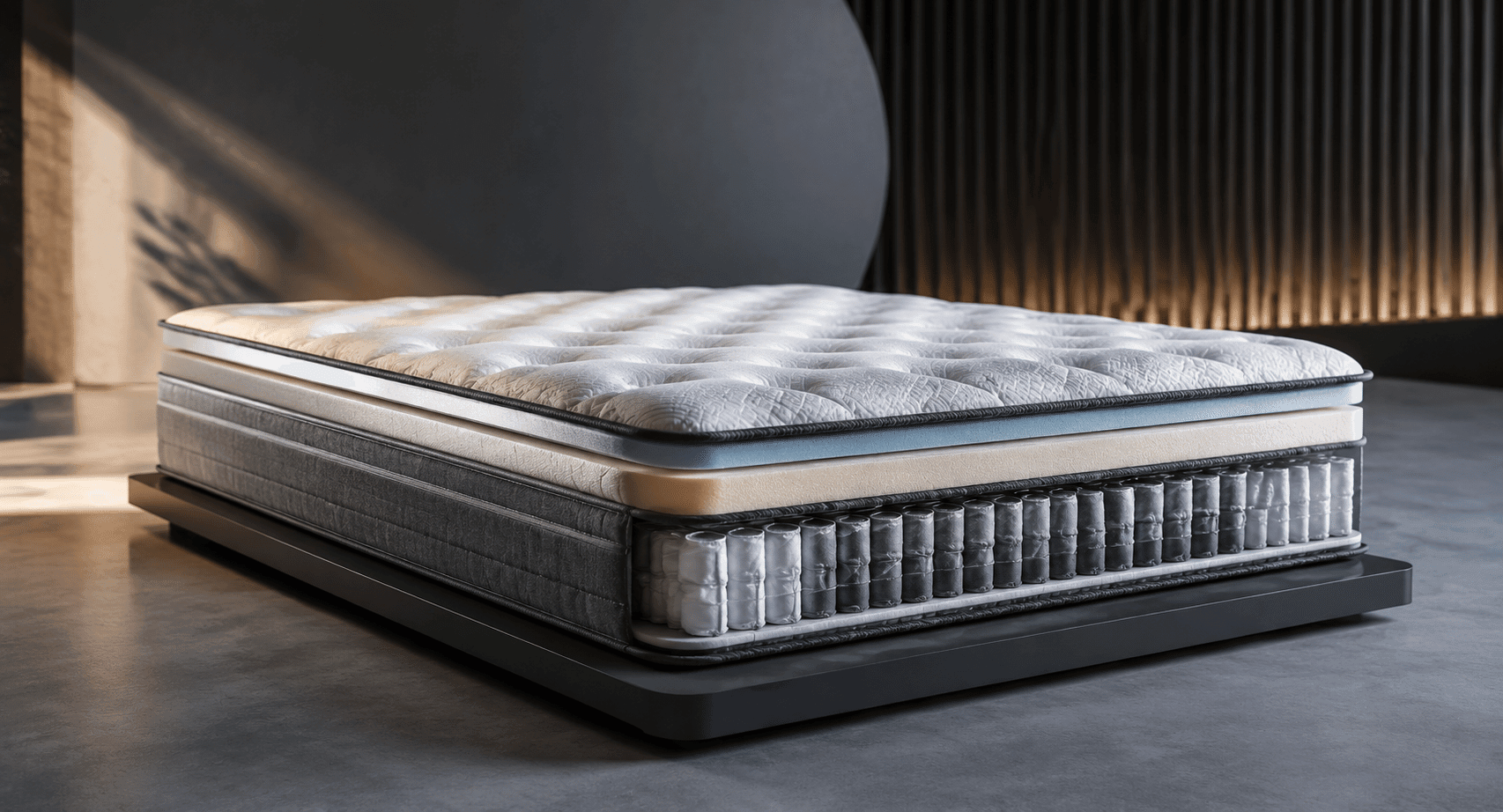
A mattress that felt perfect in year one can betray you by year three. A valley in the middle where your hips settle. Nights that grow warmer than the season warrants. A partner whose every turn arrives through the foam. These are the failure modes that push people from memory foam toward hybrid, and they trace back to a single question of build: one material doing everything, or several materials each doing one thing well. This guide compares memory foam and hybrid mattresses across four dimensions (build, support and heat, motion isolation, and lifespan), so the choice rests on engineering rather than a showroom palm-press.
How They're Built: Memory Foam vs Hybrid
Memory foam is a single viscoelastic block that envelopes the body, while a hybrid is a coil core topped by a comfort layer and a surface fabric, three layers each engineered for a different job. That structural difference, one material doing everything versus several materials each doing one thing well, drives every difference in feel that follows.
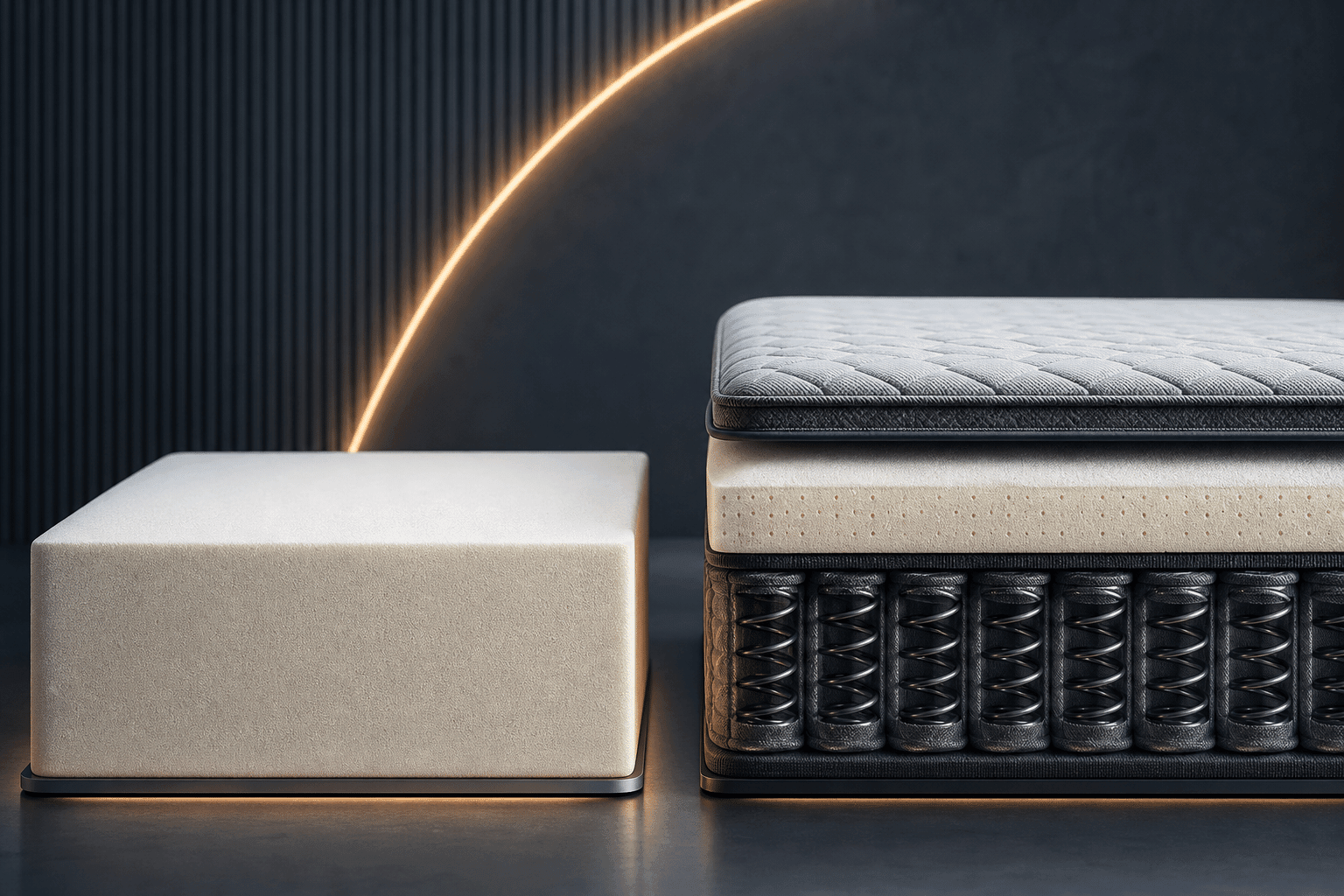
(This image is AI-generated for reference only, not an actual product photo.)
At base, a memory foam mattress is one block of temperature-sensitive polyurethane foam that slowly molds around pressure. Nothing inside is layered or zoned; the material itself does both the supporting and the contouring. A hybrid is built differently. A core of steel coils, often pocketed so each spring moves alone, carries the load. A comfort layer of latex or foam on top shapes the surface feel. A quilted surface fabric manages breathability and touch. The hybrid's premise is separation of concerns: let springs do support, let foam do contouring, let fabric do cooling. Memory foam's premise is integration: one material doing everything, at the cost of airflow.
Support, Contouring & Heat
Memory foam contours closely to the body but traps warmth, while hybrids pair coil airflow with a breathable comfort layer to sleep cooler while still cradling pressure points. The trade-off is contour depth, since memory foam still wins on pure pressure relief for people who sink in deeply, while hybrids trade a bit of that molding for cooler, more responsive support.
Memory foam reacts to body heat, softening where you press hardest and slowly molding around curves. That close contour relieves pressure at the shoulders and hips, but the same foam that envelops you also insulates, holding heat against the body through the night. The result is the 'sleeps hot' complaint that follows memory foam more than any other. A hybrid handles heat differently: the coil core is mostly air, so air moves through the mattress rather than pooling under you, and the comfort layer, especially when it is latex rather than dense foam, pushes back instead of absorbing, sleeping noticeably cooler. As what is a hybrid mattress over at Consumer Reports notes, the coil-and-comfort-layer construction is precisely what separates a hybrid's thermal behavior from an all-foam bed. The trade-off is contour depth: memory foam still wins on pure pressure relief for people who sink in deeply, while hybrids trade a bit of that molding for cooler, more responsive support.
Motion Isolation for Couples
Memory foam isolates motion by absorbing it across the whole surface, while hybrids rely on pocketed coils that move independently so a partner's turn ripples less than through a linked spring system. The compromise is that very sharp motion, a leap onto the bed, can bounce through coils more than through foam, so hybrid isolation is better for turning than for full-body impact.
On an all-foam bed, motion dissipates by traveling through the foam itself; the material dampens the wave, which is why memory foam earned its reputation for stillness. The same property, though, is what gives foam its stuck feeling: you press in and the foam holds the impression, making it harder to turn over. A hybrid's pocketed coils work on a different principle. Each spring is wrapped in its own fabric sleeve, so compressing one coil does not load its neighbor. Press one piano key and the adjacent keys do not move. The hybrid isolates motion without the stuck-in-sand feeling, which is why couples with different schedules often prefer it. The compromise is that very sharp motion, a leap onto the bed, can bounce through coils more than through foam, so the isolation is better for turning than for full-body impact.
What a Real Hybrid Looks Like: Inside Century Dream's 3-Layer Build
A real hybrid is not 'foam over springs' but a coordinated stack where each layer is sourced and tested for a specific job. DeRUCCI's Century Dream 3D Latex Mattress (MOC1-012) is built as German AGRO® springs for support, SANITIZED® foam for the comfort layer, VIRASE® antiviral fabric at the surface, and Dutch Vita Talalay latex carrying the cooling argument that memory foam cannot win.
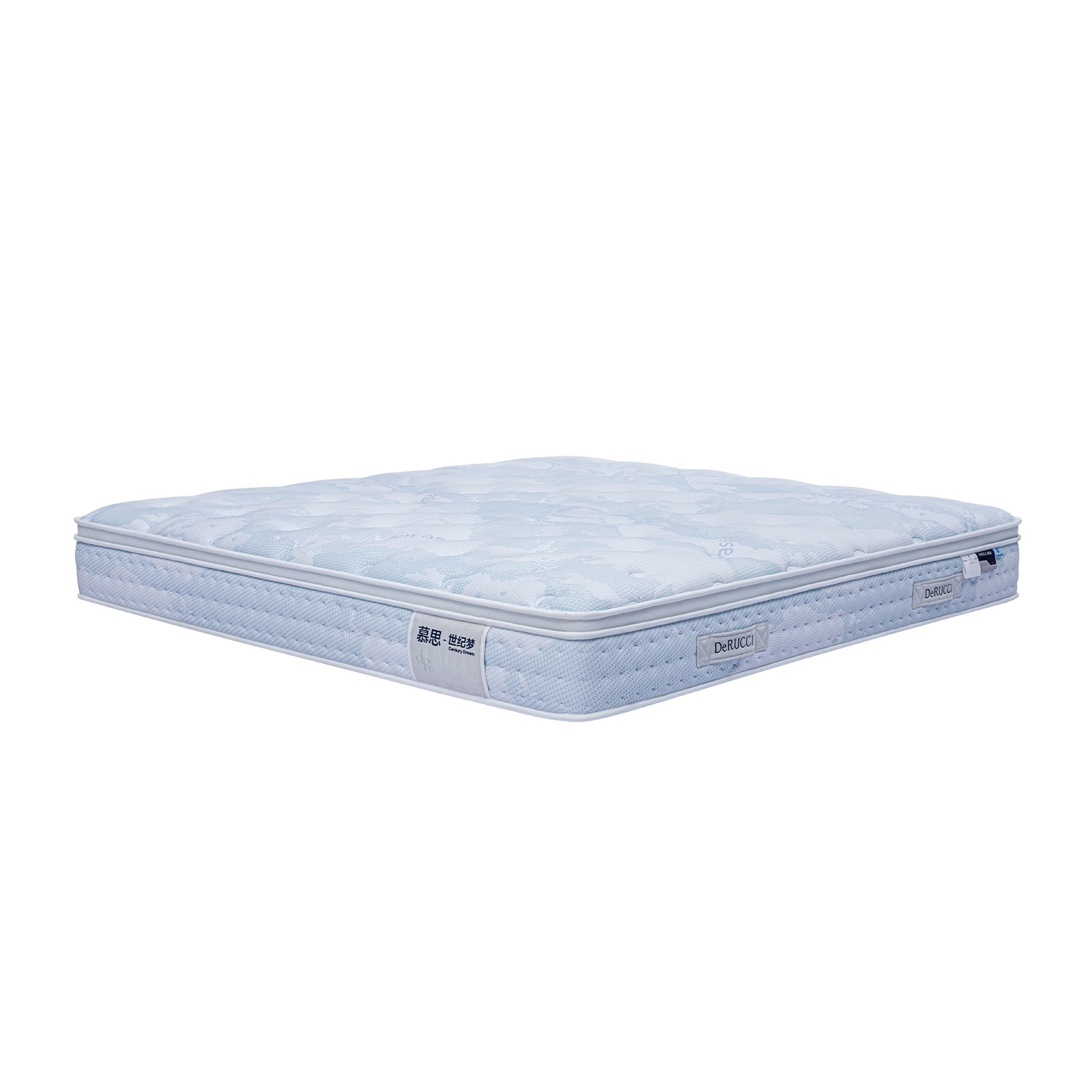
Once the comparison clarifies what each layer should do, the question becomes whether a given hybrid actually engineers those layers or merely stacks them. The Century Dream pairs a German AGRO® spring core, built to roughly 300,000 compression cycles with A.TiCu-S titanium-copper alloy, with a SANITIZED® foam comfort layer and a VIRASE® treated surface fabric that meets ISO 18184:2014 for antiviral performance. Layered into this build, Dutch Vita Talalay latex is physically foamed rather than chemically molded, which is the same open-cell rebound that lets it sleep cooler than the dense memory foam it is being compared against. To see how these materials are arranged across the range, the DeRUCCI mattress materials guide lays out each layer, and the Century Dream mattress collection shows how the same three-layer logic scales across models in the range.
Lifespan & Which One to Pick
Memory foam tends to hold body impressions sooner, while hybrids, built on steel, usually outlast foam on the support dimension. Pick memory foam for contouring and motion absorption at lower cost, and a hybrid when heat, partner motion, or longevity matter more, since a coil core retains its response far longer than foam holds its shape.
Memory foam's weakness is time. The same viscoelastic property that molds to your body also slowly takes a permanent set, leaving a body impression where you sleep. High-density foams resist this longer, but the material is ultimately a polymer that ages under sustained load. A hybrid's coil core is steel, which retains its response far longer than foam holds its shape, so the support layer of a hybrid typically outlives the comfort layer above it. When the comfort layer fades, a hybrid can sometimes be topped or rotated, while a failed foam core usually means replacement. The practical summary: choose memory foam when budget and pressure relief are the priority and heat is not; choose a hybrid when you sleep hot, share the bed, or want the mattress to still feel structurally sound in year eight. To compare memory foam and hybrid builds in person, find a global store and test both side by side.