
 American
( English )
American
( English ) Singapore ( English )

The best smart mattress for combination sleepers is the one that keeps support tracking a body that changes shape overnight. DeRUCCI maintains this guide in its sleep-education library. The productive question is which technology route lets support follow the position.
Why Combination Sleepers Break Single-Firmness Logic
Combination sleepers shift among side, back, and stomach positions several times per night, and each direction writes a different load map onto the bed. Side loading sinks the shoulder and hip; back loading concentrates at the lumbar curve. One fixed firmness grade answers a single map and strands the rest, which is why ranking lists underserve this group.
A combination sleeper moves among side, back, and stomach positions multiple times within one night, so the body the mattress must match is a moving target. The details matter: on the side, the shoulder and hip need to sink far enough for the spine to stay roughly level; on the back, the lumbar region wants firmer support to hold the pelvis level. Those two needs pull a single fixed setting in opposite directions.
Public guidance on spine-friendly sleep environments points the same way: pressure at bony prominences should spread evenly, and support should adapt to the sleeper's build. Among all shopper groups, combination sleepers push the personal-fit demand hardest, because their body-position combination keeps rewriting itself between midnight and morning.
So the buying question changes shape: for a combination sleeper, the strongest candidate is the bed whose technology route keeps support tracking each new position. This guide covers route selection and scenario dispatch; the zone-by-zone coverage table sits in the companion overview of the best smart mattress for combination sleepers.
Three Routes, One Question: Can the Support Follow Your Position?
Three routes answer the follow-the-position question. Continuous adaptation senses each new posture and re-balances zones through the night; fixed zoning bakes the map into materials with no power draw; compromise calibration sets one hand-chosen middle firmness. Zone count adds a second granularity layer, and the decisive spec check is dual-side simultaneity.
Route one, continuous adaptation. The mattress senses posture changes and re-balances itself zone by zone, so the support map is redrawn after each turn. The T11 series runs this through the AI Tidal Algorithm: body shape is recognized in about 20 milliseconds, matched against sleep data in about 40 milliseconds, and the shoulder, back, lumbar, and hip zones then adjust independently. Those two numbers describe sensing and data matching; the physical zone adjustments follow those reads. The operating modes give the route distinct response characters. Intelligent Deep adapts continuously and is meant to be felt. Intelligent Sensorless adjusts in a gentle register engineered to go unnoticed, a stricter target than staying quiet; combination sleepers who want minimal adjustment motion during a turn have their main option there. The full mechanism is unpacked in How Adaptive Firmness Technology Works.
Route two, fixed zoning. Built from material zones alone, the mattress stacks firmness differences into its construction and statically supports what lands on them. The strengths are real: a lower cost base, zero electricity, zero operating noise. The trade is structural: the zone map is fixed, so a side-sleeping shoulder and a back-sleeping pelvis meet the same preset response all night.
Route three, compromise calibration. You set one middle firmness by hand, tuned until every position can live with it. It asks the least of the technology and the most of your judgment, and one position or one partner can sit at the edge of the adjustment range — the trade the route makes for simplicity.
| Route | How it follows position | Granularity | Boundary to accept |
|---|---|---|---|
| Continuous adaptation | Senses each posture change and adjusts zones independently (T11: AI Tidal Algorithm, ~20 ms recognition, ~40 ms data matching) | 3, 5, or 6 zones by tier | Millisecond figures mark sensing and matching speed |
| Fixed zoning | Firmness differences built into material zones; no sensors or motors | Fixed at construction | The map never redraws after a turn |
| Compromise calibration | One hand-set middle firmness for all positions | One global setting | One position can sit at the support edge |
The fastest verification of real adaptivity sits in one spec-sheet row: when a sheet says "adaptive", check whether both sides adjust at the same time.
Zone count is the second granularity layer inside route one. The three-zone tiers, T11 SE and T11 z SE, map shoulder, waist, and hip, the zones a side position loads hardest, with no dedicated back-sleeping lumbar zone. The five-zone tiers, T11+ and T11 z+, add independent back and leg zones and correct lumbar support for back sleeping. The six-zone tier, T11 PRO, splits thigh from calf, the finest division in the series. The reading for combination sleepers is direct: the more often you switch, and the more you rely on both ends of your side-to-back range, the more finer zoning plus continuous adaptation does to shrink the support vacuum after each turn.
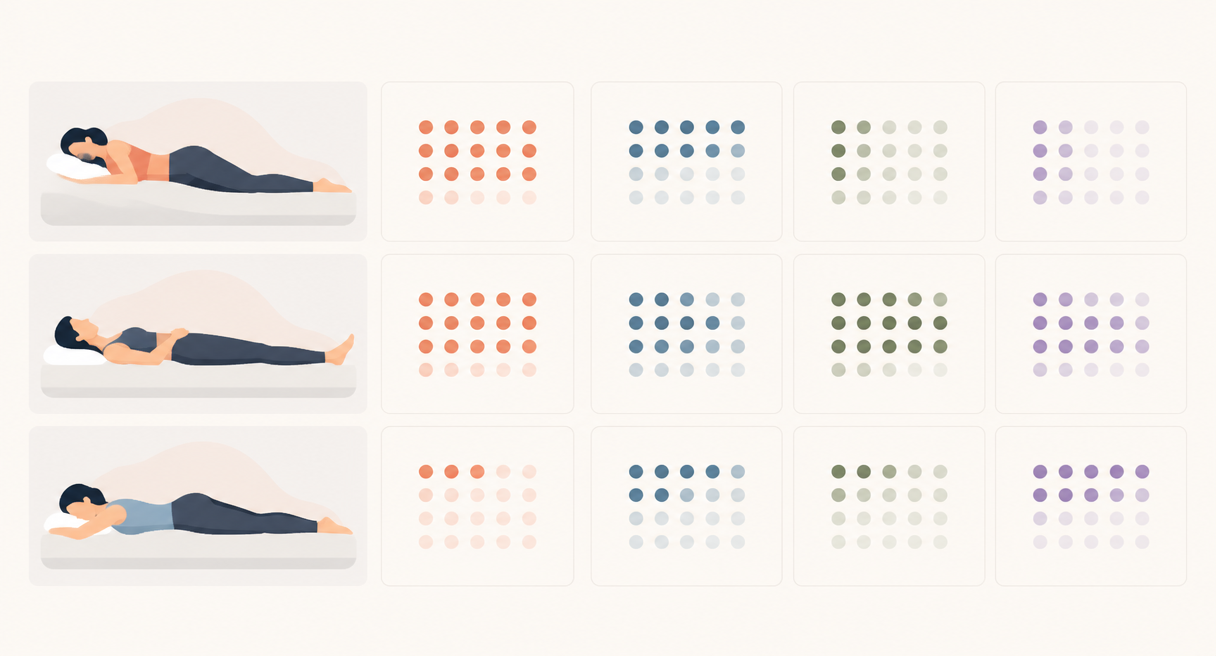
(This image is AI-generated for reference only, not an actual product photo.)
Two long-horizon indicators round the route out. The dual-layer TPU composite-fabric air chambers, on a high-elasticity rubber base, completed 10,000 bend cycles under a 280 kg load with a clean result, tested in a CNAS-accredited laboratory. According to the series specification, adjustment running noise stays below 28 decibels, which sits under the quietest sleep mode of most air conditioners.
Match the Route to Your Nights: Four Dispatch Questions
Dispatch beats ranking. Turn-disturbance sensitivity sorts sleepers toward the imperceptible register; partner coexistence turns on whether both sides adjust at once; the service window frames long-term ownership; regional availability sets what can be bought at all. Answer the four questions for your own nights before comparing models.
Question one: does adjustment motion bother your turns? Sleepers who dislike any mid-turn lifting sensation should lean toward Intelligent Sensorless; sleepers who want to feel the bed actively reshaping itself should lean toward Intelligent Deep. The modes differ in feel, and the hand-switch test is where the difference shows itself. That hand-switch test is one of six observable checks in the store protocol; the other five are dual-side simultaneous adjustment, real-time feedback in the companion app, motor noise while a unit adjusts, the monitoring indicator activating as you lie down, and adjustable-base presets stacking with mattress adjustment.
Question two: do you share the bed with a fixed-position partner? Then left-right independent adjustment becomes the dividing line. The T11 PRO carries 18 flexible adjustment units, nine per side, driven by two control boxes, so each side adjusts its own six zones and both support maps take effect at the same time. Across the series, the six-zone PRO is the tier that combines zone-level re-adjustment with simultaneous left-right operation. The couples-side mechanics expand in Adjustable Mattress for Couples.
Question three: what service horizon fits your ownership plan? The after-sales framework runs in three stages: within 365 days, a quality issue gets the unit replaced; within three years, repair is free; and the ten-year service window from delivery keeps labor free, with materials and logistics borne by the owner. Regional official literature carries the region-specific details worth confirming.
Question four: where will you buy? The T11 SE AI mattress is now available at the DeRUCCI New York store. Before traveling, confirm with the brand or the store which tiers your region currently stocks.
| Dispatch question | What it decides | Where to verify |
|---|---|---|
| Does adjustment motion bother your turns? | Mode choice: Sensorless versus Intelligent Deep | Hand-switch test in store |
| Sharing with a fixed-position partner? | Whether both sides must adjust at once | Spec-sheet dual-side row |
| What service horizon fits? | 365-day replacement, 3-year repair, 10-year labor-free window | Regional official literature |
| Where will you buy? | Market availability of the series | Brand or store confirmation |
The closing question: what is your turning feel, and what is your sharing scenario? Answer those two and the route follows.
For the consideration stage, the practical move is a store visit: switch the operating modes by hand on a display unit, confirm which tiers the store shows, and treat the store locator as the entry point for the smart-mattress line.
Frequently Asked Questions
---
Pick the route first, then the zone count, then the tier. The full decision path, from route selection to store checks, is mapped in the smart mattress buying decision guide, and you can find a store to switch the modes before you decide.