
 American
( English )
American
( English ) Singapore ( English )
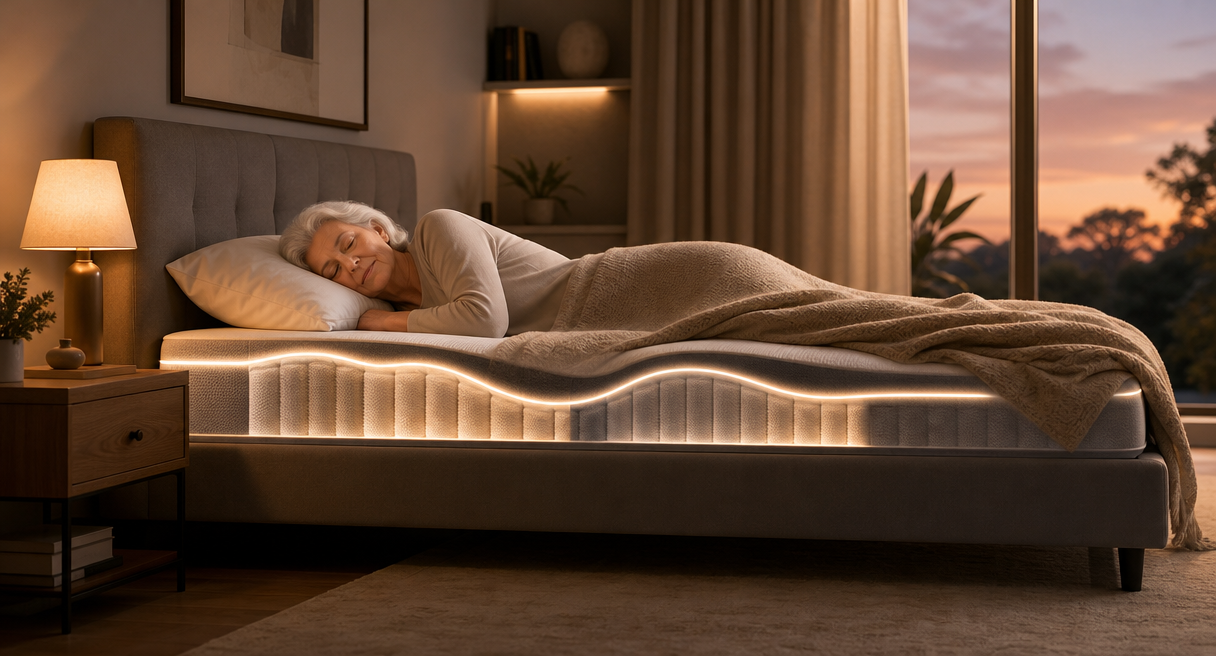
Buying the best smart mattress for seniors starts from a fact most checklists skip: the sleeper has changed, and keeps changing. Sleep grows lighter and shifts earlier; joints greet the morning stiffly; two partners rise at two different hours. This guide matches each of those changes to the mattress feature that actually answers it — before any brand enters the picture — then shows one worked example, names who should not buy one, and closes with a short list for adult children buying for a parent. DeRUCCI maintains this guide in its sleep-education library.
How Does Sleep Change With Age — and What Can a Mattress Touch?
Age changes sleep in four directions at once: it turns lighter, it starts earlier, mornings arrive stiff, and two partners drift apart in schedule. A mattress can answer the support side of every one of these — and this guide matches each change to the feature that answers it.
The changes are ordinary and well documented. In survey research across age groups in China, older adults reported the slowest path to sleep — roughly four in ten take longer than half an hour — and waking in the night unable to drift back emerged as the most common complaint of mid and later life. Sleep also moves earlier: drowsiness arrives sooner, and so does dawn waking. All of it reshapes what a bed is asked to do.
What a mattress genuinely touches is a shorter list: how pressure is distributed under changed shoulders and hips, how much a partner's turn travels across the bed, whether two schedules can share one surface, and how much sound and fuss the night involves. Every feature in this guide maps to one of those four lines.
The quiet physical fact underneath it all: support needs drift. Shoulders and hips sit differently on a surface as bodies age, muscle padding thins over bony points, and position changes multiply through the night. A mattress tuned once, in a showroom, at one age, is tuned for a body that no longer exists a few years later. That drift is the aging-specific problem this guide matches features against. How the underlying technology works, sensor to air chamber, is traced step by step in How Adaptive Firmness Technology Works.
Matching Features to Changes: A Checklist That Skips the Age Labels
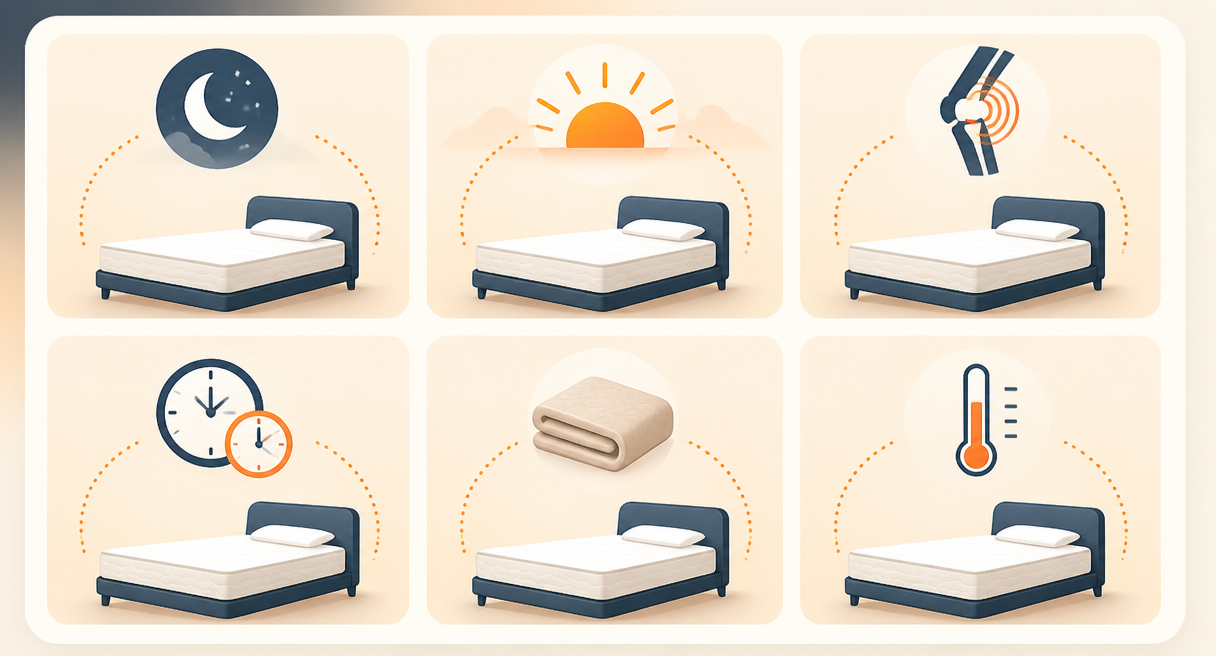
Read the change, not the birthday. Six recurring changes map to six concrete features, and every one can be verified in a store or a spec line: re-balancing pressure zones, undisturbed partner sides, quiet operation, no wearable routine, a fixed-feel exit, and readable after-sales terms. Marketing words like senior-friendly certify nothing — features do.
The word senior-friendly appears on countless listings and certifies nothing; no industry standard stands behind it. The verifiable approach is to start from what actually changed in the night and check the feature that answers it:
- Night waking and restlessness → pressure that re-balances itself at the shoulder and hip, so each new position settles quickly and fewer adjustments are needed to get comfortable again.
- Slow, light sleep → a surface whose firmness can shift slightly through the night, so comfort is not a one-time gamble fixed at purchase.
- Stiff mornings, sensitive joints → zoned support that spreads load away from bony points.
- Two schedules, one bed → left-right independence: one partner asleep at nine while the other reads until eleven, neither one's adjustments reaching across the divide.
- No appetite for gadgets → a bed that asks nothing of the sleeper at night: nothing worn, nothing charged, nothing pressed. Operation complexity is the top practical worry families raise about smart beds for older users, and the answer that works is a design that removes the operating altogether.
- Runs warm or cold differently than before → breathable materials and temperature zoning, checked as numbers, not a mood.
Three questions separate real capability from a label on any product in this class: does it act on its own through the night; does it stay quiet and unnoticeable while doing so; and can the sleeper exit to a plain fixed mattress experience. Fail any one, and a well-made traditional mattress serves an older sleeper better than a smart label does. For how posture and sleeping position shape support needs in the first place, what is the best sleeping position walks through each posture in detail.
(This image is AI-generated for reference only, not an actual product photo.)
What Adaptive Support Maps To as Bodies Age
One worked example: a mattress that re-reads the body through the night answers the aging problem directly, because support follows the body, never freezing at the showroom setting. The T11 series builds for it — adaptation across the full life cycle, older ages included — and the numbers that matter here are few, each with its plain meaning attached.
On the T11 series, the product story itself is built around life-cycle change: adaptation to the body as it changes with age, lifestyle and sleep habits — children through older adults, in the maker's own phrasing. The translation for a sixty-eight-year-old buyer is simple: the support is designed to keep following the body, year after year.
The night side of it runs without anyone operating anything. Nothing is worn and nothing is charged, because the sensing lives in the bed; an older sleeper keeps every bedtime habit exactly as it is, and the AI Tidal Algorithm reads posture and load through the night, re-tuning support zone by zone on its own. For lighter sleepers, the working sound stays below 28 decibels — quieter than a whisper at one meter, which is the level a light-sleeping housemate would never notice. The one outcome anchor carries its source with it: according to independent CAICT lab testing of the T11 SE tier, nighttime movements fell by 27.5 percent — almost 30% less tossing and turning. That is a sleep-structure measurement from the tested tier; match the model before borrowing the number.
Two more mappings finish the picture. For the two-schedules couple, the two sides of the bed adjust independently, so an early riser's settings never drag a partner's side with them. And for the no-gadgets preference, a fixed or do-not-disturb mode is a real exit: the bed can behave like the mattress the sleeper has always known, with the adaptive layer resting. After-sales reads as one page: from the delivery date, 365 days of replace-not-repair service, then a three-year full warranty, then years three through ten with parts and logistics charged and labor free. If the power cuts out overnight, the pre-outage feel typically holds for about a day, because core support does not depend on a live network connection. And where the morning question centers on the back, the matching guide is Best Smart Mattress for Back Pain Relief, which handles that decision in full.
Who Should Not Buy One, and the Family Buyer
Two no-sell cases come first: a person who wants zero devices in the bedroom deserves exactly that, and some sleepers will feel little difference however well support is set. For adult children buying for a parent, the sequence starts the same way: identify the change first, then the bed.
The first no-sell case is a preference. A sleeper who wants nothing electronic in the bedroom is making a legitimate choice, and a high-quality fixed mattress serves it completely; the fixed mode on an adjustable bed covers the middle ground for mixed households. The second is perception. A small share of people feel little difference even when support is set objectively well — bodies vary in what they register, and the test that settles it is lying down in a store, in the true sleeping posture, for more than a passing minute.
For adult children, the survey research carries a quiet warning: among measures families take for a parent's sleep, buying mattresses and pillows ranked below asking about sleep or reminding parents to rest — while parents themselves named bedding among the first environmental factors. The gap is real: the giver's instinct runs to company and reminders, the sleeper's need runs to the surface under them. So the family buyer's checklist is short — name the change first (night waking, stiff mornings, split schedules), then run the three questions, then test in a store in a real posture, then read the service ladder on one page before paying. The T11 SE AI mattress is now available at the DeRUCCI New York store. Availability beyond that is rolling out region by region — confirm which models are currently purchasable in your region before planning a store trip.
Frequently Asked Questions
---
Changes, features, one worked example, the cases to walk away — that is the whole decision. The wider path from first question to purchase is mapped in the smart mattress buying decision guide, and to feel the adaptation in person you can find a store.