
 American
( English )
 Singapore ( English )

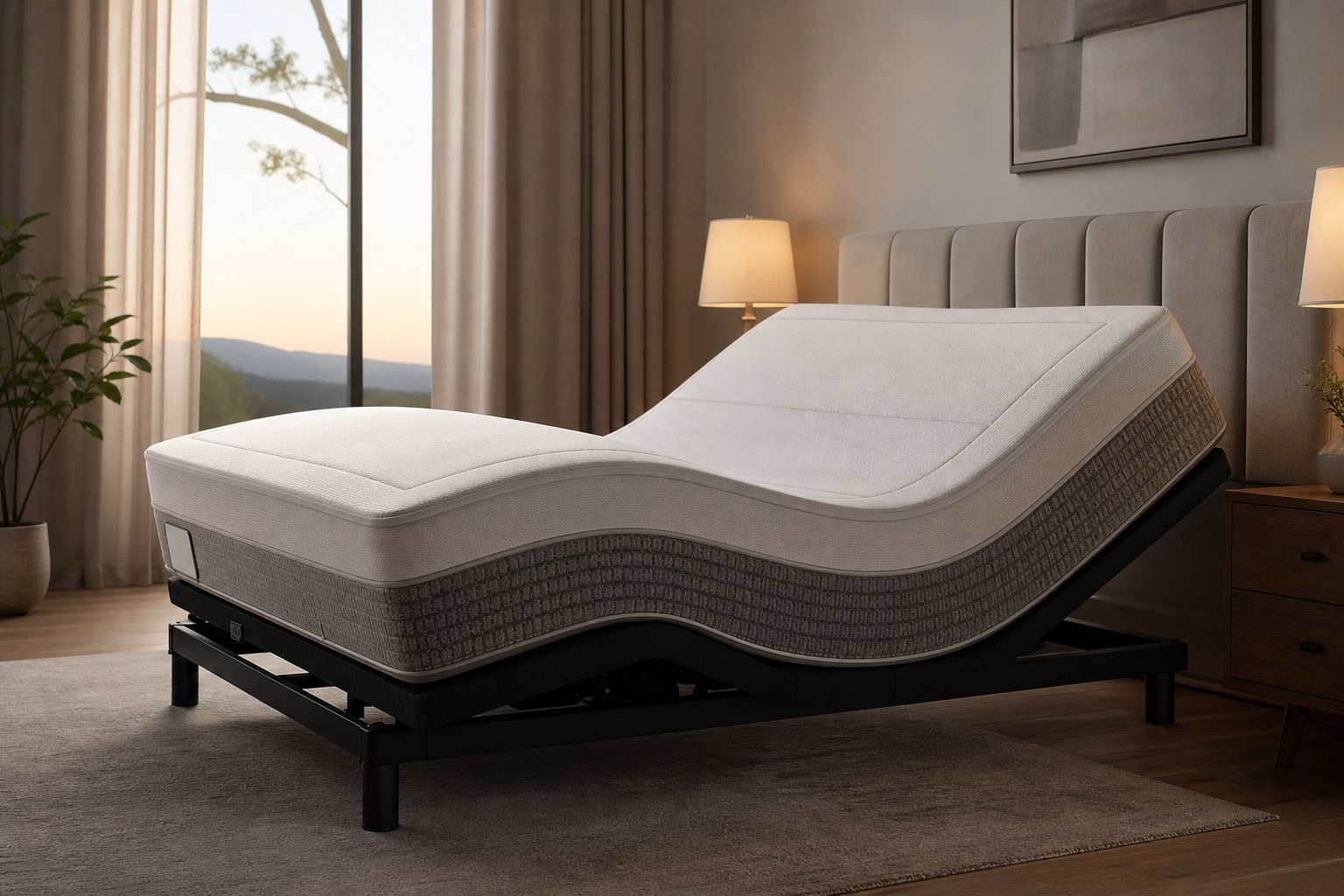
Standing in a showroom, the two products look like rivals: a mattress full of sensors on one platform, a hinged frame bowing its head and foot on another. They are not rivals. A smart mattress and an adjustable base change different things, and spending on the wrong layer is the expensive version of this mistake. The question worth asking is which comfort problem belongs to which layer. DeRUCCI makes both, which makes drawing the line cleanly easier, not harder.
Support Adjustment or Position Adjustment: What Does Each Layer Change?
The mattress layer changes support: how deeply the body settles and how support spreads across zones. The base layer changes position: the whole surface tilts around a hinge, head and feet through their recline ranges on DeRUCCI's Serene frames. One changes how far you sink in; the other changes the angle you are held at.
Start with the mechanism, because everything else follows from it. Inside a smart mattress such as the T11 series, air-pressure zones raise and lower the surface under different parts of the body. The body settles deeper or shallower, and the distribution of support shifts, but the body itself stays roughly where gravity put it.
An adjustable base does the opposite. The frame tilts the entire sleeping surface around its hinges. On the Serene series the head lifts through a 0–65° range and the foot through 0–45°. Nothing about the mattress's firmness changes; what changes is where your body sits in space, upright for reading, legs raised for elevation, flat for sleep.
The practical starting question follows from it. Ask yourself whether the discomfort comes from firmness that does not fit, or from lying flat itself. The first belongs to the mattress layer, the second to the base layer.
That covers the functional split. A separate question, whether an integrated smart mattress or a separate base is the better product form, is a form-factor debate with its own trade-offs, and it is covered separately.
Which Comfort Problems Belong to the Mattress Layer?
Three problems route to the mattress layer: firmness that fits badly in either direction, missing zone support for how you actually sleep, and two partners needing different firmness on one bed. What they share is a body-to-surface relationship gone wrong, which no tilting fixes. Zoning runs three, five or six zones per side, with 18 units on the T11 PRO.
Take the three in turn.
Firmness mismatch. A mattress too soft lets the body's heaviest sections win, the spine's curve flattens or bows, and muscles spend the night holding a line the surface gave up on. Too firm, and load concentrates at the bony points, shoulder, elbow, knee, ankle, with restless repositioning following. Spinal-friendly bedding guidance describes both failure modes, and neither is fixed by raising the head of the bed.
Missing zone support. Bodies are not uniform, and support mapped to their bands outperforms one overall feel. DeRUCCI's tiers run three zones covering shoulder, waist and hip, the bands that carry the most load in side sleeping; five adding back and leg zones; and six splitting thigh from calf. The same nominal firmness reads differently across postures, which is the whole point of mapping.
Two partners, one bed, different needs. The T11 PRO's 18 units, nine per side, adjust left and right simultaneously and independently under Dual-Drive, so a side sleeper's shoulder-and-hip map and a back sleeper's lumbar map coexist on one frame.
What the mattress layer does not solve: anything about body angle. Reading upright, elevating swollen legs, sleeping with the head raised, those are position questions, and firmness adjustment does not change your position. That set belongs one section down.
For how the sensing-to-zone loop actually works, see How Adaptive Firmness Technology Works.
Which Comfort Problems Belong to the Base Layer?
The base layer answers anything about body position: head and foot elevation for reading, watching or leg position, through the ranges listed above, plus preset modes including Zero-G and wake-up and massage on higher tiers. What a base cannot do is change the mattress feel: it never enters the mattress, so firmness and zoning stay.
The base layer's problem list, in Serene's own terms:
1. Position needs. Reading with the torso raised, watching with legs supported, elevating the legs after a long day. Head and foot through the ranges listed above.
2. Preset scenarios. On the Serene Plus and Premier, seven presets cover Zero-G, Theater, Reading and Snore Relief, alongside memory settings and one-touch flat.
3. Wake and massage. Gentle Wake-up in the app, and dual massage — back and leg zones — on both the Plus and the Premier.
One naming note, because precision matters here: Zero-G is a general preset posture in the adjustable-base industry, not any brand's exclusive. Serene simply includes it among its seven presets.
The tiers divide functionally, and the differences are worth keeping straight: the Serene Lite carries five presets, without the app and without massage; the Plus and Premier carry the full seven. Choosing between them is choosing which of the scenarios above you actually use.
The boundary runs the other way too, stated as plainly as this one. A base does not enter the mattress. If the problem is that the surface is too soft at the shoulder or unsupportive at the waist, tilting the platform changes neither; it just delivers the same surface at a new angle. Those problems belong to the mattress layer above.
Why the Two Layers Work Better Together
The two layers stack rather than compete. The T11 series is compatible with adjustable bases, combining internal adaptive adjustment overnight with external scenario positioning, with modes including Snore Relief, Theater, Wave Massage, Reading, Zero-G, Gentle Wake-up, One-touch Flat and memory. Budget permitting, both layers can run at once; on a constrained budget, route by your primary problem.
According to official product materials, the T11 pairs with an adjustable base to deliver what the brand describes as the only AI mattress that can be paired with an adjustable base, running a 7+N mode set: Snore Relief, Theater, Wave Massage, Reading, Zero-G, Gentle Wake-up, One-touch Flat, plus memory positions. That wording is the manufacturer's own.
Mechanically, each layer keeps doing its own job in the stack. The mattress layer continues adapting firmness zone by zone through the night, internal and active. The base layer positions the body for waking scenarios, external and on demand. Neither takes over the other's work, which is exactly why they pair well.
On budget: buying both layers is the ceiling, not the floor. If one layer must come first, the routing from the two previous sections decides it, no ranking attached. Someone whose nights are undone by firmness fit starts at the mattress layer; someone whose evenings need elevation and whose nights need a raised head starts at the base.
For what that combination looks like as a whole room — power, placement, what else pairs with it — see How to Build a Smart Bedroom. Specifications for the compatible models are on the T11 product page.
Frequently Asked Questions
With the routing decided, what remains is checking models and compatibility. You can check current models and find a store to see both layers in person and confirm what your region sells.