
 American
( English )
American
( English ) Singapore ( English )
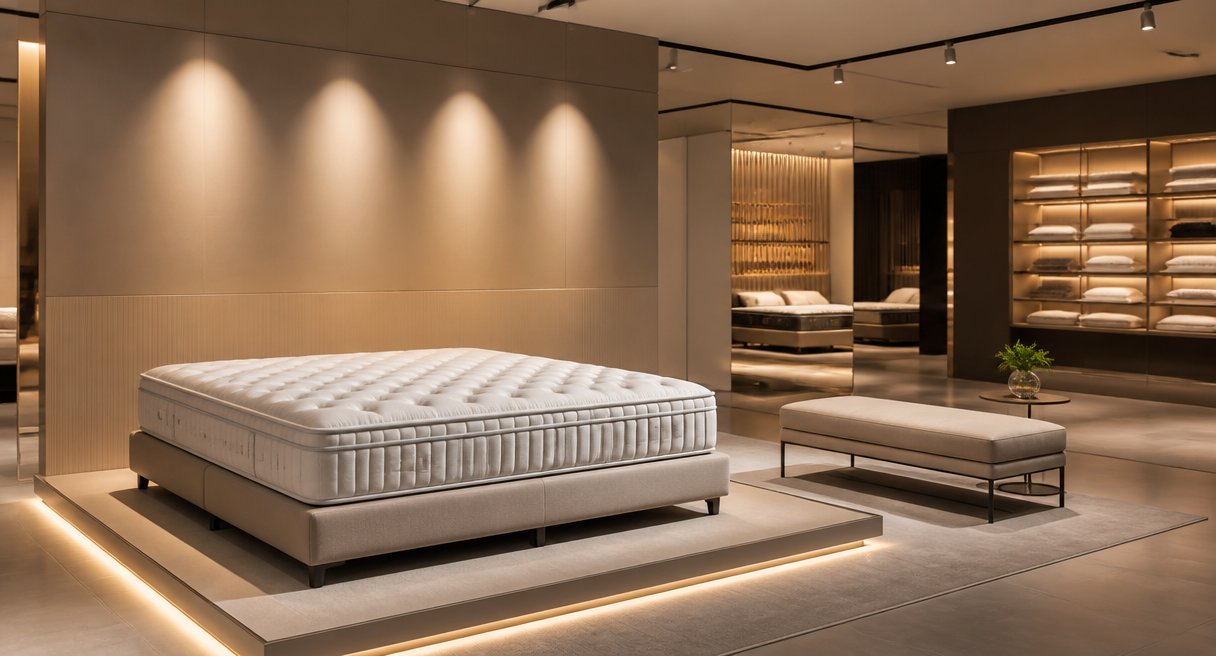
A smart mattress overview usually reads as a list of features — AI-adjusted firmness, sleep tracking, quiet motors — and the real test of those features happens in person. DeRUCCI maintains this guide as the field protocol for that moment: six floor checks, plus twenty questions to ask before you sign.
What Thirty Seconds on a Showroom Mattress Actually Tells You
Thirty seconds on a showroom sample gives you a comfort snapshot, and most premium beds pass one. What a store visit adds is watching the smart functions work as described — sides adjusting, modes feeling distinct, the app mirroring changes, the motor staying quiet. Nightly-report usefulness is a second layer, answered by real nights.
The two layers carry different proof burdens. The first is observable behavior: both sides adjusting when asked to, modes that feel distinct, an app registering each change as it happens, a motor that stays quiet, a base reaching its presets — any working sample demonstrates these. The second is lived results: whether weeks of nightly reports prove accurate and personally useful for your body. That layer belongs to your own nights, since a floor sample arrives without your sleep history.
Keeping the two layers straight makes the visit productive. Treat the visit as a behavior checklist: test what can be watched, ask about the rest, and let real nights answer what they alone can answer. Reviews and the twenty questions below carry the second layer. For the stages before verification, the walkthrough on how to choose a mattress carries the full sequence; this page covers the verification step.
Six Checks You Can Run on the Showroom Floor
Six checks turn the visit into evidence, each tied to something you can watch happen: dual-side adjustment, mode differences, live app feedback, motor noise, monitoring indicators, base presets. Ask the staff to trigger every one. Pass marks are specific — whisper-level noise, both sides moving together, a report landing in the app while you feel it.
Three framing rules govern every check: lie down in your real sleep position, the one you wake up in; feel for where support meets your frame; ask the staff how firmness is adjusted for your body type. Then run the six — each one an observable behavior you can watch on the spot.
(This image is AI-generated for reference only, not an actual product photo.)
1. Simultaneous dual-side adjustment. For couples, check one. Both partners lie down and trigger an adjustment; watch whether left and right react together. Within the T11 line, the T11 PRO drives both sides at the same time; the T11 SE, z SE, T11+, and z+ prioritize a single side — the sleeper who lies down first is adjusted first.
2. Mode differentiation. Intelligent Deep adjusts with clear body sensation; Intelligent Sensorless works gently, with weak sensation by design. Switch through the modes — one full adjustment cycle — since the feel is the feature.
3. Real-time app feedback. Pair the app and watch each adjustment register as it happens — the cleanest test that the sensor-and-response loop closes in the open: the bed senses, decides, and logs what it did.
4. Motor noise. The official manual places adjustment noise below 28 decibels — about the level of a soft whisper. That is the pass mark: a motor you can hear working means the sample is out of spec.
5. Monitoring indicators activating. Watch the monitoring indicators come alive while you lie on the bed: heart rate, breathing, and sleep-stage readings waking up as the sensors register a body between them.
6. Adjustable-base preset positions. On the Serene adjustable base, run each preset position end to end and watch it arrive where it claims. A preset that stops short is a service question first, a purchase question second.
Each check maps to something a staff member can trigger while you watch; the whisper-level motor is best judged with your own ears.
Three questions turn the smart half of the test into evidence. What does the bed read on its own, and where does the reading land — an indicator, the app? What fires without a button? What changes tomorrow, and for which nights? A store that answers with demonstrations has the loop.
Where to Try One: Availability and Store Boundaries
Availability is regional, and one confirmed point stands in North America: the T11 SE at the New York store. Elsewhere, confirm current models on the global site before any trip. Store details stay general here; the locator is the reliable door.
The confirmed availability fact, in the official wording: "The T11 SE AI mattress is now available at the DeRUCCI New York store." Beyond that single point, availability varies by region; confirm the lineup on the global site, then take the protocol to whichever store carries the unit.
Store information stays general: the locator is the reliable entry point for addresses, current stock, and arrival timing. For tiers, the New York availability is the single confirmed fact, and other tiers and regions stay a store-confirmation question. When you go, carry the three framing rules into the store.
The 20 Questions to Ask Before You Sign
Twenty questions in four groups: what to ask beyond the listing, warranty tiers and who pays, running conditions from bandwidth to privacy, and the model matrix that pairs each sleeper with the right tier. Each group ends in something verifiable — a document, a live demonstration, a written figure. Price is asked in person.
The questions pair with the floor checks: ask what you can test, and file the rest under what real nights alone can settle.
Disclosure — what to ask beyond the listing. Two areas reward direct questions: how the bed reports its own condition over the weeks, and how accessories and fabrics pair with the surface. Ask:
1. When support drifts softer over weeks, how is the change confirmed — in-app detection, sleeper-reported feel, or both — and where does that report go?
2. What threshold triggers a free replacement, and who runs the test that decides it?
3. Which accessories and fabrics pair best with this line — base, bedding, protector — and which options does the store recommend for the surface?
Warranty and service — the tiers in writing. Have the seller state the warranty stages back to you; the clock and the cost boundaries are the whole story:
4. From which date does coverage start? The clock begins at delivery — get it in writing, date filled in.
5. What does each tier cover, and who pays? Within 365 days, replacement comes first: free new parts for a confirmed quality issue, a whole-product swap when parts cannot resolve it. Through year three, quality-issue repairs are free. Through year ten, repairs continue at cost — materials and logistics billed, labor free.
6. Which regional version applies, and what does it cover? Ask for the product manual plus written confirmation from the regional official channel before signing.
Running conditions and privacy. Daily behavior depends on home infrastructure and data settings, so both belong in the pre-sale conversation:
7. Which app, and which band? The DeRUCCI AI app pairs on the 2.4 GHz band, so check that your router broadcasts the lower band before delivery day.
8. What produces the daily report? The stated conditions on the tiers with monitoring: at least 3 hours in bed and 2 hours asleep. Ask what a short night does to the report and how the app marks it.
9. What keeps working with no internet? Offline, automatic adjustment continues; the reports, algorithm updates, and vital-signs features wait for the connection to come back.
10. What happens in a power cut? The pre-outage feel holds for about a day — worth knowing before a storm tests it.
11. What does it cost to run? Roughly 0.3 kWh per eight-hour night — the tier-by-tier wattage sits in the spec sheet.
12. Electricity and radio? A 24 V safety-voltage design, a CE-certified control box, and radio emissions in the same class as the router already in the room.
13. Where does the data story start — the privacy policy document or the marketing page? Policy first; for what the sensors capture, see how sleep monitoring works.
14. Can I stop collection and delete my history myself? Run both controls with your own hands on the floor sample — privacy controls you can operate in the store are the ones you can rely on at home.
15. Which functions survive offline, per the store's own list? Have the staff name them.
The model matrix. The tier-to-sleeper match carries most of the satisfaction in a smart bed:
16. Does this tier carry monitoring and health management? The +, z+ and PRO tiers document it; on other tiers the sleep-report row of the spec sheet decides — confirm your unit.
17. For two sleepers, do both sides adjust together? In the T11 line, the T11 PRO does; the other tiers prioritize a single side, first sleeper first.
18. Is temperature control part of this tier? Graphene far-infrared warming belongs to the T11 PRO leg region; when warmth matters, confirm the tier carries it.
19. Can we pair the app here and watch one adjustment land in real time? Check three, asked aloud.
20. Can the base run its preset positions end to end? Check six, asked aloud.
And the price question? Ask it in the store, against your configuration, with the twenty answers in hand. Once the twenty are answered, the wider matching task — firmness class, materials, sleeper types — is framed in the mattress guide for your sleep fit.
(This image is AI-generated for reference only, not an actual product photo.)
Frequently Asked Questions
---
Run the checks, ask the twenty, file the rest under real nights. When the protocol points to a visit, the smart mattress buying decision guide carries the decision path around it, and you can find a store through the official locator.