
 American
( English )
American
( English ) Singapore ( English )
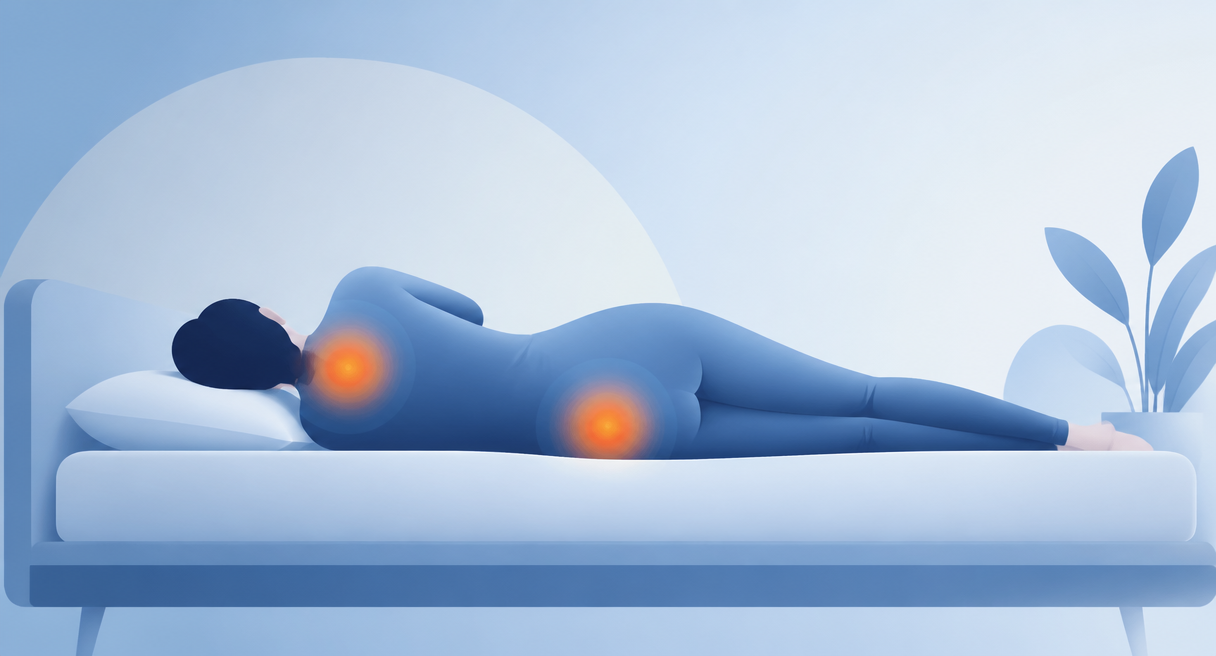
Side sleeping is the most common adult posture, and it changes the mattress question from a comfort preference into a measurable pressure-matching problem. Lying on your side shrinks the contact area between body and mattress and drops the load onto two bony points — the shoulder and the hip. That is the pass line for a smart mattress for side sleepers: both points sinking just far enough to keep the spine roughly level. This 2026 review is built on that test — DeRUCCI maintains it in its sleep-education library — and adds a body-type firmness scale, a zone-map check across adjustable tiers, and in-store checks you can run yourself.
Why Side Sleeping Changes the Mattress Question
Side sleeping shrinks the contact area between body and bed and loads the shoulder and hip with most of the weight. The evaluation question changes with that geometry: a suitable mattress lets both bony points sink far enough for a level spine, and a poor one fails in one of two opposite directions — too deep or too hard.
Surveys of sleep position put more than 60 percent of adults on their side for at least part of the night — the default case a mattress has to answer. The geometry is the hard part: the contact area is far smaller than when lying on your back, so the same body weight concentrates on two bony prominences. Spine-care guidance lists the shoulder, elbow, knee and ankle as the pressure points needing even dispersion; in side lying the shoulder carries the heaviest share.
A mattress fails this geometry in two opposite directions. Too soft: the pelvis sinks, the spine loses its natural curve, and the back muscles stay tense all night compensating. Too hard: the shoulder and hip take the load directly, localized pressure builds into the ache side sleepers know, and unconscious position changes break sleep continuity. Expert guidance lands in the middle — enough surface give to relieve the pressure points, enough support to hold the pelvis.
This guide covers evaluating side-sleep support, self-testing before purchase, and the in-store checks that settle the match; the first criterion is a pressure-matching check, a question of support geometry that outranks any soft-or-firm preference. For ranked picks by shopping scenario, Best Smart Mattress for Side Sleepers lists current models.
The Shoulder-Hip Self-Test: Match Your Body to the Firmness Scale
The self-test runs in three steps: read the wake-up signals, place your body type on a firmness scale, then check the zone map. Morning shoulder ache or hip soreness points to a mismatch in one direction or the other; body weight sets how much support the scale needs; the zone count decides how precisely each region can be tuned.
Step one reads the body's own feedback. Wake up with an aching shoulder or a sore hip, and the pattern identifies the mismatch: pain pressed onto the bone points to a surface too hard for you, while sinking with the lower back left unsupported points to one too soft. The two signals call for opposite adjustments — which is why blanket 'go softer' advice misses as often as it helps.
Step two places your body type on a category-level firmness scale. The heavier the body, the deeper it presses and the more understructure it needs to keep from bottoming out. Posture redraws the map: a side sleeper needs controlled sink depth at the shoulder and hip; a back sleeper needs firmer lumbar support to stop the pelvis dropping. Two different support maps — the structural reason a single fixed firmness leaves one partner compromised in a mixed household, and why this scale dispatches by body type with no universal winner. For which firmness tends to suit which sleeper, see best mattress firmness for side sleepers.
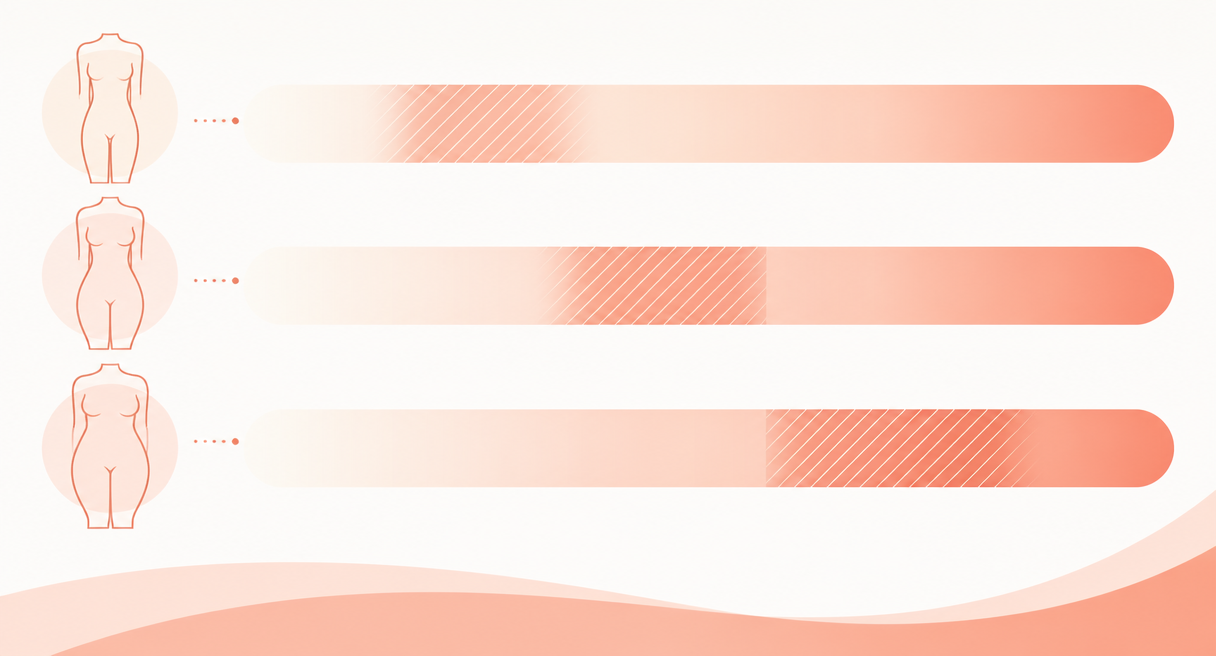
(This image is AI-generated for reference only, not an actual product photo.)
Step three turns the scale into hardware: the zone map. In the DeRUCCI T11 series the tiers step down like this:
| Tier | Zones | Side-sleep relevance | Adjustment units |
|---|---|---|---|
| T11 SE | 3: shoulder, waist, hip | The three heaviest zones in side lying | 10 |
| T11+ | 5: adds back, leg | A dedicated lumbar region for back sleepers | 14 |
| T11 PRO | 6: splits thigh, calf | The finest zone division in the series | 18 |
The mechanism matters more than the count: these are air-pressure zones that adjust firmness automatically, each region's chambers responding to the load placed there — a physical mechanism that pushes back under the heaviest points. The adjustment runs on its own: the bed reads shoulder load and hip load as you shift through the night, and each region answers in real time — the give under the heaviest points follows the sleeper, hour by hour.
One row of the scale is easy to miss: durability. The chambers are high-elasticity rubber air bags in double-layer TPU composite cloth, and the structure passed 10,000 bending cycles under a 280 kg load in CNAS-accredited lab conditions. For heavier users that is the part most often overlooked — once a support structure fatigues under years of heavy loading, the firmness chosen at purchase stops being the firmness you sleep on.
What a 2026 Review Verifies In-Store
A store visit earns its keep on function behavior: switch the adjustment modes by hand, listen to the motor under load, and run the zone demonstration in your real side posture. Surface comfort needs more than a first impression to read, and the six observable checks below carry the visit.
What you can verify directly is behavior — the checks below, three decisive for side sleepers:
- The adjustment modes, switched by hand. Intelligent Deep is clearly perceptible; Intelligent Sensorless is designed to be nearly unfelt. Pick the unfelt mode and wait for deep tactile feedback, and disappointment follows — switch through the modes to find your match.
- The motor-noise listening check. Lie down, have a staff member trigger an adjustment, and listen: the running-noise spec for this series sits below 28 decibels, roughly a soft whisper, and a motor you can clearly hear means the demo unit fails its own spec sheet.
- The zone demo in your real posture. Ask for the demonstration with you lying on your side — how far the shoulder zone lets the shoulder sink, and how the hip zone carries the pelvis. Demo on the side you actually sleep on; for that choice, which side should you sleep on covers how left and right differ.
- Three more, in brief: dual-side simultaneous adjustment on dual-drive models; live per-zone feedback in the DeRUCCI AI App over a Bluetooth pairing, on supported tiers; the monitoring indicator activating as you lie down, plus preset pairing with an adjustable base.
The spec sheet settles the zone count and the left-right operating mode; personal fit — whether the shoulder zone sinks far enough, or the lumbar region holds the pelvis level — surfaces when you lie in your real posture for more than a few minutes.
One channel note before the trip: The T11 SE AI mattress is now available at the DeRUCCI New York store; other tiers and regional supply stay a store-confirmation question — check which models the store displays before traveling.
Firmness Feel, Service Terms, and Availability
Firmness feel is personal — body weight, posture, and preference all shift it — and the tiers answer with a wide adjustable range and per-zone tuning. Service terms run ten years from delivery, labor free, and availability centers on the New York store, where the T11 SE tier is on the floor; confirm regional supply before planning a visit.
Firmness feel is personal: body weight, posture, and preference all shift it, and the tiers are designed around a general comfort range with per-zone tuning to narrow the fit. If the extreme setting still feels off, re-check the zone map and your posture first — the three-step self-test above usually finds the adjustment that lands it, and an adaptation week lets the new setting settle.
On service terms: a 365-day replacement window, three years of free repair, and a ten-year service window beyond it, counted from the delivery date — labor free, materials and logistics owner-borne. The official product documentation and the regional terms carry the details worth confirming before ordering.
Before You Buy: Availability Check
DeRUCCI's North American retail presence begins at the New York store, where the T11 SE tier is the sellable model on the floor. Confirm what your region stocks — and which demo units can run the checks — before planning a visit.
Frequently Asked Questions
---
Read the signals, place your body on the scale, check the zone map, then verify the checks in person. The wider decision — from first signal to after-sales terms — is laid out in the smart mattress buying decision guide; to run the store checks yourself, find a store.