
 American
( English )
American
( English ) Singapore ( English )
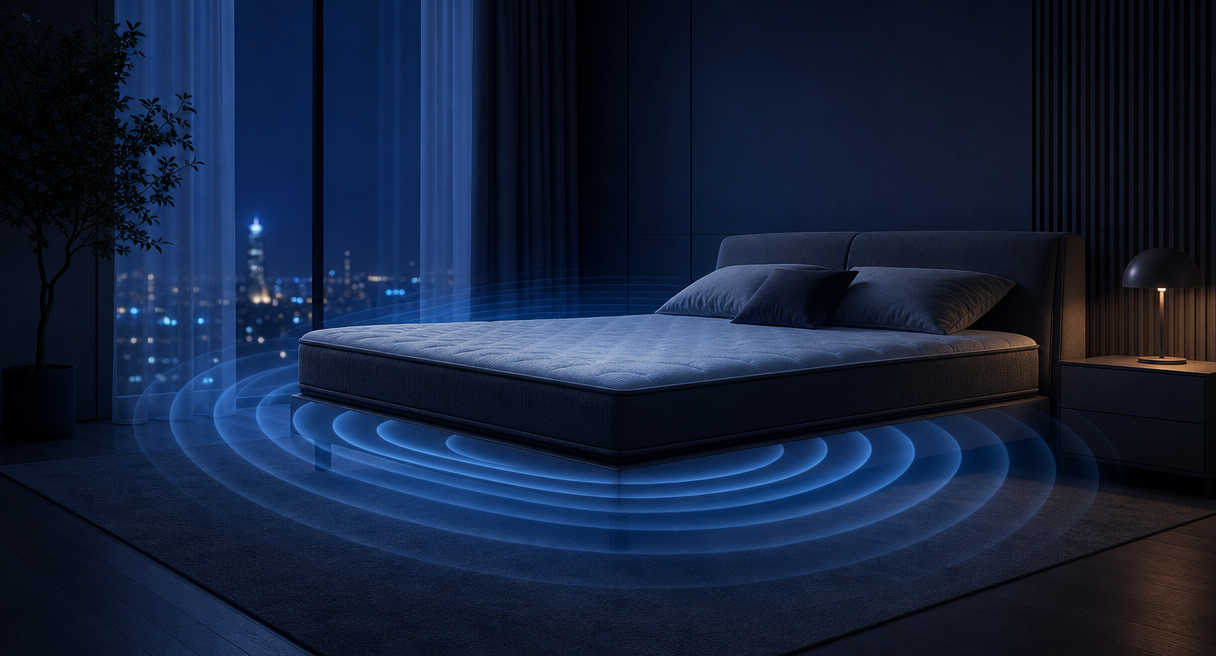
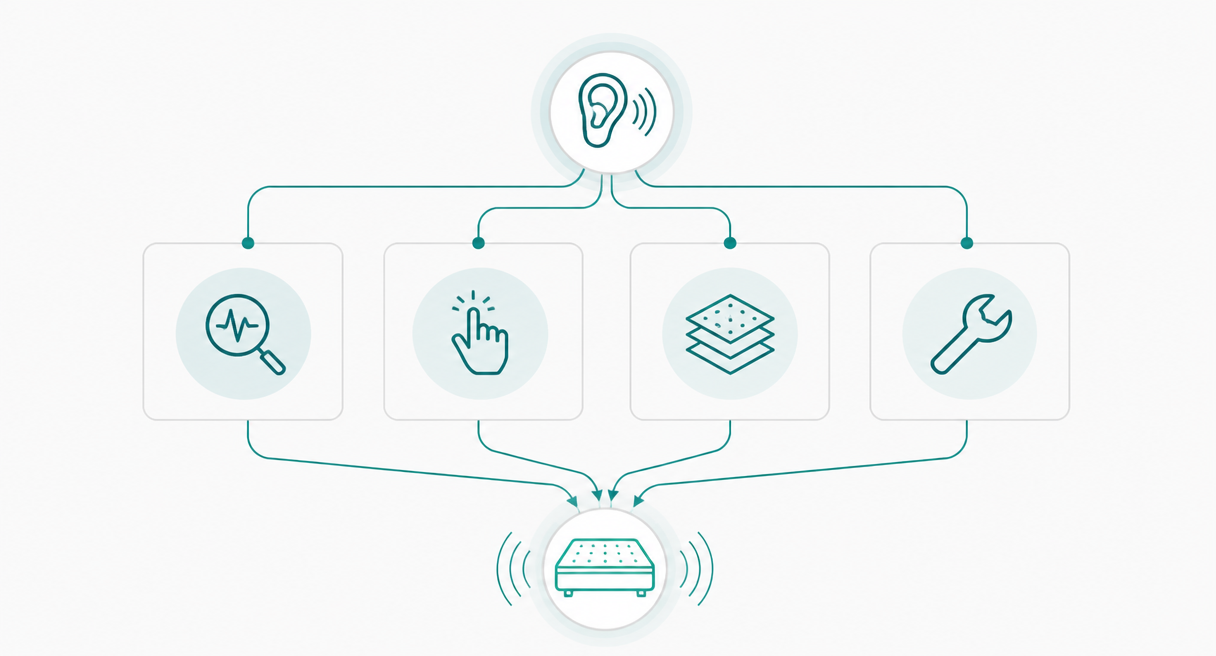
It usually starts at 2 a.m.: a click, a faint hum under the mattress, and soon you are listening for every night sound in the room. The search behind those sessions — smart mattress noise at night, described as a pump, a fan, clicking or hissing — is rarely about whether the bed is good; it is a troubleshooting task: what the sound is and what to do next. DeRUCCI maintains this guide in its sleep-education library; the tree below answers in four levels: baseline, red line, false alarms, and repair path.
What's Normal at Night: The Baseline and the Real Sound Sources
Start every noise investigation with the baseline. DeRUCCI's official documentation states that adjustment runs below 28 decibels — about a soft whisper — because the moving parts are slow-deflating soft columns. Night sounds fall into three traceable sources: column action, base motors, and power parts.
The measuring stick comes first. DeRUCCI's official documentation states that adjustment operating noise stays below 28 decibels and that its impact on sleep is very low — the series' written answer to light sleepers who worry about sound. The architecture backs the figure: in the T11 series, adjustment is carried out by flexible units — high-elasticity rubber air columns with a TPU core and a double-layer fabric pressing process, arranged evenly through the mattress interior, a structure that passed CNAS-certified testing at 280 kg and 10,000 bend cycles with no abnormality.
Searches often name a pump or a fan, and the answer is in the architecture: there is no separate pump or fan unit to service, and no official procedure involves opening anything. So the night-sound branches land on three traceable sources: the intermittent action sound of the adjustment columns — short air movement or a light touch as a zone fills and releases; motor sound from an adjustable base, when the Serene base articulates its head and foot sections; and power components — adapter and cable — which belong to the red line below.
The tree covers sounds the bed and its power parts make in use; renovation noise, a partner's snoring, and room acoustics sit outside it. For why 28 decibels reads as quiet, see smart mattress noise at night; here the figure is the baseline.
(This image is AI-generated for reference only, not an actual product photo.)
The Red Line: Power Components That Mean Stop Using It
Power components draw the hard line: a frayed cable, a cracked plug, or an adapter whose output disagrees with the nameplate rating means stop using the bed and request a replacement. Everything else — the safety-voltage internal supply, the low-voltage converter, the certified control box — sits in normal territory.
The official maintenance checklist states it in one line: "No damaged or substituted power components." A cable jacket worn through, a cracked plug body, an adapter whose output disagrees with the nameplate rating: on an electrified bed these are electrical faults first and appearance problems last — at worst a genuine safety risk. The action is to stop using the mattress and request a replacement.
The self-check takes three steps and a few minutes:
1. Run the cable's full length between fingers and eyes, hunting jacket wear at crush points, kinks, and connector ends.
2. Inspect each plug body for cracks, and test the fit for looseness at both ends.
3. Read the adapter's printed output rating against the nameplate; the model's rating can be verified through its product detail page.
What the checks do not flag sits in normal territory, and the numbers explain why. Electrified furniture is a normal feature of modern bedrooms: the internal supply is a 24 V safety-voltage design, the converter works at 5 V, and both sit far below the roughly 36 V human-safety threshold. The control box carries CE certification, and the radio operates in the 2.4000–2.4835 GHz band at about 70 mW maximum transmit power — the same radiation class as the Wi-Fi router and Bluetooth speakers in the room. Those figures describe electrical safety in normal use; a worn or damaged cable sits outside them, which is why the red line above comes first.
False Alarms: Warmth, Mode Settings, and Connection Resets
Three night complaints look like faults and usually are not — warmth from your own body heat, a bed that seems idle because its mode works quietly, and a pairing that needs a reset; an outage adds a fourth case. Each has a cause you can confirm in minutes.
Warmth that worries you. A warm feeling after use is your own body heat held by the layers — every mattress is a heat reservoir, and conventional ones hold heat too, unnoticed because nothing moves. Warmth spread evenly across the surface reads as normal; a localized hot spot crosses into the red line above.
A bed that seems idle. When lying down brings no sensation of adjustment, open the DeRUCCI AI App before suspecting hardware. The running mode explains most silence: Intelligent Deep adjusts with clear body sensation; Intelligent Sensorless works in a gentle, subdued way, with weaker sensation by design. The feeling of nothing happening usually traces back to a setting.
A pairing that will not hold. When Bluetooth cannot find the mattress, check in order: the power connector at the bed, the adapter's indicator light, then the phone's Bluetooth screen. Still absent — run the official reset: power the bed, hold five seconds, cut power, and repeat the plug-unplug cycle three times in a row.
The morning after an outage. The bed keeps its pre-outage feel for about a day without power: confirm the room's supply is back before treating silence as failure, then run the reset above.
When Self-Checks Don't Solve It: The Repair Path
When self-checks end without an answer, the path is short: stop tuning, protect the evidence, and escalate through the right door. Care rules come first — no self-disassembly, matched power cords, no heavy wet washing — then the warranty clock, whose three stages all count from the delivery date.
Escalation starts with the care rules DeRUCCI's official documentation does publish. Do not disassemble, repair, or modify the product — service goes through the dealer. Use the matched power cord and a compatible adapter, never a broken plug or a stand-in. Keep heavy wet washing out of the routine, because moisture trapped between layers deforms materials and invites mold. Read these as responsibility rules — the behavior class most likely to reappear in the clauses behind a claim. For routines that respect the boundary, the companion How to Clean a Mattress covers gentle methods.
The contacts are specific: manual questions go to the product team at productdepartment@derucci.com, and hands-on service routes through DeRUCCI Service or a nearby store.
The warranty decides who pays, on one clock — the delivery date — across three tiers. Within 365 days, replacement comes first: a confirmed quality issue brings free new parts, and when a parts swap cannot resolve it, a free whole-product replacement. Within 3 years, quality issues are repaired free, with no cost carried by the owner. Within 10 years, the bed stays serviceable: the owner covers necessary materials and logistics, and labor stays free.
Timing shapes every claim, so three questions belong before payment, while answers are still easy to compare: how a fault gets confirmed — the app's readings, your dated notes on how the bed feels, or both together; which accessories stay compatible with the exact model; and which of the three service tiers a given case falls under. Ask them early and keep dated notes from the first odd sound; the warranty clock then works in your favor from day one.
| What you found | What it means | Next move |
|---|---|---|
| Short intermittent sound, no other sign | Normal candidate | Note the timing; keep watching |
| Continuous hiss with support drifting softer | Leak verification case | Report with dated notes |
| Hum synchronized with base articulation | Base motor at work | Route to base service check |
| Worn cable, cracked plug, mismatched adapter | Electrical fault, first rank | Disconnect; request replacement |
| Self-checks exhausted | Escalation point | Dealer or product team, tier stated |
Repair and parts costs move with region and case, and this guide quotes no prices — ask at the store or the service channel for the current figure. One boundary sentence travels with the electrical numbers: insulation materials and the 5 V converter sit far below the roughly 36 V threshold — figures that describe materials and electrical safety. Water damage and regional exclusions follow the written warranty terms, so ask the retailer to confirm them in writing at purchase.
Frequently Asked Questions
---
Sort the sound, respect the red line, clear the false alarms, then escalate with dates and tier numbers in hand. The rest of the purchase decision is collected in the smart mattress buying decision guide; when the tree ends at a service contact, find a store or reach the team through the service page.