
 American
( English )
American
( English ) Singapore ( English )
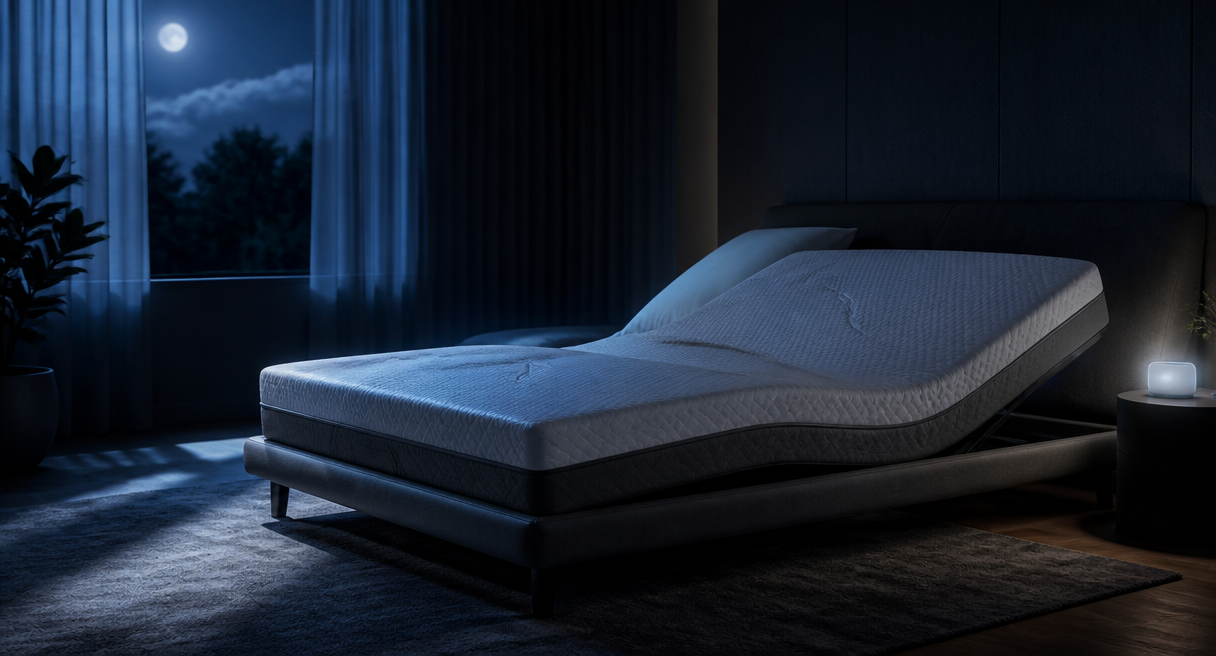
It is 2 a.m., the house has finally gone quiet, and your ear has locked onto the faintest hum in the room — the refrigerator, maybe the router. Light sleepers know this vigilance. So when a smart mattress offers to adjust itself while you sleep, one question decides the purchase: will you hear it? Smart mattress noise at night is exactly the worry that follows you to the showroom. For DeRUCCI's T11-series AI mattresses, the official specifications rate operating noise below 28 dB on every model. Here is what that number means in practice — and how to hear it for yourself before spending anything.
Why Can't You Fix Sleep Noise the Way You Fix Light?
Light has curtains and temperature has a dial; noise usually has neither. That is why it stays at the top of sleep complaints even in households that have managed everything else — and why a bed that moves on its own has to answer for its sound before any other specification. The survey record backs this up.
Two surveys size the problem from different ends. A 2018 white paper on Chinese internet users' sleep found that nearly eight in ten respondents named noise as a factor affecting their sleep — the leading environmental cause in that study — and linked the complaints directly to earplug purchases, with buyers born after 1995 buying more often than older groups. A 2015 report on entrepreneurs' sleep health added a device-level angle: among people who used dedicated sleep aids, anti-noise earmuffs accounted for 29.3% of use, second only to blackout eye masks.
The pattern is familiar to anyone who has tried. People invest in sleep, manage light and temperature first, then discover sound is the leftover problem. A self-adjusting mattress triggers exactly that worry, because the bed contains motors, valves, and an air system — the same ingredients that make an air conditioner or a hospital bed audible. Whether any of that reaches a sleeping ear is an engineering question. It has a specific answer.
What Does "Below 28 dB" Sound Like?
Every T11-series model carries the same rating: below 28 dB during adjustment, according to the official specifications, and DeRUCCI's official information describes the impact on sleep as low. One caution for spec readers — the 30,000-cycle durability test covers the mechanism's lifespan, not its sound level, and the two numbers certify different things.
In physical terms, 28 dB sits near a soft whisper or a quiet library — beside the bed during adjustment, the sound should sit at the edge of what a relaxed ear registers in a normal room. The manufacturer's product notes add a comparison of their own: quieter than the sleep mode of most air conditioners, which typically runs above 30 dB.
One neighboring figure deserves untangling. The same records show the adjustment units completed 30,000 cycles at 1,200 newtons of force without failure — a durability result. It proves the mechanism survives years of repeated motion; it says nothing about decibels. A mattress can be durable and loud, or quiet and fragile, independently.
How a moving machine stays that quiet is where the engineering comes in.
How Is the Quiet Engineered?
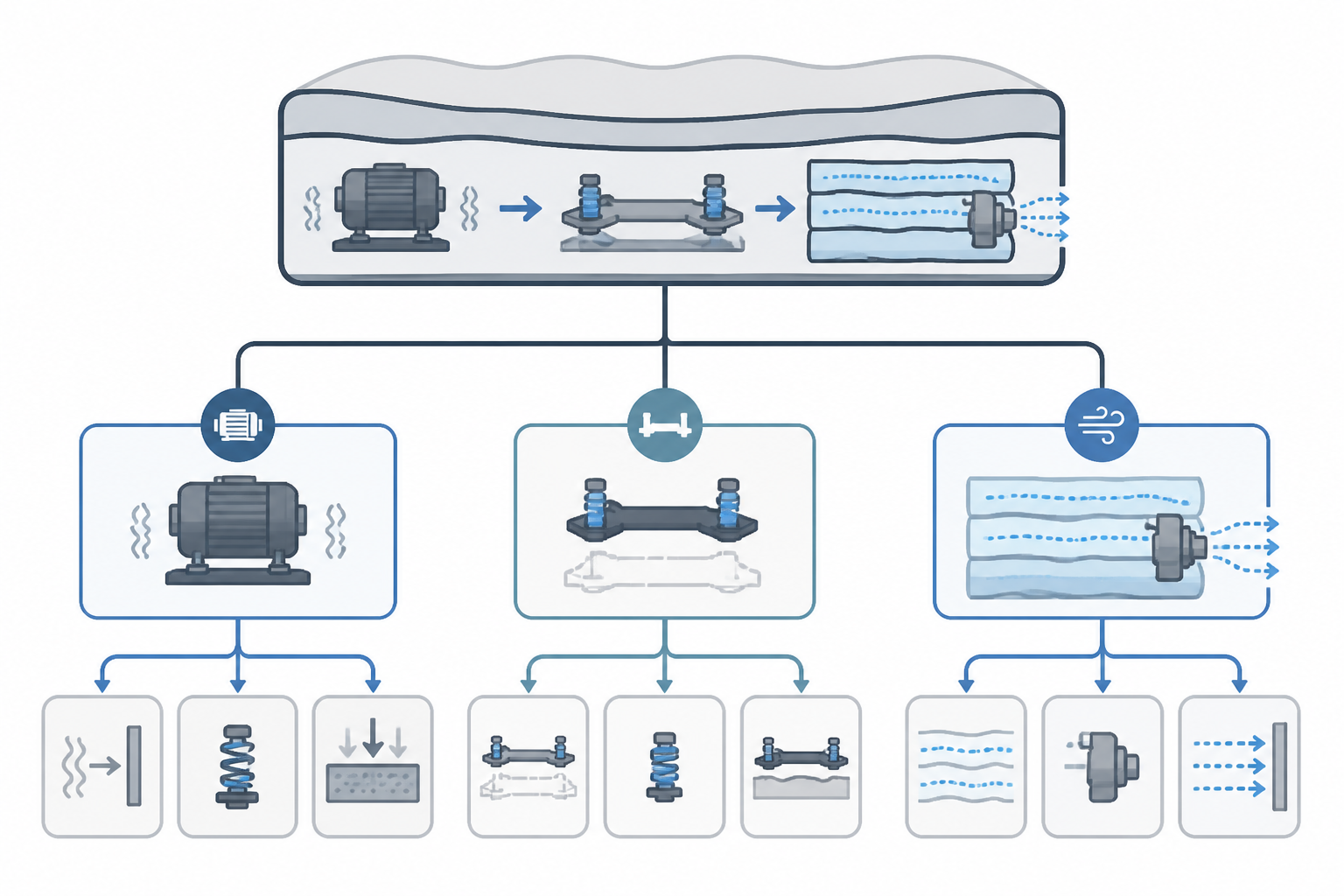
(This image is AI-generated for reference only, not an actual product photo.)
The quiet is designed in at three points, not one: the motor as the vibration source, the mounting structure as the conduction path, and the valves and air channels as the airflow noise source. Six patents cover those stages, so each link gets dampened somewhere before sound can travel to a sleeping ear.
A neighbor's stereo explains the physics. Its sound reaches you from the speaker itself, through the wall the speaker bolts to, and down the hallway as air — quieting it means attacking all three links. A mattress is no different: sound can start at the motor, travel through the structure it is mounted in, or arrive as hiss from valves and air channels. DeRUCCI's engineering addresses each link, with six patents behind the three stages: a third-generation silent motor with improved solenoid-valve control at the source, a dual-floating vibration-isolating mounting structure on the path, and a multi-channel control system that softens valve switching and airflow at the end of the chain.
When Does the Mattress Actually Move at Night?
Audibility is decided by the active mode, not by the hardware alone: manual changes happen while you are still awake to hear them, Intelligent Deep Adjustment runs the night's corrections, and sensorless mode is designed so a sleeping person does not register the adjustment at all. Do-not-disturb mode removes movement entirely.
"Automatic" is not one behavior, and a bed that adjusts itself does not move constantly. On the T11+ and higher models, one sensor stream feeds all three modes, and which mode is active largely decides whether an adjustment is something a sleeper could ever register.
Walk through a typical evening. Before sleep, in the app's manual mode, every change is yours: you command a firmer lumbar zone, you hear the adjustment, you decide. After lights-out, the mode you have selected carries the night's corrections — Intelligent Deep Adjustment for continuous adaptation, or sensorless mode, which you can switch to before sleep so the adjustments pass unnoticed. The official information describes the difference as design intent rather than volume — the mode is built to be imperceptible, not merely quiet, adjusting in a gentle, gradual way that feels faint to the body.
The fourth setting is worth knowing about before you shop: do-not-disturb. For a zero-tolerance night before an early flight, that is the setting; for every other night, sensorless mode is the one doing the quiet work.
For the underlying mechanism — which units shift, and when — How Adaptive Firmness Technology Works explains it step by step.
How Can You Test Smart Mattress Noise Before Buying?
Three showroom actions settle what a spec sheet cannot: lie down while a staff member triggers the automatic adjustment, run the official two-sleeper listening check, and switch among the three modes in the app yourself. The pass standard is simple — a floor sample you can hear is not meeting its specification.
Your own ears should close the question, and each test takes a few minutes on a showroom floor.
1. Single-sleeper trigger. Lie down in your usual position and have a staff member trigger the automatic adjustment. The official check standard is plain: the human ear should not hear the motor running. Treat an audible motor as a flag about that sample, and ask to try another unit.
2. The two-sleeper check. Bring your partner, or use the official two-sleeper trial method: one person lies still while the other triggers adjustment on their own side, and the listener on the opposite side judges whether the adjusting side stays quiet enough to ignore. This verifies low disturbance between two sleepers — a different property from one person's quiet night, and usually the one that decides whether a couple keeps the bed.
3. Mode switching in the app. Open the app yourself and move among the three adjustment modes. Confirm what sensorless mode actually feels like on your body, then switch on do-not-disturb so you know, concretely, what total silence trades away.
Which models are sold differs by market, so check in store or confirm availability in your region before planning the visit.
What Should a Light Sleeper Do Next?
For a light sleeper, three tools close the question: the showroom listening tests before buying, do-not-disturb mode for the rare zero-tolerance night, and white-noise masking for residual sensitivity. The specification says the adjustment should stay below awareness — your ears should have the final word.
The store tests come first, and hearing a unit once more after them costs nothing. The second tool sits in the app: for a zero-tolerance night before an early flight, do-not-disturb mode stops adjustment entirely. The third is masking — using one steady sound to cover another. On whether white noise genuinely helps sleep, Harvard Health Publishing — can white noise really help you sleep better? covers the evidence in plain language.
From there the decision is small rather than sweeping: browse the current models on the DeRUCCI smart mattress collection page and compare each model's listed noise rating, or find a store near you and hear a unit in person — the quiet is easier to trust once your own ears have checked it.