
 American
( English )
American
( English ) Singapore ( English )
Waking hot, flipping the pillow, hunting the cool edge of the bed — that is the nightly pattern this article serves. Searching for a smart mattress with adjustable temperature and sleep tracking in 2026 returns feature lists that blur three technologies into one word, and most buyers cannot tell which they are paying for. DeRUCCI maintains this piece in its sleep-education library.
Can a Smart Mattress Actually Cool You Down?
Temperature in a smart mattress is three different technologies, not one. The first buying question is whether the route you want exists in the product in front of you, because a spec sheet that reads simply "temperature control" tells you nothing about which of the three you are paying for.
One route is active cooling — hardware that removes heat, found mainly as water-circulating or phase-change topper forms added over a mattress. One route is passive: fabrics and breathable structure that shed the heat a body produces all night. One route is active heating, delivered as targeted far-infrared zones. The three routes divide the work — each answers a different complaint, and no route covers for another.
That division makes the buying question concrete: overheating shops the cooling or passive route; cold legs shop the heating route. Before comparing brands or tiers, confirm which of the three routes the line in front of you carries — the phrase "temperature control" on a spec sheet does not say.
One distinction belongs here because later expectations depend on it: the felt effect of a temperature intervention and changes in sleep structure are two different kinds of evidence. A surface can feel cooler while sleep architecture stays flat; architecture can improve while the surface feels unchanged. Keep those two kinds of evidence apart. For the physical mechanics — how materials trap or shed heat, what a heating zone does — smart mattress temperature for hot sleepers has the full walkthrough.
What Temperature Control Actually Delivers
The T11 line works the passive route for hot sleepers: breathable, heat-shedding materials carry the in-bed work, the bedroom completes it, and the one active temperature feature is graphene far-infrared leg heating on the T11 PRO, set per side through the app. Bedding and airflow remain the biggest levers on top.
In the DeRUCCI T11 series, that one active feature works as follows. Powered on, it emits far-infrared waves in the 6–15 μm band; through the DeRUCCI app each side of the bed sets its own leg-zone temperature anywhere from 25°C to 55°C. Because of the quilting layer, the surface temperature sits about 15°C below the set value — the number to compare when reading spec sheets. A timer of one, two or four hours switches the zone off automatically.
For a hot sleeper, the practical split is simple: the cooling job lives on the passive side — breathable materials, bedding, bedroom airflow — while the heating zone answers cold legs and mixed sleeper couples. The stated benefit for the heating zone, per official materials, is promoting blood circulation and easing fatigue from within to support restorative sleep. In plain terms: graphene far-infrared heating is for warmth, and the passive route is for cooling.
A warm feel has an unglamorous explanation: a body sheds heat all night and every mattress traps a share of it, so slight warmth after switching is expected physics.
The electrical anchors stay small: rated power is 20 W for the T11 SE, T11+ and T11 z+ and 85 W for the T11 PRO, and heating adds at most 0.05 kWh per hour.
Does Sleep Tracking Help a Hot Sleeper?
A hot sleeper does not need data for its own sake; the report has to answer one question — after the temperature side changed, did time-to-fall-asleep and nighttime movement move too. The T11+, T11 z+ and T11 PRO document the sleep-management system with daily reports; on other tiers the sleep-report row of the spec sheet decides before purchase.
Tracking helps exactly when it feeds the decision of whether a temperature change worked — everything else is dashboard decoration.
Monitoring splits by tier first. The T11+, T11 z+ and T11 PRO document the sleep-management system — heart rate, breathing, sleep stages, a daily report — and on the T11 PRO the SleepCare system uses contactless cardiopulmonary coupling developed by Harvard Medical School: nothing worn or charged, because the bed reads the mechanical signature of heart and lung movement through the mattress itself. On other tiers, the sleep-report row of the spec sheet is the place to check.
Report trigger conditions are verifiable, which makes the promise testable. Reports generate inside a 20:00–10:00 local window and need at least three hours in bed and two hours of sleep before one reaches the app. A shorter night produces no report by design — check it against any brochure promising nightly scores.
Accuracy anchors sit at two tiers. The T11+ sensor states contactless detection accuracy above 97%, built on more than one million ergonomic data records — records, not people. The T11 PRO's sensing group is CAICT-certified for contactless measurement; the per-metric figures sit in the spec sheet — the buying question is which tier carries them.
Independent voices keep the trust calibrated. Reviewers and sleep scientists describe consumer-grade sleep staging bluntly — "generally not great" is one published verdict — and some advise ignoring deep-sleep staging entirely, because wearables stage sleep by population averages, not direct measurement. A user who tracked ninety consecutive nights compressed it: nobody pays for measurement itself — what they want is "a measurement that leads to a decision." That is the case for contactless sensing here: no wearing burden, the same readings drive the bed's own adjustment — the surface keeps re-tuning as the night's data comes in — and the report answers what a hot sleeper actually asks: did falling asleep quicken and did movement settle after the surface and bedroom changed? The mechanics of that sensing loop are unpacked in how an AI smart mattress monitors sleep health.
Power-cut behavior belongs on the same map: smart functions go offline with the supply, and the bed typically holds its pre-outage feel for up to a day — one bad night is the grid's, not the mattress's.
Hot-Sleeper Decision: Expectations and Trade-offs
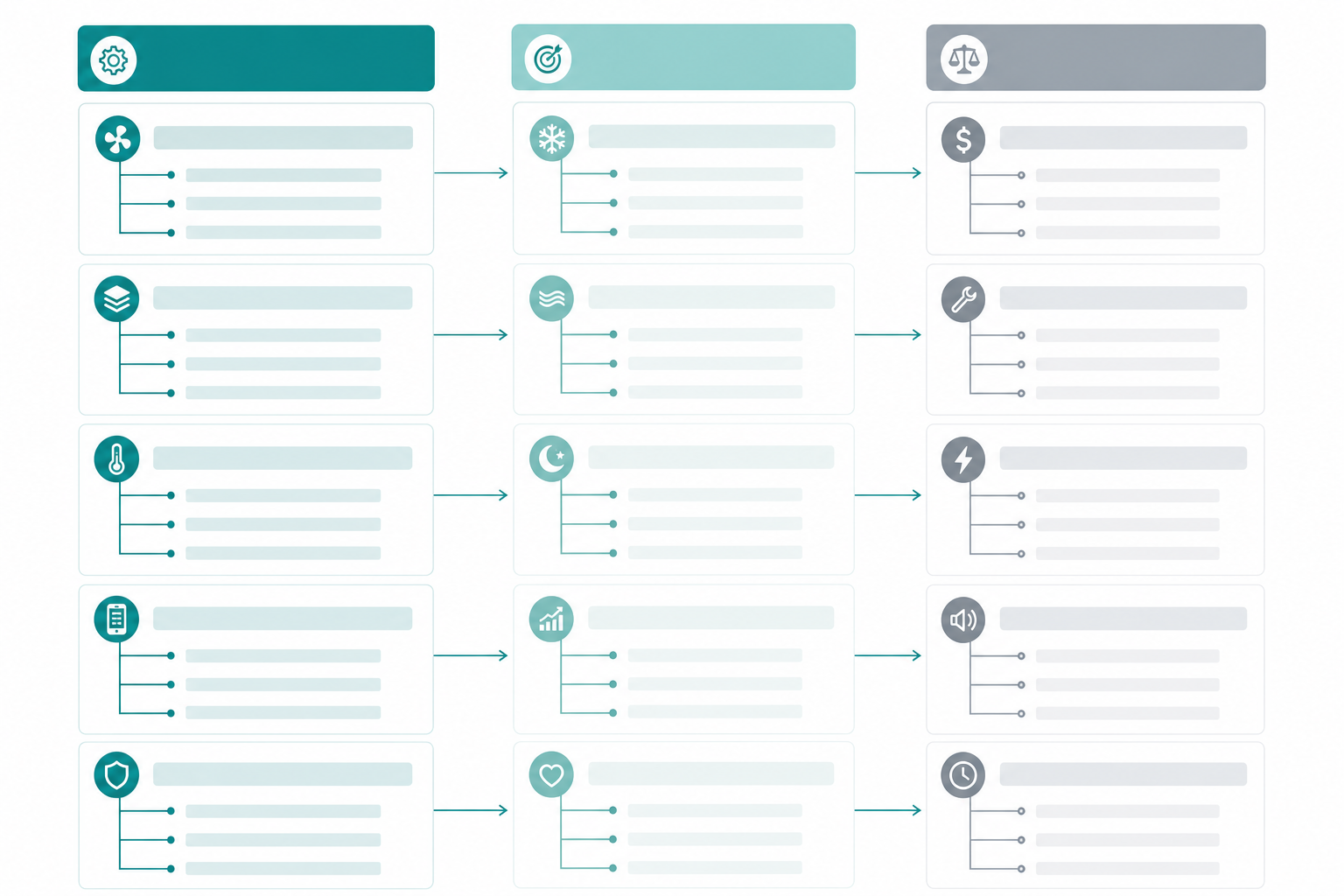
Set expectations on two separate tracks: how the surface feels night to night, and what the daily report shows — time to fall asleep, nighttime movement, deep-sleep length. Five trade-off dimensions, from temperature route to monitoring tier, decide the configuration, and both tracks are checkable.
The demand-side numbers explain the urgency. In a 2025 white paper on healthy sleep — 2,500 respondents — 91% of those with sleep troubles had bought or used a sleep-aid product, and 66% of those buyers said it fell short; a 2026 survey found 72% willing to invest more in sleep. Hot sleepers sit in the bought-but-unserved group, which is why expectations need anchoring first.
According to independent CAICT lab testing — the China Academy of Information and Communications Technology — the T11 SE tier measured sleep onset time 37.3% shorter, nighttime turning 27.5% lower, deep-sleep duration 4.5% longer and continuous deep sleep 5.9% longer. The felt translation: if falling asleep normally takes thirty minutes, 37.3% is about eleven minutes. These numbers describe sleep structure — falling asleep sooner, turning less, sleeping deeper — while the temperature side of the line works through breathable materials and the bedroom.
Five trade-off dimensions carry the configuration decision:
| Dimension | What to weigh | Where to check |
|---|---|---|
| Temperature route | Passive fabric and bedroom management carry the cooling job; graphene leg heating is PRO-tier | Product page route wording vs tier function table |
| Monitoring tier | The +, z+ and PRO tiers report heart rate, breathing and daily summaries; the sleep-report row of the spec sheet settles the rest | Tier-by-tier function table |
| Zones and units | 3, 5 and 6 zones with 10, 14 and 18 adjustment units across the SE, + and PRO tiers | Specification sheet |
| Firmness balance | A too-soft surface leaves muscles compensating; a too-hard one presses pressure points — medium-firm is the expert-backed balance | In-store lie-down with a posture check |
| Operation and safety | Under 28 dB — quieter than most air conditioners run in sleep mode; voltage and radiation figures belong to the spec sheet | Specification sheet |
Two if-then rules close the decision. If the purchase is mainly about trouble falling asleep, weigh the certified sleep-architecture figures and let the report answer after two weeks. If the nights are shaped by cold legs, or a warm-and-cold sleeper couple, graphene heating exists on the T11 PRO alone. Waiting carries its own cost: another summer of broken nights is the price of an undecided trade-off.
Availability as it stands: the T11 SE AI mattress is now available at the DeRUCCI New York store, and buyers in other markets should confirm availability through the global site. Ask ahead which models are on display — the tier boundary is the whole decision, and one question settles it. For the passive side — airflow, bedding, bedroom setup — how to sleep cooler carries the checklist.
(This image is AI-generated for reference only, not an actual product photo.)
Frequently Asked Questions
---
Run the checks in order: the route you need, the tier that carries it, the report thresholds that prove it. The smart mattress buying decision guide carries the surrounding decisions from first questions to after-sales, and to verify the passive route in person you can find a store.