
 American
( English )
American
( English ) Singapore ( English )
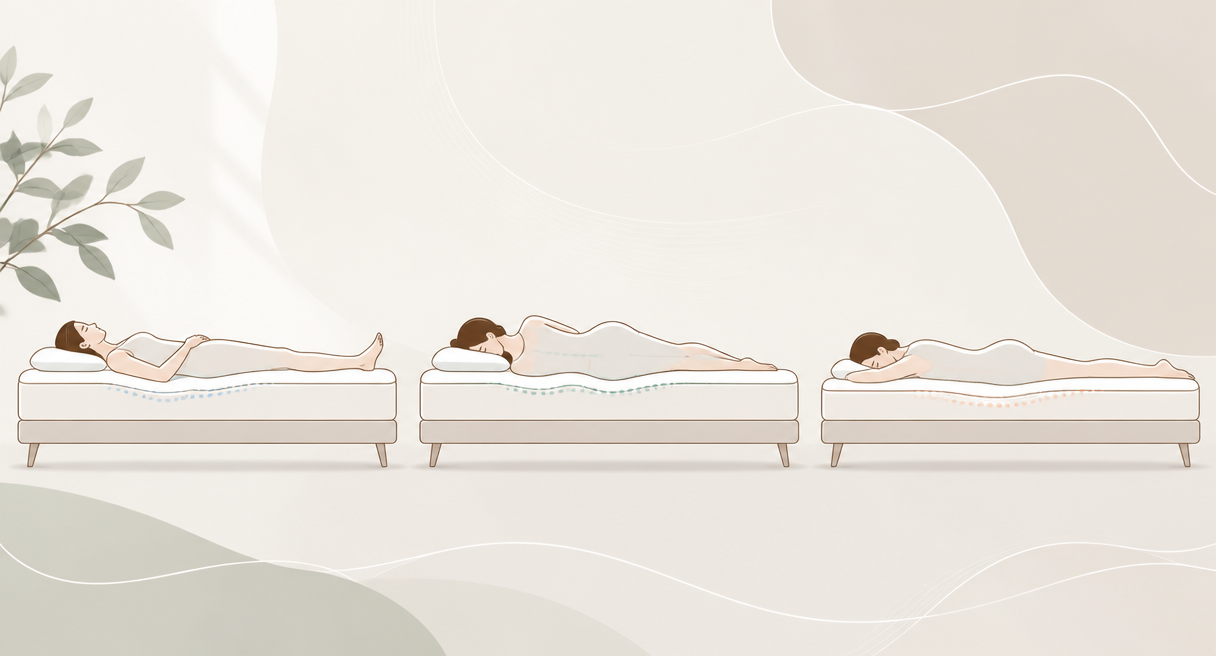
Back pain turns mattress shopping into a search that bed reviews never settle: the phrase most people type — the best smart mattress for back pain relief 2026 — is, at its core, a question about support. The workable approach is matching. Adjustable firmness becomes a calibratable support parameter; four posture-habit groups meet four support standards; each group maps to the standard that serves it. DeRUCCI maintains this piece in its sleep-education library.
Is a Firm Bed the Answer? What the Evidence Says
The evidence says no. The folk prescription — a hard bed for a sore back — fails on mechanics: an over-firm surface concentrates load on bony points and multiplies position changes, while an over-soft one lets the spine bow until muscles compensate. Spine-health survey data: 59 percent of respondents name spinal discomfort as their chief sleep disruptor.
The demand is real: in the spine-health white paper survey, 92 percent of respondents are acting on it — 63 percent through habit correction, 61 percent through sleep-related investment including spine-friendly bedding — and 72 percent will invest more.
The same white paper lists four sleep misconceptions: that lower-back pain calls for a board-hard bed, that a high pillow is harmless, that skipping the pillow is safer, and that spine-friendly bedding is a purchase to postpone. The last is quietly wrong — well-matched bedding serves every sleeper, every night.
The white paper lays out the mechanism. Too soft, and the heavier segments sink, the spine loses its curve, and back muscles tense to compensate — stiffness by morning. Too firm, and load parks on the shoulder, elbow, knee and ankle pressure points until the sleeper keeps shifting to escape. "Medium" names the band between those failure modes, and it differs from body to body.
Here adjustability earns its place. A fixed mattress asks you to guess your medium once and live with the guess; adjustable firmness makes the middle band a calibratable personal parameter — checked against posture, build and feel, rechecked as they change. For shopping-scenario picks, the companion piece Best Smart Mattress for Back Pain Relief carries the recommendations; this guide carries the fit criteria.
Match the Support to Your Body: Four Types, Four Standards
The matching framework has two axes: four posture-habit groups — side, back, heavier, curled — and four standards, precise contouring, stable support, even pressure distribution, individual adaptability. Each group maps to the standard that serves it. Lighter frames load pressure spread first, heavier builds load support, changing bodies load adaptability — and some sleepers need no adjustability at all.
The four standards come from the spine-friendly bedding white paper as a shared evaluation language: A, precise contouring — the surface matching the body's curves; B, stable support — enough understructure to stop global sag; C, even pressure distribution — load spread wide, never pooling on bone; D, individual adaptability — parameters calibrated to one sleeper, re-calibrated as that sleeper changes. Posture-by-posture detail, pillows included, belongs to what is the best sleeping position.
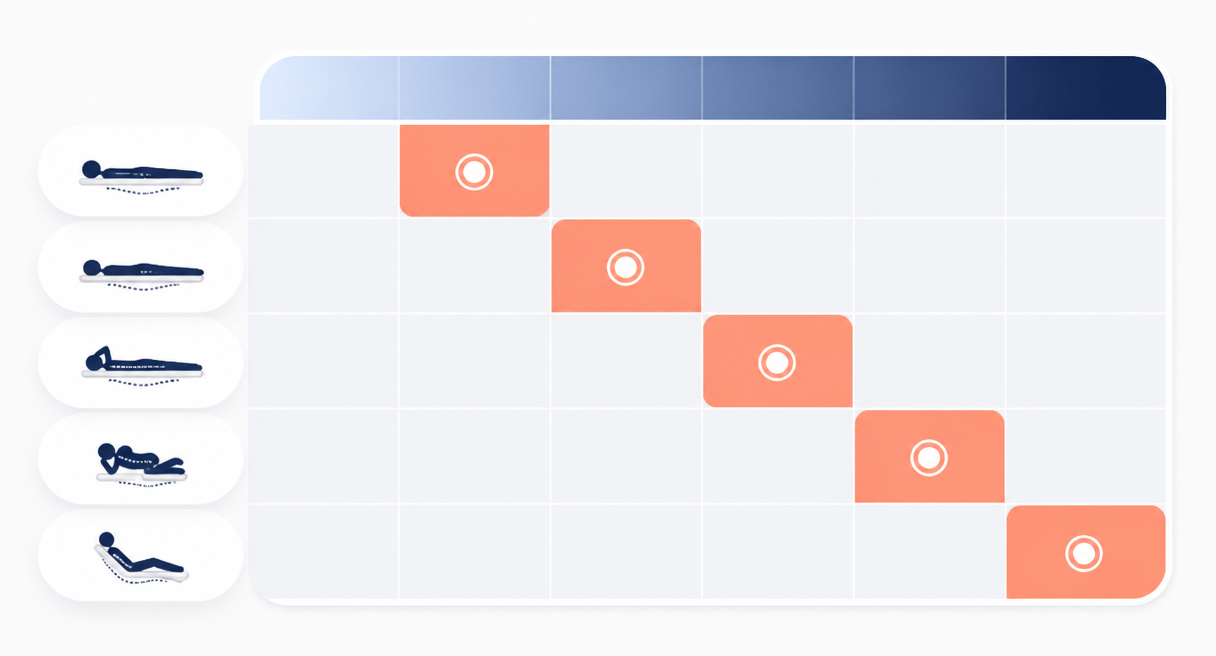
(This image is AI-generated for reference only, not an actual product photo.)
Side Sleepers: Fill the Neck-Shoulder Gap
Side lying concentrates load on the shoulder, waist and hip — the zones a zoned mattress addresses first. The pillow fills the neck-shoulder gap so the head stays level. Priorities: A for the curve, C for the shoulder and hip.
Back Sleepers: Lower the Lumbar Load
Face-up sleeping leaves the lumbar curve working against gravity. A pillow under the knees tilts the pelvis and lowers tension across the lower back. Priorities: B to hold the lumbar region, A to keep the curve supported.
Heavier Builds: Guard Against Sag
Greater body weight asks more of the understructure, so B comes first — the pelvis should not drive the mattress into a hammock shape. Side lying with a pillow between the knees keeps the pelvis neutral; a firmer band within the middle range is the usual fit.
Curled Sleepers: Resist the Torso Sink
Curling up flexes the spine and invites the midsection to sink — the failure mode to resist is a soft middle. A medium-height pillow keeps the neck neutral. Priorities: A and C, with D worth having as positions change.
One habit the white paper flags outright: stomach sleeping rotates the cervical spine and extends the lumbar one — a posture no mattress rescues.
Two groups deserve a second look. Bodies in flux — pregnancy, recovery, changing schedules — are the strongest case for adaptability, because a setting that fit last month can miss this month. At the other end, sleepers who prefer one fixed feel and want no device interaction do not need adjustable firmness: a fixed-comfort mattress is a legitimate choice.
What Adjustable Firmness Actually Maps To
Zone architecture carries the contouring and pressure standards, tiered by zone count across the T11 line, with the finest division at the top tier. The certified CAICT numbers are sleep-structure results on the T11 SE — sleep onset, nighttime movements, deep sleep.
Here the matching turns concrete: the DeRUCCI T11 series, as worked example. Zone tiers run three on the T11 SE — shoulder, waist and hip — side sleepers' heaviest zones; five on the T11+, adding back and leg zones; six on the T11 PRO, which splits control into two hubs so each partner's zones answer to their own parameters. DeRUCCI's official documentation names the six zone functions — Shoulder Support, Back Lumbar Alignment, Lumbar Support, Hip Pressure Relief, Thigh Support, Calf Relief — with the stated intent of holding the spine in natural alignment overnight.
The algorithm side answers support and adaptability. Tidal Algorithm 2.0 states its goal as "keep your spine in perfect alignment." In operation, that goal runs unattended: the bed reads posture and load through the night and re-tunes the middle band on its own. Modes answer adaptability's exit: beside the adaptive settings, the app's manual control can hold one chosen firmness through the night. Adjustability is a capability a sleeper can decline; calibration waits until build, posture or season changes.
On the outcomes side, according to independent CAICT lab testing of the T11 SE tier, sleep onset time shortened by 37.3 percent, nighttime movements fell 27.5 percent, deep-sleep duration grew 4.5 percent and continuous deep sleep extended 5.9 percent.
The matrix completed — where each group's priority standard lands:
| Group | Priority standard | T11 series answer |
|---|---|---|
| Side | A, C | Shoulder-waist-hip zoning; Hip Pressure Relief function |
| Back | B, A | Back Lumbar Alignment and lumbar support zones |
| Heavier | B | Per-side six zones on the T11 PRO |
| Curled | A, C | Fine zone division resisting mid-body sink |
| In flux | D | Nightly recalibration, or a firmness held on manual control |
What each firmness level does for back pain is summarized in mattress firmness for back pain.
From Morning Feel to Store Floor: The Verification Path
The verification path runs in three steps: read your morning feel, check it against the support matrix, then confirm on the store floor in your real sleep posture. Durability carries the same weight — a 280-kilogram, ten-thousand-cycle flex test at a CNAS-accredited laboratory stands behind the structure, and the sleep report shows the multi-night trend.
Mornings carry the most useful signal. The way the body feels on waking — a stiff shoulder, a lower back that loosens slowly, pressure that sits on one hip — is the starting clue, and it maps straight onto the matrix: group first, priority standard second. The store floor then confirms it, in the posture you actually sleep in.
Beds do reach an end state: a fatigued structure shows visible depression or a collapsed midsection, and that is a replacement conversation. Adjustment tunes support inside its range; material life belongs to the structure itself, and the durability figure in this line is a 280-kilogram, ten-thousand-cycle flex test at a CNAS-accredited laboratory — a structural-endurance figure built for years of nightly load.
Comfort perception varies between people, which is why the middle band is calibratable: broad comfort bands carry most of the range, and a shared lie-down in store — both partners, real postures — settles what a spec page cannot.
The sleep report rounds out the picture. On tiers carrying the sleep-management system, reports generate automatically inside a 20:00-to-10:00 window once you have been in bed at least three hours and asleep at least two; a missing report usually traces back to one of those conditions. Read the trend across nights — a single night counts for little.
Four closing actions, in order:
1. Read the morning feel first — where the body asks for support on waking sets the group to check in the matrix.
2. Match posture and build to the matrix above — group first, priority standard second.
3. Test in your real sleep posture: lie the way you actually sleep and watch how the zones respond. The T11 SE AI mattress is now available at the DeRUCCI New York store; other tiers and regions are a store-confirmation question.
4. Judge long-term fit by the trend across nights — independent reviews plus your own sleep report's multi-night direction.
Frequently Asked Questions
---
Match the standard, test the posture, read the trend. The full decision path, from matching to after-sales, is mapped in the smart mattress buying decision guide, and to try the zones in your real sleep posture, find a store.