
 American
( English )
American
( English ) Singapore ( English )
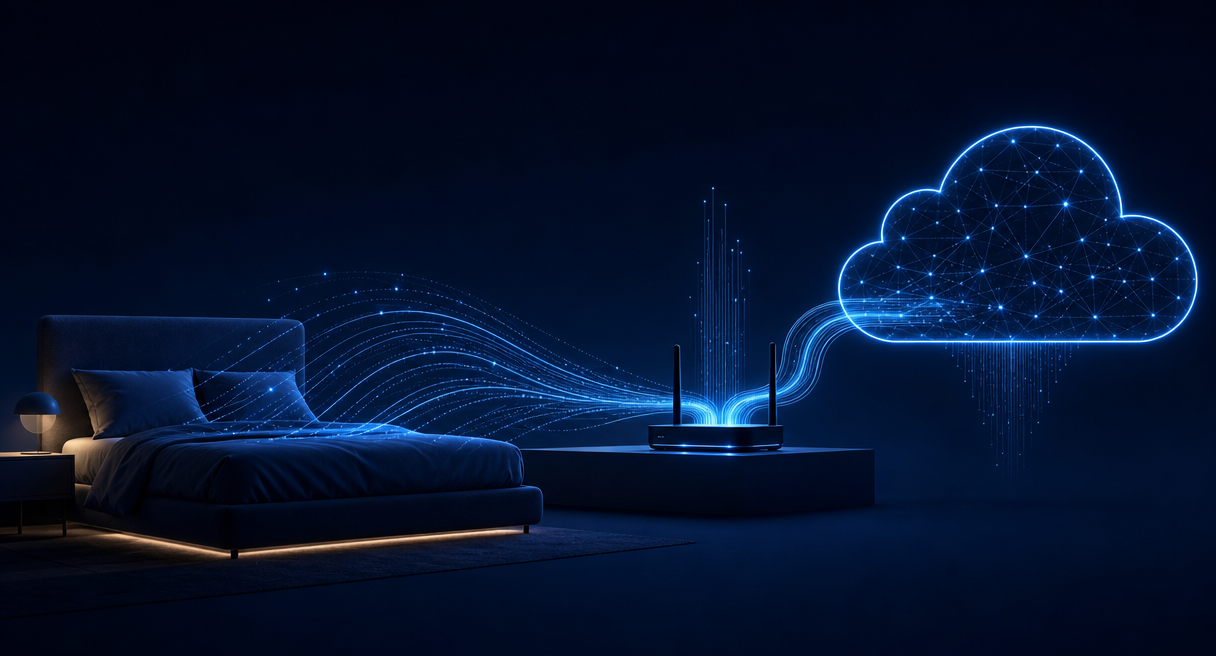
A smart mattress that tracks sleep runs on data, and privacy questions follow the data collection itself. Sleep tracking in this guide means the readings the bed takes through the night, followed through four layers: what the sensors read, how the signals travel, where they are stored, and who the policy says can see them. DeRUCCI maintains this piece in its sleep-education library: the chain is category architecture first, with this maker's documented parameters as the worked example. The second half states the published privacy points, then lays out the off switches and what each one changes.
What the Mattress Collects, Where It Goes, Who Can See It
A sleep tracking mattress moves data through four layers. Built-in sensors in the sleep surface collect heart rate, breathing, sleep-stage conversion and body movement, with no wearable involved; the signals travel over Bluetooth and Wi-Fi toward an account-bound cloud; the usage layer generates nightly reports and adaptive firmness changes. Each layer raises its own privacy question.
The collection layer needs no wristband. Sensors embedded in the mattress surface do the reading, which means nothing to strap on and nothing to charge — the practical shape of built-in sensors with no wearables needed.
The transmission layer is short-range wireless. The bed pairs through the maker's phone app and communicates over Bluetooth and Wi-Fi, with a documented reach of roughly 10 meters from the bed, falling to about 5 meters through a wall. One compatibility constraint is easy to miss: the mattress supports the 2.4 GHz band, and 5 GHz networks are not supported — on a dual-band router, confirm the 2.4 GHz band stays active.
The storage layer is a cloud backup tied to your account; per the documentation, the data is usually not viewable before the first sync completes. The usage layer turns it into features: the nightly report and the adaptive firmness changes applied overnight.
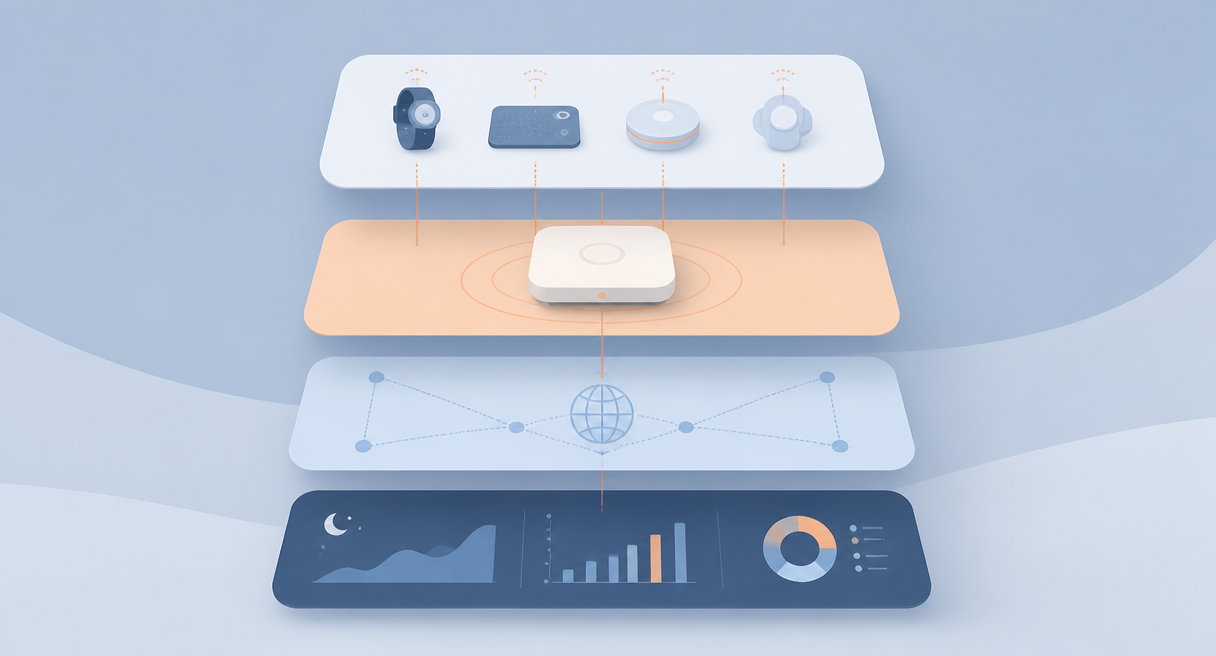
(This image is AI-generated for reference only, not an actual product photo.)
On the radio side, the official parameters are concrete. The maker's documentation states that the control box carries CE certification, sits beneath the foot of the mattress, transmits between 2.4000 and 2.4835 GHz, and emits at a maximum of about 70 mW. For scale: that is the same band, and the same radiation type, as the home Wi-Fi router and Bluetooth devices already running in the house — the mattress joins a crowd that was there first.
The report layer carries a name, SleepCare, on the T11 PRO: daily readings of heart rate, breathing and sleep stages, delivered as a report you can open each morning. The scope of this guide: the data chain, and every documented control over it.
For what the sensors measure and how a report is built, see How AI Smart Mattresses Track Sleep Health.
What the Published Privacy Policy Says
DeRUCCI's published privacy policy makes four commitments for sleep data, and each one is concrete: cloud storage protected with bank-grade encryption, data visible to the user alone, use limited to the personal sleep program, and in-app switches that stop collection or delete history.
The four points above come directly from DeRUCCI's published privacy policy — the reference text for how this series treats sleep data.
In practice: records live in an account-bound cloud under bank-grade encryption, and sleep data is visible to you alone. Its use is confined to the personal sleep program that adapts your mattress, and the switches that stop collection or delete history sit inside the DeRUCCI AI app, where you can run them yourself at any time. Privacy terms are maintained region by region; the policy page for your region carries the wording in force there.
A sleep tracking mattress belongs to a category that feels different: devices that stay on in the bedroom all night. That wider background is covered in the Technology and Sleep guide.
Your Off Switches: Stop Collection, Delete History, Disconnect
Three controls are documented. App switches stop collection and delete history; disconnecting leaves automatic firmness adjustment working offline, while sleep reports, the newest adaptive algorithms and vital-sign tracking require a live connection; and a 2.4 GHz phone hotspot can stand in during a home-network outage, with the report excepted. Export is not among the documented points.
Stopping collection and deleting history are documented controls — the fourth published point. The app carries switches that close data collection and remove your history records; the exact menu paths follow the app's current version, which for this series is the DeRUCCI AI app.
Export sits outside the published points: no data-portability term appears in the available documentation, so a request for your records runs through the current app and your regional policy — and any export path a seller describes deserves a document to back it.
Disconnecting is the third switch, and its behavior is tiered. Every model requires first-time online setup. After that, offline behavior splits into two columns: supported with no connection — automatic firmness adjustment, which keeps the bed a working mattress; requires a live connection — sleep reports, the newest adaptive adjustment algorithms, and vital-sign tracking.
| Tier | Keeps working offline | Needs a connection |
|---|---|---|
| T11 SE | Automatic adjustment | Manual functions and mode switching |
| T11+ / T11 z+ / T11 PRO | Automatic adjustment | Newest adaptive algorithms, breathing-rate and heart-rate viewing, sleep reports |
| T11 z SE | Turn-assist follows default values | Personalized turn-assist response |
When the home network drops, the report is the one function a hotspot cannot bring back: the analysis runs in the cloud, so a bed with nothing to send has nothing to build a report from.
The report carries thresholds that explain most missing-report moments. On the T11+ tier and above, it generates once in-bed time passes three hours and actual sleep passes two; for users in other regions the recording window runs 20:00 to 10:00 local time. Sleep data uploads continuously for cloud analysis, so an unconnected bed produces no report at any threshold.
The Real Trade-Off, and How to Verify It Before You Buy
The controls put you in charge: app switches stop collection and delete history. On upper tiers, stopping the data pauses the features that use it — reports and the newest adaptive algorithms. Verification runs in three steps: identify the policy version for your market, run the stop-and-delete flow on a demo unit, and list which features run offline.
The features that make a smart bed smart — the nightly report, the adaptive algorithms — run on the data. Switch collection off or cut the Wi-Fi, and those features pause while the mattress keeps adjusting firmness on its own; turn the data back on and they resume with the next connection. The switches stay yours to run and undo at any time.
Verification takes three steps, and a store is where they run.
Step one: start from policy documents, not marketing pages. Ask the store or the official channel to identify the exact official documentation and the regional privacy-policy version that applies to your market, and finish reading it before the sales conversation goes deep. If no one can point to a specific version, that itself is an answer.
Step two: run the stop-and-delete flow with your own hands on a demo unit. Find the switches, flip them, watch the history clear: thirty seconds at the counter confirms the controls live where the documentation says they live.
Step three: ask the staff to list which functions survive with no connection. Offline automatic adjustment — the bed reading the night and re-tuning its support unattended — keeps the bed usable as a mattress; the reports and adaptive algorithms are what make it a smart one. The two columns from the section above, confirmed in person, close the gap between documentation and demonstration.
The long-term anchor on record is the after-sales framework: a ten-year paid service keeps the bed serviceable from delivery, labor free, parts and logistics billed. For anything beyond it, the policy version you identify in step one is the governing text.
For the questions to ask before buying, sleep mattress privacy questions carries the list.
Frequently Asked Questions
---
Follow the chain from sensors to switches, and test the controls where they can be tested. From first question to after-sales support, the smart mattress buying decision guide carries the full decision path, and you can find a store to run the three verification steps on a demo unit.