
 American
( English )
American
( English ) Singapore ( English )
A mattress that senses heart rate, breathing and movement is a data device you sleep on, which makes sleep tracking mattress privacy a pre-purchase question rather than an afterthought. No paranoia needed — just homework. What does the mattress collect, where does the data travel, what has DeRUCCI actually put in writing, what happens when you stop collection, and what can you test yourself in a store. The sections below answer each of these, and most of them can be checked before you pay a deposit.
What Data Does a Sleep-Tracking Mattress Collect?
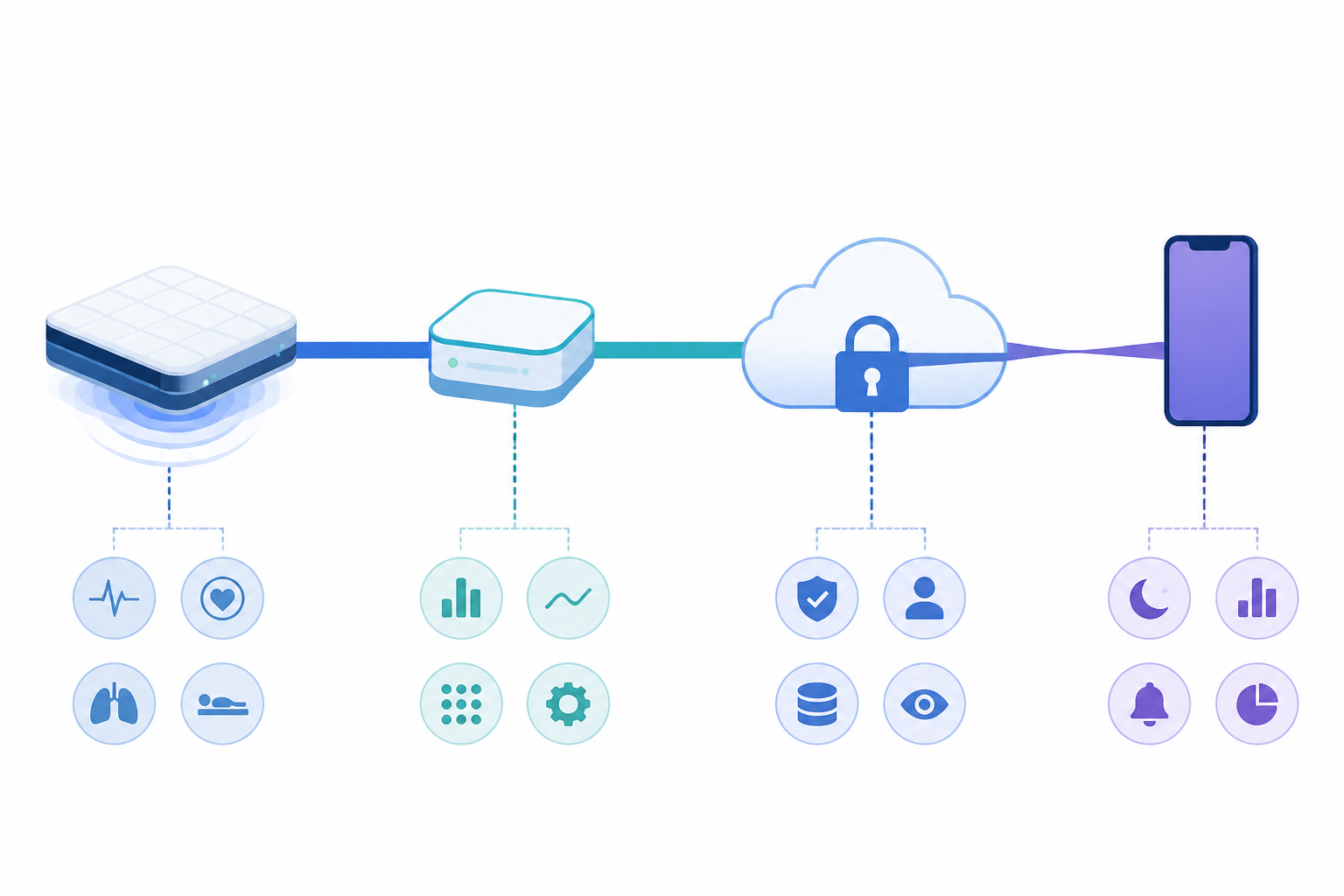
Four layers carry your sleep data from body to report: non-wearable sensors embedded in the bed surface read heart rate, breathing and movement; the mattress transmits to the app over short-range Bluetooth and 2.4 GHz Wi-Fi; storage is cloud backup bound to your account; and the data returns as nightly reports, adaptive firmness changes, or both.
(This image is AI-generated for reference only, not an actual product photo.)
Part of the appeal is that nothing is worn. Sensors inside the bed surface read heart rate, breathing, sleep-stage transitions and body movement — no wristband to charge, no ring to remember. The flip side: the bed collects body data by default, from the first night. If you are not yet clear on how non-contact monitoring works at all, start with How AI Smart Mattresses Track Sleep Health.
The transmission is short-range wireless. The mattress pairs with a phone app over Bluetooth and Wi-Fi — 2.4 GHz Wi-Fi only, with an effective range of roughly 10 meters from the bed, or about 5 meters through a wall. Storage is cloud backup bound to your account. The use layer is where the data comes back to you: a nightly sleep report, adaptive firmness adjustments, or both.
Two operating details calibrate expectations. A nightly report is generated only when the bed registers at least 3 hours in bed and 2 hours of actual sleep, and overseas recording runs in a window from 20:00 to 10:00 local time. All monitoring and reporting here is wellness-oriented — the functions are not intended for medical diagnosis or treatment.
What Does the Manufacturer's Privacy Policy Promise?
DeRUCCI's official information states four commitments: cloud storage with bank-level encryption, sleep data visible only to the user, use limited to optimizing the personal sleep program, and in-app switches to stop collection and delete your history. These are brand-stated policy points — useful, but read the current version for your market before relying on them.
Four points, one per stage of the data path. Cloud storage uses bank-level encryption — the same level of technology used by banks, in the brand's own words. Sleep data is visible only to you. Use is limited to optimizing your personal sleep program. And two in-app switches handle control: one stops data collection at any time, the other deletes your history records.
One honest limiter: these are commitments the brand states about itself, not findings from an independent audit. Policy wording also differs by region, and the applicable version is the one supplied with the product in your market. Ask the store or official channel to identify the exact manual and policy version that applies where you live, and read it before the sales conversation deepens.
Where Is Your Data Processed — Cloud or Edge?
The layer where data is processed sets the privacy boundary. In DeRUCCI's FiberCircuits smart-fiber collaboration with an MIT team, an integrated AI chip runs tinyML inference locally in the fiber itself; and the T12 announced at CES 2026 pairs an edge-computing approach adapted to European and American privacy regulations — processing that can stay local stays local.
In the FiberCircuits project's wording, running inference in the fiber protects privacy while responding quickly. The T12's edge approach points the same direction: computation moves toward the device, and the cloud handles what genuinely needs it.
For a buyer, the question this hands you is direct: on the model in front of you, which processing happens on the device, and which requires the cloud? It is a fair question for any connected sleep product, and the general framework behind it is public — the U.S. National Institute of Standards and Technology publishes research on Analyzing Data Privacy for Edge Systems.
What Do You Give Up When You Stop Collection?
Stopping collection is a right with a real cost attached: the moment you stop it, or disconnect Wi-Fi on a higher model, you also lose the output that justified buying a smart bed. Offline, automatic firmness adjustment keeps working; sleep reports, adaptive algorithm updates and vital-sign tracking do not.
Both controls live in the app: a switch that stops data collection at any time, and one that deletes your history records. On paper, the right to opt out of collection is complete. The tension is what happens next — on the higher models, the reports and adaptive adjustments are the product's distinguishing output, and they stop when collection stops.
Losing internet does not brick the mattress. Automatic firmness adjustment keeps working offline, so the bed stays usable as an adjustable mattress; what requires a valid connection is everything that made it smart — the sleep report, the latest adaptive algorithms, vital-sign tracking. If your home network fails, a 2.4 GHz phone hotspot serves as a backup connection and the mattress stays fully usable. But no hotspot restores reports you chose not to generate. One more question therefore belongs on the pre-purchase list: what do you keep, and what do you give up, when the mattress is offline? A peer-reviewed analysis of privacy-preserving edge computing and IoT (NIH/PMC) covers how local processing reduces cloud exposure.
Which Three Checks Can You Run in the Store?
One store visit covers the checks: ask for the exact policy and manual version for your market and read it first; run the stop-collection and delete-history flow hands-on on a demo unit; and ask staff to list which functions survive without a connection. Pair your own phone and view a sample report to complete it.
The stop-collection switch deserves hands-on attention. A setting that exists only in help articles, sits buried four menus deep, or errors out on a demonstration account is a right that works on paper only — operate it yourself. The offline list is worth asking for too: automatic adjustment surviving offline and connected features making the bed "smart" are two different promises, and staff can name which functions fall on which side.
Add one verification of your own: pair your phone in the store (Bluetooth plus 2.4 GHz Wi-Fi), check the connection, and open a sample nightly report on your own account. Seeing the report flow end to end gives the question "who can see my data" a concrete comparison point. The monitoring and reporting functions are wellness-oriented — not intended for medical diagnosis or treatment — and which models are sold differs by market, so confirm availability in your region at the same visit.
What Should You Do With the Answers Before Buying?
Work in this order: read the policy version before the sales conversation, test the stop-collection switch before you rely on the reports, and ask the cloud-or-edge question while the demonstration unit is running — so every answer arrives while you can still walk away. What you verify yourself beats what you are told.
Answers with receipts: the switch works on the demo unit, the report renders on your account, the offline list matches what the manual says. Each of those is worth more than any reassuring phrase, and none takes long.
With the checklist answered, model selection is the smaller step: confirm the models on sale in your region, then find a store near you and run the checks in person.