
 American
( English )
American
( English ) Singapore ( English )
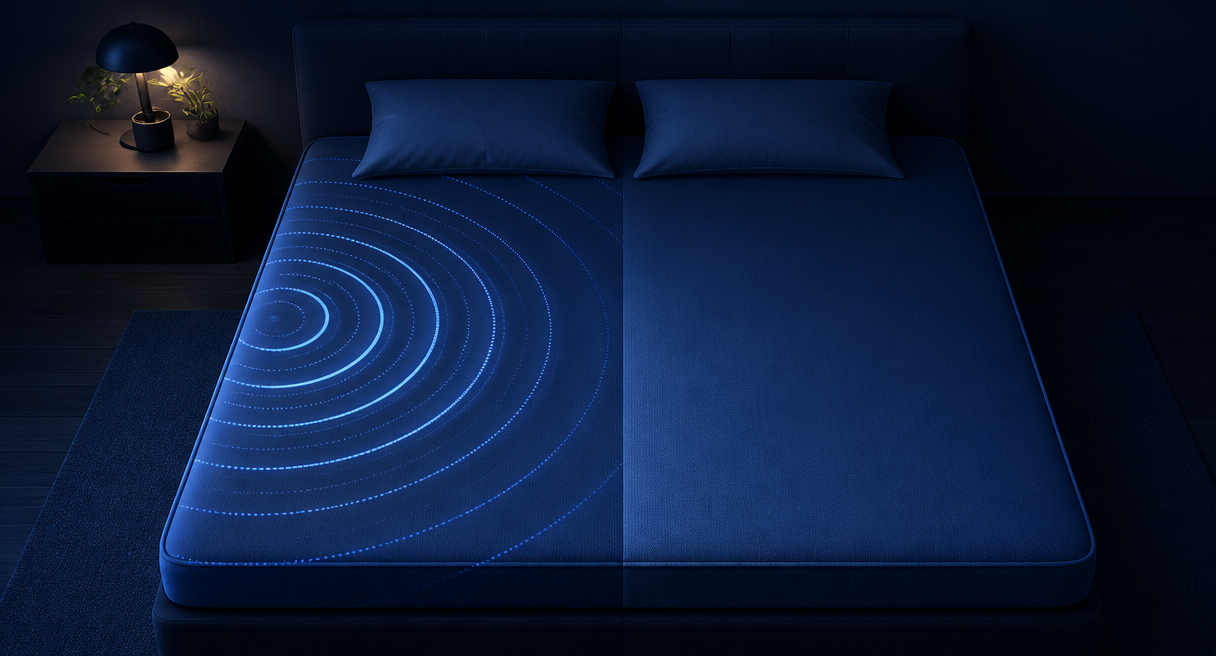
If one partner's turning wakes the other — the classic couples complaint — or the hum of an adjusting base breaks a light sleeper's night, the question is never just how good the motion isolation is. It is which disturbance you are fighting. On a smart mattress, motion isolation splits into four separately evaluable channels: passive structural isolation, operating noise, cross-side interference, and measurable outcomes such as nighttime movements. DeRUCCI maintains this piece in its sleep-education library.
What Motion Isolation Means on a Smart Mattress
Motion isolation on a smart mattress is not one property but four channels evaluated separately: passive structural isolation that absorbs a partner's turning in the materials, operating noise from motors during adjustment, cross-side interference when one side adjusts, and measurable outcomes such as the nightly count of nighttime movements. Each channel gets its own criteria and its own test.
Not every bed that moves is truly smart. The umbrella term hides the split. Motion transfer is what crosses from one sleeper's side to the other through the structure; operating noise is the sound the bed makes while adjusting — a disturbance source ordinary mattresses never had; cross-side interference is whether one partner's adjustment disturbs the other's half; nighttime movements are the measurable outcome, the toss-and-turn count that turns "we sleep better" into a checkable number. Dual-drive, covered below, decides the cross-side channel.
A scope note sets the frame. Included here: everything tied to movement and noise. Excluded: temperature control — it belongs to its own dedicated guide. Anti-snore behavior is base-side preset territory: it runs through preset positions on an adjustable base, so it is covered where base pairing is discussed. And the stakes reach beyond the bedroom: every motion one half passes into the other becomes two people's lost sleep.
The question that follows smart beds around — will adjusting bother a light-sleeping partner — has a spec answer: the series states a running-noise figure below 28 decibels. For solutions organized by shopping scenario, the companion piece Best Smart Mattress for Couples: Motion Isolation carries the other half of the pair.
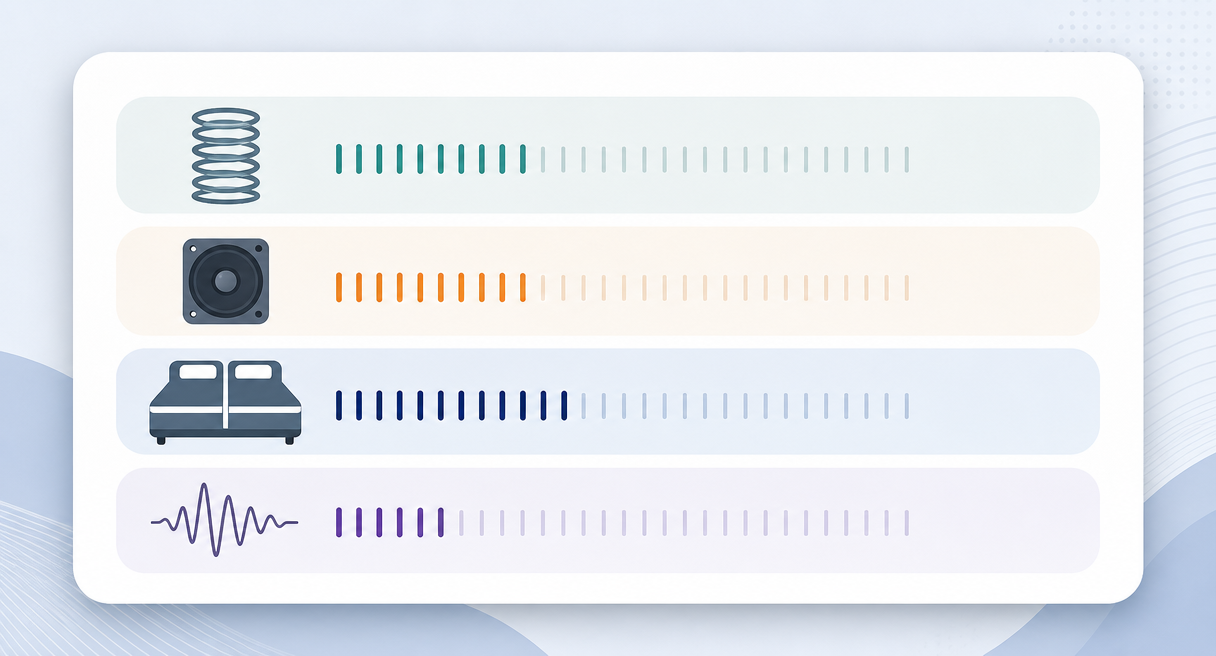
(This image is AI-generated for reference only, not an actual product photo.)
The Numbers Behind Each Channel
The four channels carry different numbers. Operating noise: below 28 decibels across the T11 series — quieter than the quietest sleep mode of most air conditioners. Cross-side: dual-drive on the T11 PRO adjusts both sides at once, neither disturbing the other. Outcomes: CAICT-measured nighttime movements down 27.5 percent on the T11 SE.
On the noise channel, the series spec sheet states one figure across the line: adjustment running noise below 28 decibels. The quietest sleep mode of most air conditioners already runs at 30 decibels or more, so a bed under that figure is quieter still — roughly a soft whisper. And the design goal of the Intelligent Sensorless mode is adjustment that passes unnoticed — a stricter target than adjustment you can barely hear. The quiet running rests on granted patents — silent motors, dual-floating vibration isolation, multi-channel noise control.
On the cross-side channel, architecture is the whole story. Dual-drive motors in the T11 PRO let the left and right sides adjust independently and at the same time, with neither side disturbing the other — the engineering description of a bed built for two. For the 3 a.m. question, the loop is the operational answer: the bed reads a partner's turn as it happens and reshapes that side on its own, in the Sensorless mode designed to go unnoticed.
On the outcomes channel, the certified number belongs to the T11 SE: according to independent CAICT lab testing of the T11 SE tier, nighttime movements fell by 27.5 percent — in plain terms, the sleeper tossed and turned almost 30% less. Keep the two clocks apart where response times are discussed: the 20-millisecond figure covers Tidal 2.0 data analysis, and the within-eight-seconds figure covers the mechanical adjustment itself.
On the passive channel, the material story is German AGRO springs: individually pocketed, each spring encapsulated so it moves on its own — a partner's turn compresses the springs beneath them without dragging the rest of the net. The pocketed coil survived 300,000 compression cycles, with the A.TiCu-S titanium-copper alloy among its patented material choices. The mechanics of pocketed coils are unpacked in what is a coil mattress.
| Channel | What it measures | Reference numbers | Tier notes |
|---|---|---|---|
| Operating noise | Sound during adjustment | < 28 dB, series-wide | Sensorless mode: imperceptible by design |
| Cross-side | One side's adjustment vs the other | Simultaneous dual-drive | PRO dual-drive; each tier's left-right mode sits on its spec sheet |
| Outcomes | Nighttime movements, detection | −27.5% (CAICT, T11 SE); movement detection 100%, ≤8 s (T11 PRO) | 20 ms = data-analysis figure |
| Passive structure | Motion transfer through materials | 300,000-cycle pocketed coils | AGRO springs, all tiers |
How to Test It: Store Protocol and Home Evidence
Testing runs on two proof layers. A store visit settles first-night comfort and almost nothing about motion isolation for smart features; noise, cross-side behavior and outcomes need their own checks — six in store, and multi-night evidence at home. Mixing the two layers is the most common cause of smart-bed disappointment.
The two layers carry different proof burdens: ten minutes on a mattress tells you about initial comfort, while the channels above are about behavior over hours and weeks. The store protocol checks what a store can:
- Dual-side simultaneous adjustment — on a dual-drive demo, run both sides at once and watch whether one side disturbs the other.
- The modes — switch between Intelligent Deep and Intelligent Sensorless, and feel whether Sensorless is genuinely imperceptible.
- App pairing for both partners — the app pairs with two phones; confirm adjustments register in real time on both.
- The motor-noise listening test — you should barely hear a healthy demo unit's motors; clearly audible ones mean the unit fails its spec — ask for another or walk away.
- The monitoring indicator — confirm the tier carries monitoring and watch it activate as you lie down.
- Adjustable-base presets — if paired with an adjustable base, test how its presets stack with mattress adjustment.
The home layer answers what no store can: whether the behavior holds night after night. On tiers carrying the sleep-management system, the report generates automatically inside a 20:00-to-10:00 window once you have been in bed at least three hours and asleep at least two — which explains the two most common false alarms. No report appeared? Check those durations first. Cannot feel the adjustment? Check whether the bed is in Sensorless mode, designed to be nearly unfelt. The multi-night movement trend is what to watch — read the trend across nights; a single night proves little.
A spec sheet confirms the stated noise figure and the left-right mode; it cannot confirm your sensitivity to 28 decibels. A meaningful store visit needs a dual-side demo unit and room for two, and a call ahead to confirm the floor can run both. The adjustment modes continue in How Adaptive Firmness Technology Works.
Weights and Verdicts: Matching Channels to Your Couple Type
Weights follow the interference structure, with no total score computed. Light-sleeping pairs load operating noise and cross-side behavior first; offset-schedule couples load adjustment timing and quiet; heavy turners load passive isolation and the measurable outcomes. How much disturbance you feel comes down to three things: the movement sources in the night, how much of each transfers, and your own sensitivity.
That three-factor structure explains why blanket verdicts fail. Weights, accordingly:
| Couple type | Load first | Decisive test |
|---|---|---|
| Light-sleeping pair | Operating noise, cross-side | Noise listening test + simultaneous-adjustment demo |
| Offset schedules | Adjustment timing | Sensorless overnight; does the later partner's adjustment disturb? |
| Heavy turners | Passive isolation, outcomes | Pocketed-coil structure + multi-night movement trend |
One upstream mechanism belongs in every weighting: a mattress that is too firm forces the sleeper on bony pressure points to change position more often — getting support right is upstream of getting movements fewer, and no isolation architecture out-engineers a support mismatch generating them.
Verdicts, and the caveats that come with them. If you can clearly hear motor noise on a demo unit, that unit fails — swap it or walk. If your schedules collide at bedtime, the left-right operating row of the spec sheet and a dual-side demo in store settle the cross-side question. The category alternatives are worth knowing, because no single winner exists: a manually adjusted split pair — two singles side by side — leaves a feelable seam but gives each side complete independence; fixed-zone air-chamber beds offer zones without continuous adjustment, and vibration can travel their structure; a pure memory-foam passive bed has no electronics, hence no operating noise — and no adjustment capability at all.
The T11 series answers, channel by channel: operating noise at the series figure quoted above plus the Sensorless mode; cross-side behavior via dual-drive on the PRO and the left-right operating mode stated on each tier's spec sheet; outcomes via the CAICT-measured movement reduction cited above on the T11 SE and the PRO's certified movement detection; passive isolation via AGRO pocketed coils. The T11 SE AI mattress is now available at the DeRUCCI New York store; other tiers and regions are a store-confirmation question — check the product page's spec table and confirm display models before traveling.
Frequently Asked Questions
---
Press each factor, run the six checks, read the trend at home. The full decision path, from evaluation to after-sales care, is mapped in the smart mattress buying decision guide, and to run the listening test yourself you can find a store.