
 American
( English )
American
( English ) Singapore ( English )
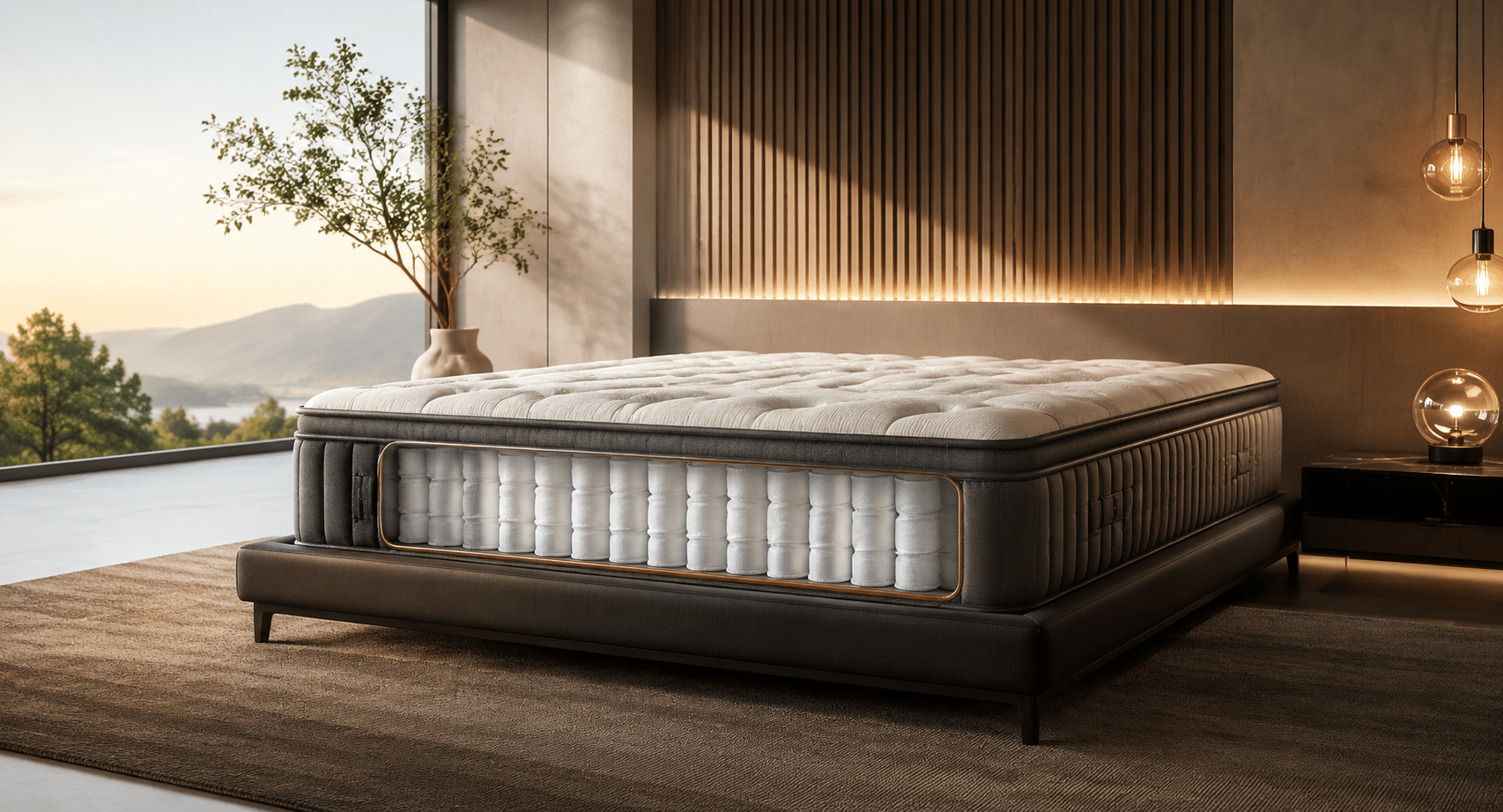
Coil mattresses carry an unfair reputation. Many shoppers still link springs to the squeaky, sagging beds of decades ago and assume that anything 'advanced' must be made of foam. Yet metal springs remain the support core of most premium mattresses, including the ones that cost the most and last the longest. Coil technology did not stand still. The springs inside a modern high-end bed are engineered to a level the old continuous units never reached. To understand what a coil mattress really is, you have to separate the three spring architectures, see why independent pocketed coils changed the category, and learn what distinguishes a commodity spring unit from one built to last for many years.
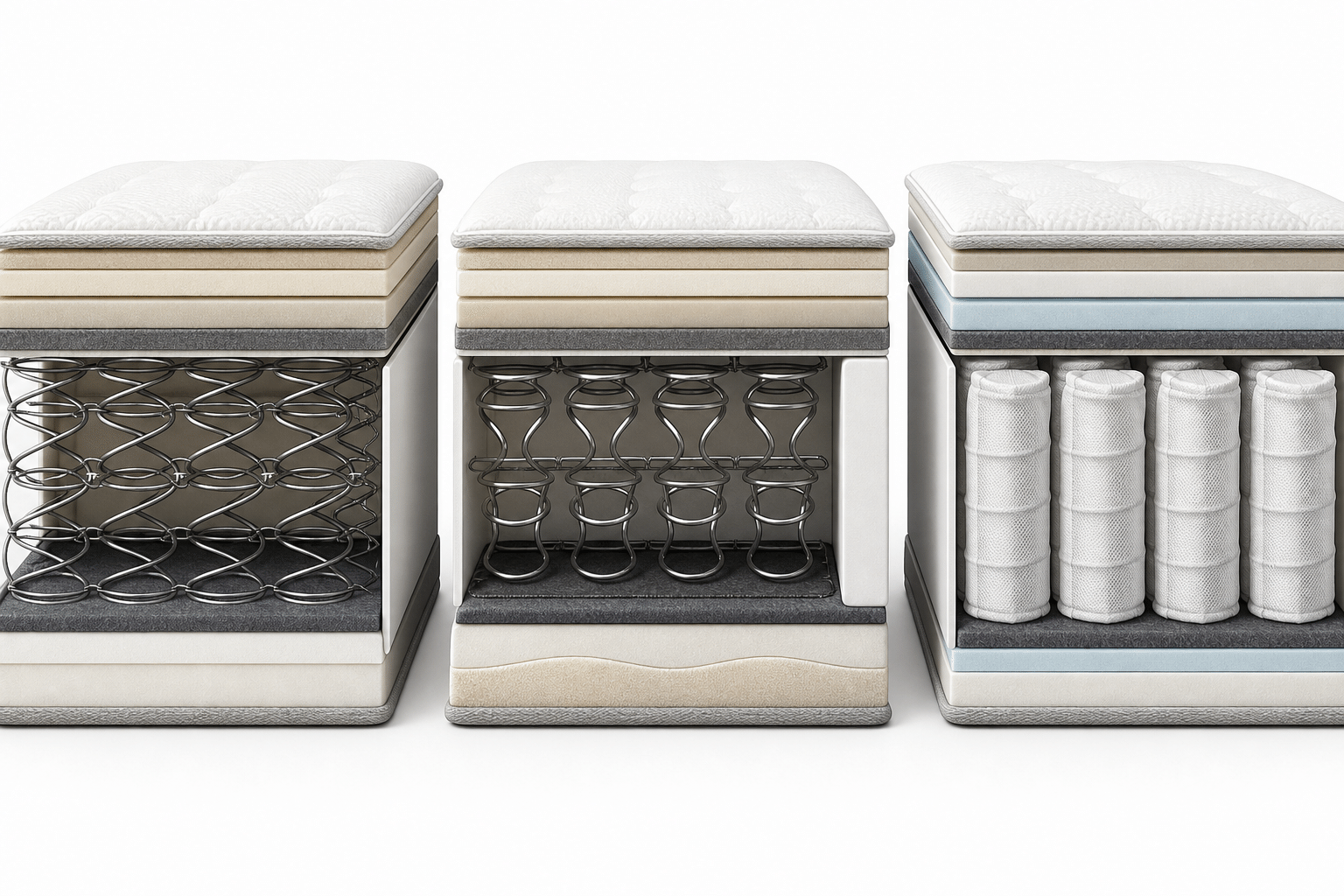
(This image is AI-generated for reference only, not an actual product photo.)
What 'Coil Mattress' Actually Means
A coil mattress is any mattress whose main support layer is a grid of metal springs, and three architectures dominate: Bonnell, offset, and pocketed. The distance between the oldest and the newest is the distance between a budget guest bed and a flagship, because pocketed coils wrap each spring in its own fabric sleeve so it compresses without pulling its neighbors.
Bonnell coils are the original design: a single continuous wire shaped into an hourglass grid and tied together across the top. Because every spring is physically connected, the whole unit moves as one sheet. It is inexpensive to build, but it transfers every movement and offers little targeted support. Offset coils improve on this slightly by hinging each spring on its own, which softens the ride, but they still share a connected frame. Pocketed coils are the modern break from that chain. Each spring is wrapped in its own fabric sleeve, so it compresses on its own without pulling its neighbors. That single change is what allowed springs to compete with foam on comfort while keeping the airflow and resilience that foam cannot match.
How Coil Springs Work: Pocketed vs Continuous
Continuous coils move as one connected web, so a partner's toss ripples across the entire surface, while pocketed coils sit in individual fabric sleeves so each spring responds on its own. That difference is exactly what ended the motion-transfer and noise problems that earned springs their bad name.
Picture a continuous-coil unit as a single trampoline: press one corner and the rest shifts with it. That connected motion is why older spring beds sent every roll and turn to the other side of the mattress, and why they creaked under load. Pocketed coils work like the keys of a piano or the independent shock absorbers on a car: press one, and only that one moves. Each wrapped spring compresses under the weight directly above it, so a heavier hip gets firm pushback while a lighter waist sinks less, and a partner rolling over stays on their own side of the bed. The fabric sleeves also dampen the metal-on-metal contact that causes spring noise, which is why a well-built pocketed coil unit is effectively silent.
Support Zones & Durability
A coil layer's real quality shows in how it is zoned and tested, not in raw coil count, because good units split the bed into firmness zones that match the shoulders, waist, and hips. Lifespan is measured in compression cycles and wire gauge, the same yardstick that separates a short-lived bed from a long-lived one.
Support zones matter because the human body is not uniform: the shoulders and hips need to sink while the waist needs lift. A zoned coil unit changes the wire gauge or coil count in different bands to give each region the right resistance, keeping the spine level rather than letting the heaviest parts bottom out. On durability, the figures that count are the wire gauge (thicker steel holds its shape longer), the number of compression cycles the unit survived in testing, and whether the steel received an anti-corrosion treatment to stop rust over years of humid nights. Coil count, by contrast, is a weak signal on its own. A high count of thin, untested wire will sag far sooner than a lower count of heavy, certified steel.
The Pinnacle of Pocketed Coils: Inside German AGRO Springs
If pocketed coils are the ceiling of spring engineering, the benchmark for that ceiling is set in Bad Essen, Germany, where AGRO Springs has spent more than sixty-five years building independent pocketed coils. Its A.TiCu-S titanium-copper alloy spring system, protected by international patent and certified to roughly 300,000 compression cycles, is what goes into mattresses built to a multi-decade standard.
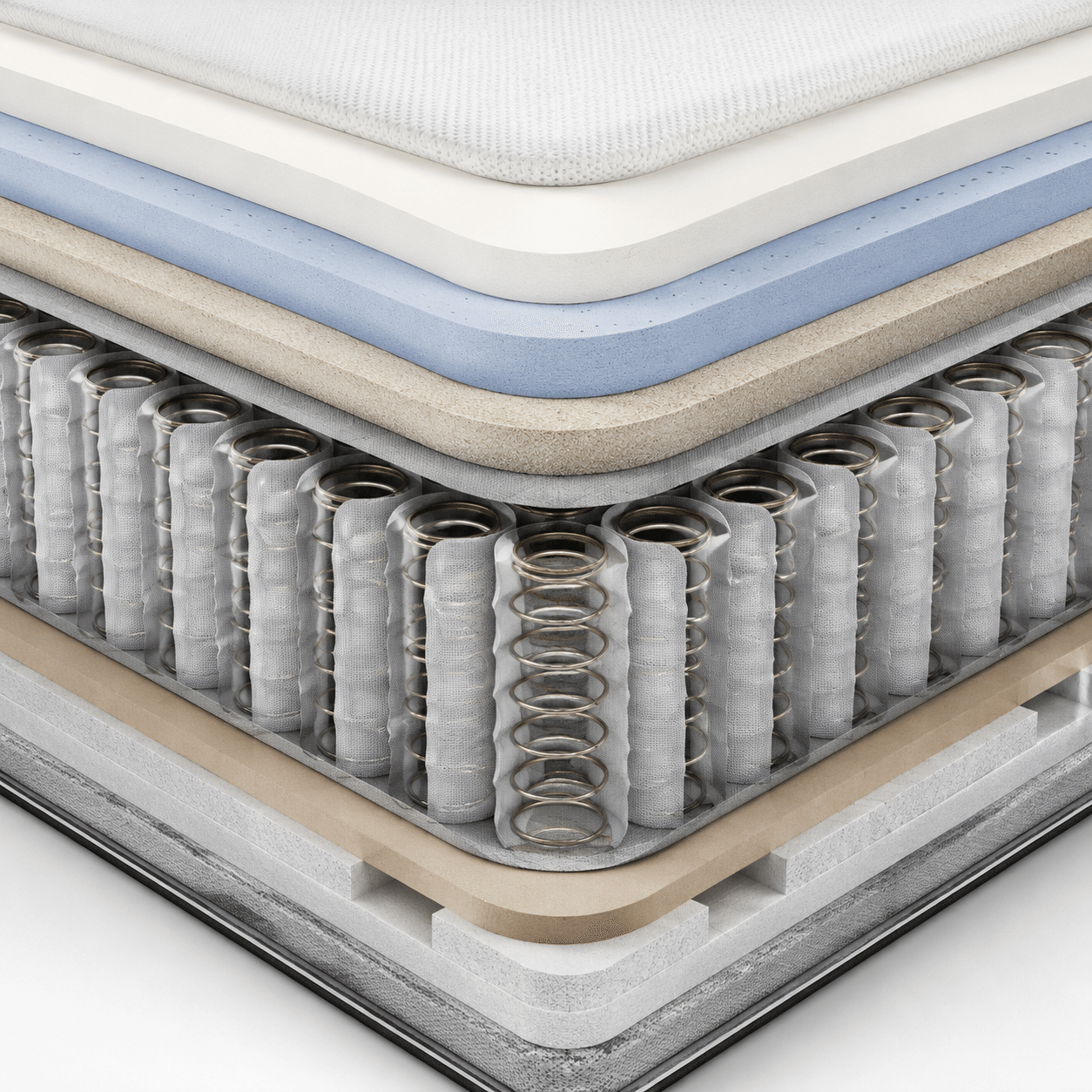
(This image is AI-generated for reference only, not an actual product photo.)
AGRO's six-plus decades of pocketed-coil experience matter because spring engineering is cumulative. The tolerances, sleeve materials, and heat treatments that make a coil hold its rebound for years are learned on the factory floor, not sketched on a screen. Its A.TiCu-S system uses a titanium-copper alloy that is lighter, more corrosion-resistant, and more fatigue-resistant than ordinary steel, and the unit is certified to roughly 300,000 compression cycles. That is the kind of number that explains why a properly built coil layer can outlast the foam above it. Each coil is individually encased so it compresses independently, and the system carries three international certifications covering performance, materials, and safety. (Source: DeRUCCI product material specifications.) To see how this spring engineering combines with latex and breathable fabrics in a finished bed, the DeRUCCI mattress materials guide lays out each layer, and the Century Dream mattress collection shows the same AGRO coils in a current model.
Buying Tips & Common Myths
Three questions come up again and again with coil mattresses, whether pocketed coils work with adjustable bases, whether they suit a bad back, and how long they last, and the answers cut against the old myth that springs are basic. Run a short checklist on coil type, wire gauge, zoning, and anti-corrosion treatment before buying.
Pocketed coils pair well with adjustable bases because each sleeve flexes independently, so the bed can bend at the head or foot without stressing a connected grid. For back pain, the relevant feature is zoned support: a coil unit that firms up under the lumbar region keeps the spine aligned better than a uniformly soft surface. And on lifespan, a coil layer built to a high compression-cycle standard often outlasts the comfort foam on top of it, which is why the frame of a quality spring bed can survive long after the first owner replaces the mattress.
Before buying, run this checklist:
- Confirm the coil type. Pocketed, not Bonnell, if you share the bed.
- Ask about wire gauge and compression-cycle testing, not just coil count.
- Check whether the unit is zoned for shoulders, waist, and hips.
- Look for anti-corrosion treatment on the steel.
- Match the coil firmness to your sleep position.
If you want to feel how German AGRO pocketed coils pair with latex and breathable fabrics in a finished bed, the Century Dream collection brings that combination to the range. To test the build in person, find a global store.