
 American
( English )
 Singapore ( English )

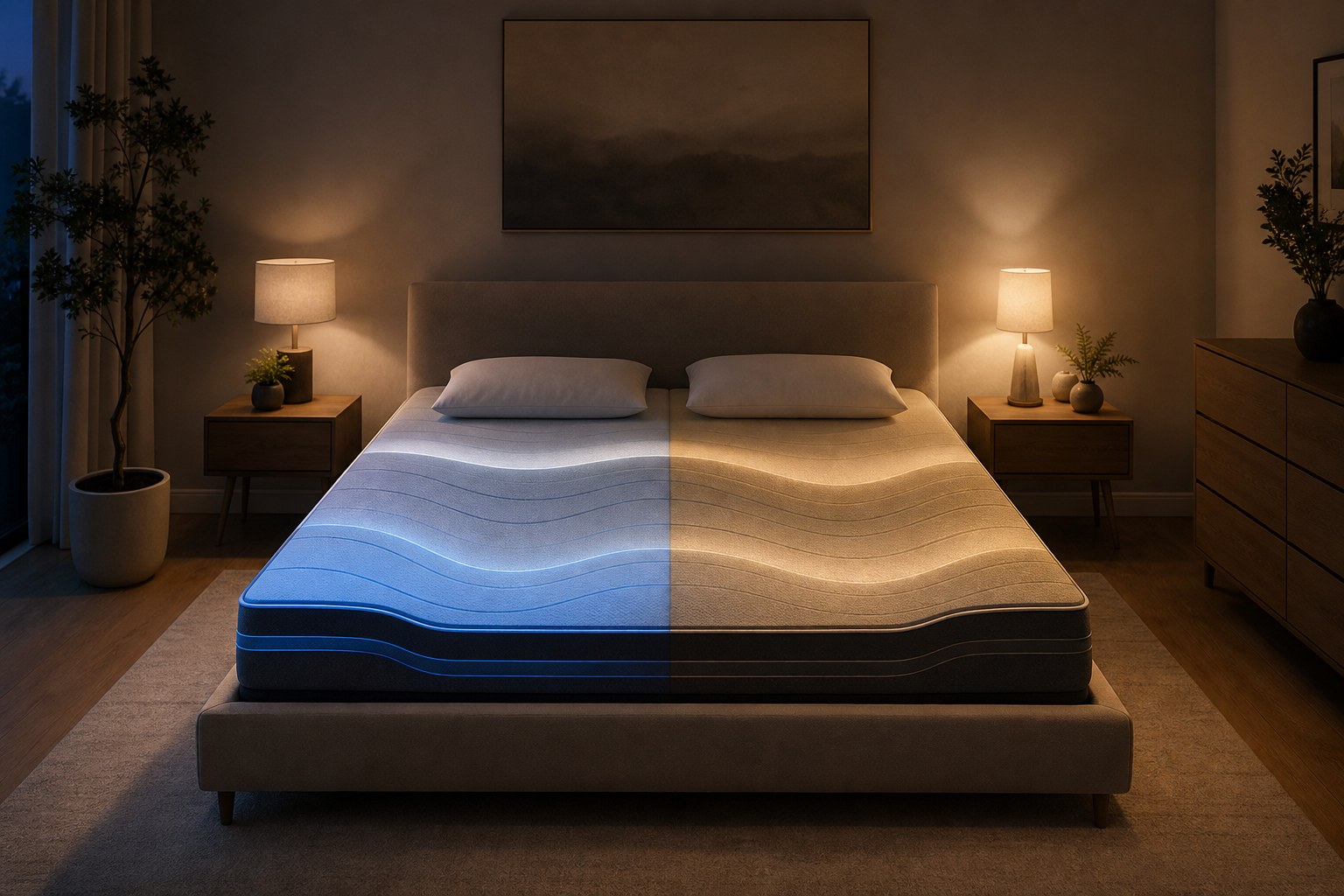
Sleep changes during pregnancy, and the bed underneath it starts to matter in new ways. Searching for the best smart mattress for pregnancy usually means two things at once: the body needs more deliberate support in side-lying positions, and the heat that builds through the night becomes harder to shake off. DeRUCCI's T11 series addresses both, though in different layers — worth taking one at a time. Nothing here is medical advice; it is a walkthrough of what support and temperature features actually do.
What Two Things Should a Pregnancy Mattress Get Right?
Judge any candidate on two lines before comparing brands. First, side-lying support: the recommended arrangement pairs a side position with a pillow between the knees and a supportive pillow under the abdomen, on a surface firm enough to avoid sinking. Second, heat handling: breathability and any temperature features matter as much as firmness when nights run warm.
The support line comes with a specific sleeping arrangement, not just a firmness number. Sleep-guidance materials that categorize sleepers by body type place pregnant users in the load-bearing group, with side-lying as the main position, a pillow between the knees to steady the pelvis, and a pillow beneath the abdomen to reduce the pulling sensation of the belly's weight. The pillows handle the body's positioning. The mattress handles what each loaded zone pushes against.
The firmness principle that follows is the same one spinal-friendly bedding guidance gives everyone, just felt more strongly: a surface too soft leaves muscles working all night to hold position; a surface too hard concentrates load on bony points and invites constant repositioning. During pregnancy, with more weight carried forward, both failure modes make themselves noticed faster.
The second line is temperature. Warm nights during this stage are a common enough complaint to treat as a design input, not an anecdote. For a mattress, that means asking a narrower question: how does this specific construction move heat, and what can its materials actually do? Both lines below describe support, comfort and temperature as experiences, never health outcomes.
How Does Zoned Support Match a Side-Lying, Load-Bearing Body?
In side-lying positions, shoulder, waist and hip carry the load, so the mattress needs to answer each of those bands rather than offer one overall firmness. DeRUCCI grades zoning across three tiers: three zones covering those exact bands, five adding back and leg, six splitting the leg zones most finely. Pillows and zones are complements, not substitutes.
Zone by zone, the logic is straightforward. The shoulder needs to settle so the neck stays level. The waist needs a bridge so it does not sag into a gap. The hip, carrying more weight now than usual, needs to sink just enough without bottoming out. A single firmness answers all three with one compromise; zoning answers each on its own terms.
| Tier | Zones per side | How it reads for side-lying support |
|---|---|---|
| T11 SE | 3 | Shoulder, waist, hip — precisely the bands that take the load when side-lying |
| T11+ | 5 | Adds back and leg zones, extending coverage for varied positions |
| T11 PRO | 6 | Splits thigh from calf; the finest division in the series |
According to the T11 PRO product documentation, each side features 6-zone adjustment covering shoulders, back, lumbar, hips, thighs, and calves, adjusted independently on each side.
One detail matters for couples: the T11 PRO runs 18 adjustment units, nine per side, on two control boxes, so both sides adjust simultaneously and independently. On tiers below the PRO, one side finishes adjusting before the other begins. For two people sharing a bed through a pregnancy, that timing difference is worth knowing, not overselling.
What Can Graphene Heating and 4.4x Breathability Actually Do?
Temperature claims deserve precise reading. The far-infrared graphene heating in this series exists only on the T11 PRO, only in the leg zone, and it heats rather than cools. Breathability is the other half: the 3D-Plus material carries a 4.4x airflow rating. There is no active cooling in this series, and that is where realistic expectations start.
Start with what the heating is, precisely. According to official specifications, the graphene far-infrared layer warms the leg zone of the T11 PRO, controlled per side in the app. That is its entire scope. It is written here as a leg-comfort feature for people whose feet run cold, in the same spirit as the foot-of-the-bed hot water bottle, and not as anything with circulation or health effects. Respecting your body's comfort signals during this time is its own discipline, and a warm surface is one input among several.
Breathability is the broader half of the temperature answer. The 3D-Plus material carries a 4.4x airflow rating in DeRUCCI's materials specifications, and dispersed airflow is how a mattress sheds the heat a body accumulates through the night. For warm sleepers generally, that rating is the number to look for.
Two more reference points are worth carrying:
- As a general (not product-tested) reference, 60–67°F is the commonly cited bedroom temperature range for sleep.
- Managing warm nights comes down to room temperature, a breathable mattress and, on the PRO, optional leg-zone warmth.
Within the wider category, surfaces that can heat a specific zone and fabrics that breathe each handle one part of the night. The full temperature picture for hot sleepers is covered in Smart Mattress Temperature for Hot Sleepers.
What Happens Overnight, and How Do You Verify It?
After sleep onset, the T11 series senses pressure changes and adjusts in real time, which is the practical difference from passive materials and from manual settings that need someone awake to change them. Certification data is attributed clearly, monitoring features belong to specific tiers, and three showroom actions let you test the loop yourself.
The overnight layer is where a mattress either responds or waits. Through a pregnancy the load keeps shifting: the belly's weight changes what the hip and waist push against, and every turn of the night redraws that map. The response happens beneath you while you sleep; the only trace you will see is the morning report.
The numbers come with attribution: according to official specifications under CAICT certification — figures attached to the T11 SE tier of the series — recorded sleep onset time down 37.3%, nighttime turns down 27.5%, deep sleep duration up 4.5% and continuous deep-sleep stretches up 5.9%. This article reads those figures only as they relate to support fit and the felt experience of fewer position shifts. They are not health claims of any kind.
Monitoring has a tier structure worth knowing before you shop. Heart-rate detection accuracy of 97% is a T11+ specification. The SleepCare system, running CPC (cardiopulmonary coupling) technology developed with Harvard Medical School, belongs to the T11 PRO. The nightly report on the T11+ and above is generated after at least 3 hours in bed and 2 hours of sleep; for overseas users, the recording window runs 20:00 to 10:00 local time.
Three showroom actions close the loop:
1. Lie down in your actual arrangement: on your side, with a pillow between the knees, and feel how the zones respond.
2. Ask staff to trigger the automatic adjustment and notice whether you can feel it happening beneath you.
3. Open the app and check the zone-response display.
DeRUCCI sells through more than 5,200 stores across 11 countries and regions; which models your market carries varies, so confirm locally. For two people whose needs diverged long before pregnancy, the Adjustable Mattress for Couples guide covers how dual-side adjustment works in daily use.
Frequently Asked Questions
With both lines checked and the showroom tests done, specifications are the remaining detail. The T11 product page lists zoning and temperature features for the series. To test the side-lying arrangement yourself, find a store near you.