
 American
( English )
American
( English ) Singapore ( English )
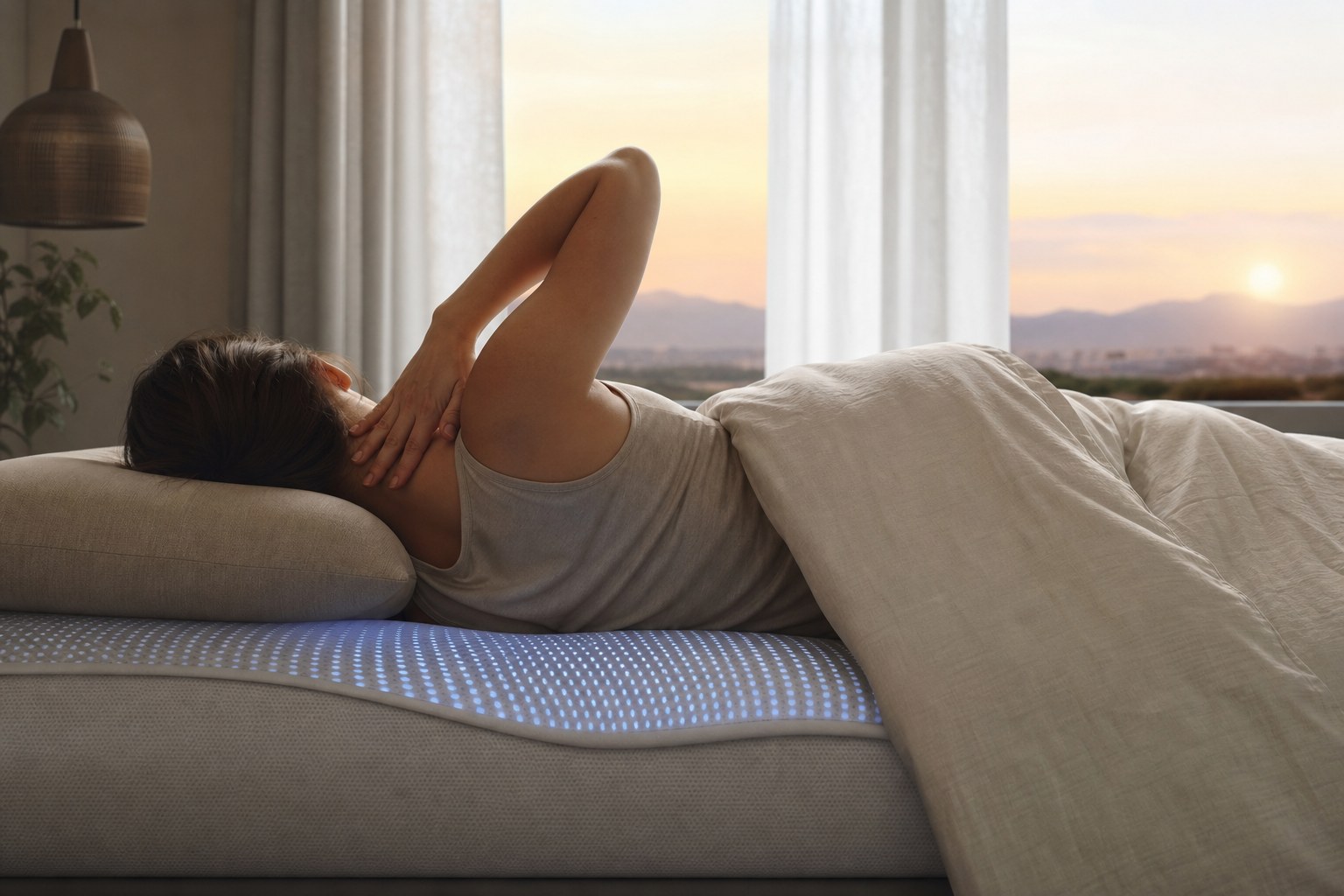
You feel it before you even open your eyes: the neck did not get through the night well. Before comparing brands or chasing rankings, it helps to know what actually separates a surface that supports the neck from one that does not. The best smart mattress for neck pain is decided by checks you can verify yourself: how well the surface follows the neck's curve, how it treats the shoulder underneath, and whether the support keeps working after you have fallen asleep. DeRUCCI builds its T11 series around those exact questions, and this article takes them one at a time.
How Do You Judge the Best Smart Mattress for Neck Pain? Three Checks First
Rankings answer the wrong question first. For neck pain, three checks matter before any brand comparison: whether the surface tracks the neck's curve while unloading the shoulder, whether the firmness sits in the medium band that avoids collapse on one side and bone pressure on the other, and whether support can change as sleep positions change overnight.
A 2026 spinal-friendly bedding white paper frames spine friendliness across four dimensions: precise fit to the spinal curves, stable support that resists sinkage, even pressure distribution at the bony points such as shoulders, elbows, knees and ankles, and personalized adaptability. For neck pain specifically, the first and third dimensions carry the most weight. The neck sits at the top of the chain: when the shoulder is not unloaded properly, the cervical section pays for it.
The second check is firmness balance. The same white paper guidance is blunt about both failure modes: a surface that is too soft leaves muscles tensing to compensate all night; a surface that is too hard presses bony points until discomfort forces position changes. A neck that wakes stiff can come from either direction.
The third check is the one most mattresses fail quietly. A fixed firmness, however well chosen, can only be optimal for one posture. Roll from your side to your back at 2 a.m. and the ideal support map changes with you. So before the badges and awards, three things are worth checking:
1. Fit and pressure: does the surface hold the neck's curve while spreading load off the shoulder's bony points?
2. Firmness band: does it sit in the medium range, avoiding both muscular compensation and bony-point pressure?
3. Adaptability: can support change as your position changes, without you waking up to change it?
Why Can't One Uniform Firmness Support the Neck and Shoulders?
Neck comfort is largely decided one zone down, at the shoulder. A shoulder zone set too firm leaves the neck suspended in mid-air; one too soft lets the shoulder sink and pull the cervical angle sideways. Zoned construction exists for exactly this reason, and DeRUCCI grades it across three tiers, from three zones per side up to six.
Side sleeping loads the neck and shoulder more than any other posture, which is why side sleeping has its own support map. The mechanism is simple: the shoulder is the widest point of the upper body. If the bed is firmer than the shoulder can compress into, the shoulder holds the body up and the neck hangs unsupported. If the bed is softer than the shoulder needs, the shoulder sinks too far and the neck tilts to meet the pillow. Neither is a fit problem you can pillow your way out of for long.
Zoning addresses it structurally, by letting each body band get its own response instead of one uniform firmness. Across the T11 series the grading runs:
| Tier | Zones per side | What the zoning covers |
|---|---|---|
| T11 SE | 3 | Shoulder, waist, hip — the three zones that carry the most load in side sleeping |
| T11+ | 5 | Adds back and leg zones; back sleepers gain a dedicated lumbar zone |
| T11 PRO | 6 | Splits thigh from calf for the finest division in the series |
According to the T11 PRO product documentation, each side features 6-zone adjustment covering shoulders, back, lumbar, hips, thighs, and calves, tuned independently per sleeper. The 18-unit, six-zone arrangement is covered by patent 202010801174.3.
Three zones aim at the side sleeper's heaviest bands. Five introduces a dedicated lumbar band that matters once back sleeping enters the picture. Six is the finest split, and per-side independence is what lets two people with different neck-and-shoulder needs share one bed. For the posture that loads the neck most, the fuller side-sleeping picture is in Best Smart Mattress for Side Sleepers.
What Happens to Neck Support After You Fall Asleep?
Neck support is tested hardest when nobody is awake to notice it. Two common constructions fall short here: passive foam waits for the body to adapt to it, and manual firmness settings need a person awake to operate them. Sensor-driven mattresses read pressure changes overnight and adjust on their own, which is where this category genuinely divides.
Discomfort does not wait until morning to start, and the surface beneath you does not have to either. That is the practical case for automatic adjustment: the hours that decide how your neck greets the morning happen while you are unconscious of them.
The difference shows up most clearly deep in the night, when a shoulder rolls further into the bed or a hip settles heavier. Those are the pressure changes the sensing layer reads — load shifting between body bands — and the zones involved respond on their own, which is the whole point of checking adaptability before you buy.
There are numbers to anchor this, with a clear attribution. According to official specifications under CAICT certification — figures attached to the T11 SE tier of the series — recorded sleep onset time down 37.3%, nighttime turns down 27.5%, deep sleep duration up 4.5%, and continuous deep-sleep stretches up 5.9%. Of the four, the nighttime-turn figure speaks most directly to the neck scenario: a support mismatch tends to show up as repeated position shifts, and fewer of them reads as a better-matched surface. These are certification figures for the platform's adjustment behavior, described here as comfort and support experience, not as medical outcomes.
Neck and lower-back complaints often travel together along the same nightly chain. If the lower back is where your mornings actually start, the supporting analysis is in Best Smart Mattress for Back Pain Relief.
How Do You Verify Any of This Before Buying?
Specifications narrow the shortlist; your own neck settles it. Three showroom actions cover most of the ground: lie down in your real sleep posture and feel how deep the shoulder sinks, ask staff to trigger the automatic adjustment and notice whether you feel it, then open the app and check the zone display.
You can run all three yourself — no special equipment or expertise needed:
1. Lie down as you actually sleep, on your side, for more than a few minutes. Feel how deep the shoulder settles and whether the neck stays roughly level. Check it against the two failure modes from the first section: suspended neck, or sunken shoulder.
2. Ask a staff member to trigger the automatic adjustment while you rest on the bed. The question is simple: do you notice it happening, or only notice the result?
3. Open the app on the display unit and look at the zone response view. Zoning that exists in the structure should be visible in the data layer, not just on the spec card.
DeRUCCI sells through more than 5,200 stores across 11 countries and regions, and which models a given market carries varies, so confirm locally what is on the floor. On the reporting side, two fixed conditions: the nightly report is generated after at least 3 hours in bed and 2 hours of sleep on the T11+ and above, and for overseas users the recording window runs from 20:00 to 10:00 local time. One more split worth knowing: heart-rate detection accuracy of 97% is a T11+ specification, while the SleepCare system, built on CPC (cardiopulmonary coupling) technology developed with Harvard Medical School, belongs to the T11 PRO alone.
One boundary stated plainly: everything in this article describes support, comfort and pressure relief as felt experience. None of it is a claim about treating or curing neck pain.
Frequently Asked Questions
With the checks and the store tests behind you, what remains is confirming specifications. The T11 product page lists the zone and adjustment details for the series. To feel the shoulder zone with your own neck, find a store near you and lie down in the posture you actually sleep in.