
 American
( English )
 Singapore ( English )

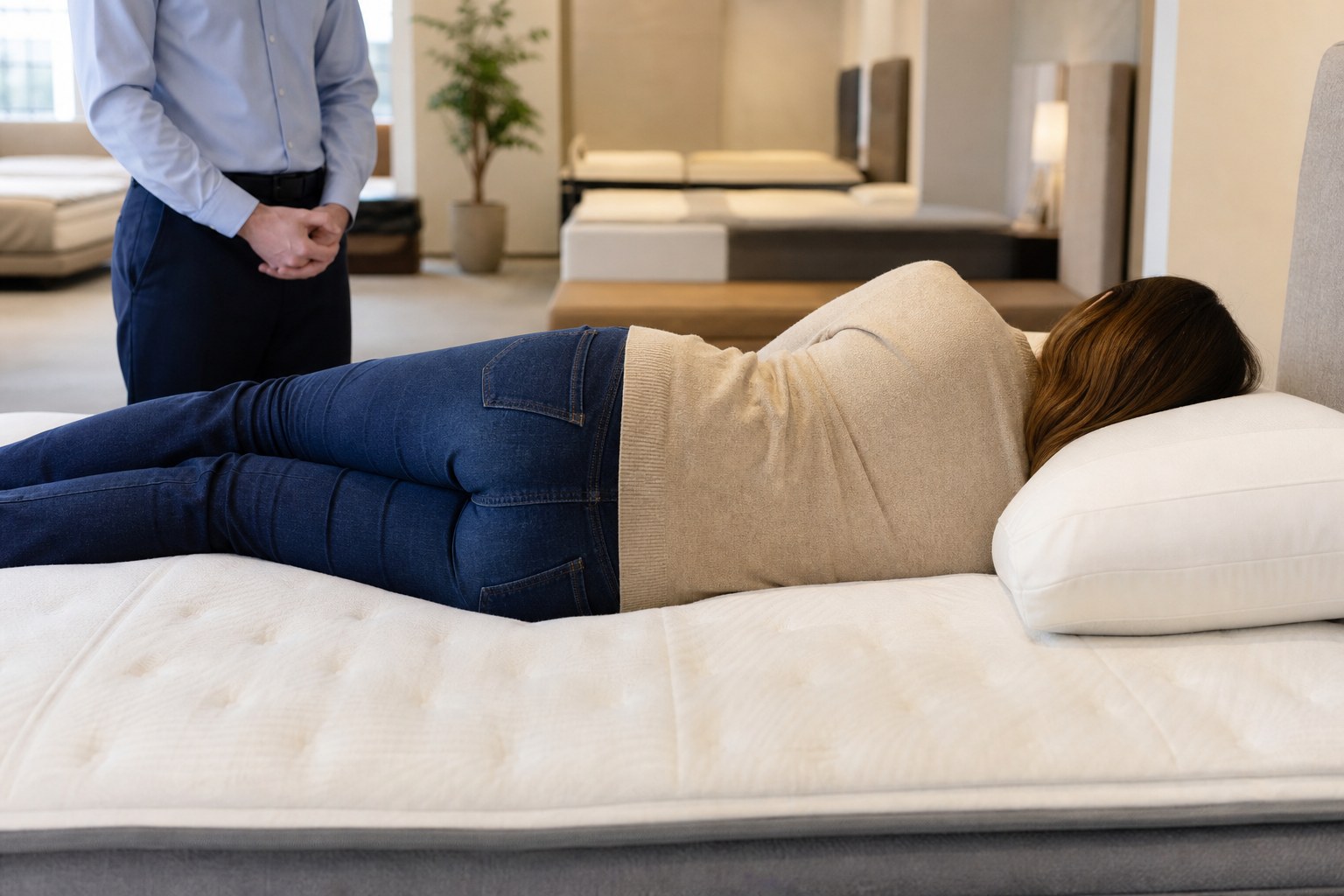
Two people buy the same medium-firm mattress. One calls it perfect; the other calls it a plank. Both are telling the truth, because "medium firm" is a factory setting, not a description of your body — the same label plays out as three different mattresses for a side sleeper, a back sleeper and a heavier body. The DeRUCCI-aligned 2026 sleep-standard white paper puts the workable zone between the soft and hard extremes, and the label decodes with three variables: zoning, body weight and sleep position.
The Label Is a Starting Point, Not a Verdict
"Medium firm" describes one property: how strongly the structure resists sinking. It says nothing about the body that will lie on it. No industry-wide mandatory firmness scale exists, so the label compares within a brand's line, not across brands. What you feel is that resistance meeting your weight and position — two variables never printed on the label.
Start with what the words are measuring. Firmness labels describe structural resistance — the materials' unwillingness to let your body sink in. That is a property of the mattress alone, testable on a factory floor and identical for every buyer.
What you experience in bed is a different quantity. Your felt firmness is the structure's resistance meeting your specific weight and sleeping position: the same structure yields more under a heavier body and feels softer than its label; it yields differently under a side-loaded shoulder than a flat back; and zoning changes which regions respond at all. Therefore two honest people can report opposite experiences of the same label, and neither is wrong about the mattress — they are right about different interactions.
The comparison boundary matters as much as the mechanism. Because there is no industry-wide mandatory firmness scale, "medium firm" from one manufacturer and "medium firm" from another are not measurements on a shared ruler. Within one brand's line the labels are consistent relative to each other; across brands, treat them as vague adjectives until your own body has tested both.
Why "Medium" Works: The Middle of the Firmness Scale
The middle of the scale is where both ends stop failing. Too soft and the structure stops holding the spine's natural curve, leaving muscles to compensate all night; too hard and the bony points take concentrated load, prompting frequent position changes. The 2026 white paper's expert guidance places the workable zone at moderate firmness with adequate thickness.
The soft end fails first in the trunk. A structure that lets the pelvis sink too far stops maintaining the spine's natural curve, and the muscles around the lower back spend the night holding shape the mattress gave up on. Waking with a tired back after a full night is the signature of that compensation — not because the night was short, but because part of you was never off duty.
The hard end fails at the edges. Where bone sits close to skin — the shoulder on your side, the elbow, the knee, the ankle on your back — a hard surface concentrates the load, and the body's response is to move off it, repeatedly, without waking fully. The white paper's framing of the two ends is what gives "medium" its content: the range where neither compensation nor concentration dominates — a fit question rather than a taste call.
Where does medium-firm sit for real people? Industry convention often recommends it for back sleepers and for people with back pain — a statement about common practice, not a prescription for your spine. For most sleeping positions it is a defensible middle. Defensible is not the same as optimal for you, and zoning, weight and position are what move it from one to the other.

How to Read the Label with Three Variables: Zoning, Weight, Sleep Position
Three variables convert the label into a prediction. Zoning changes which body regions the structure answers differently; weight changes how far the same structure yields; sleep position changes where load lands at all. Two identically labelled mattresses can be opposite experiences for two different bodies.
| Variable | What it changes | Question to ask yourself |
|---|---|---|
| Zoning | Which regions get distinct treatment — 3 zones (shoulder–waist–hip) suit side sleepers directly; 5 zones add back and leg regions, giving back sleepers a dedicated lumbar zone; 6 zones split thigh from calf | Does the zone map line up with where my body carries load in my position? |
| Body weight | Heavier bodies sink deeper into the same structure and perceive it as softer than its label; lighter bodies sink less and perceive it as firmer | Does my weight push this structure toward firmer or softer than its label? |
| Sleep position | Side sleeping needs the shoulder and hip to sink moderately; back sleeping needs the lumbar zone held; stomach sleeping is the position the white paper does not recommend | In my position, where must this mattress let me sink, and where must it hold? |
Zoning deserves its row for a reason that is easy to miss: a 3-zone layout maps onto the side sleeper's heaviest regions directly, but it has no dedicated lumbar zone for a back sleeper — the lower back gets indirect support from neighboring zones. Five-zone layouts add back and leg regions, which is precisely what corrects that gap.
Weight is the variable nobody prints. There is no official threshold — no published weight at which "medium firm" becomes functionally "firm" — so the guidance is directional only: if you are toward the heavier side, expect the same structure to read softer than its label; if lighter, expect the reverse.
Position is the variable you control — and together the three turn the label into a prediction.
The Fourth Variable: Firmness That Adjusts Instead of Settling
If a fixed label can never mean the same thing to two bodies, one engineering answer is to stop fixing it. Adjustable firmness — sensing, adjustment and algorithm layers in the category's current form — replaces the one-time bet of choosing the right label with continuing calibration to the body on it. Zoned T11 models apply it zone by zone.
A fixed label is a guess made in advance about an interaction — the structure's resistance meeting your weight and sleeping position. An adjustable structure can re-derive that guess with the actual body in the actual position, and re-derive it again when either changes. Category-level capability, stated as such: this is not a claim that adjustable beats fixed for everyone — it is a different trade, flexibility for complexity.
Placing the three variables inside a full mattress-buying process — budget, materials, sizes and the rest — is covered in Best Mattress Guide for Sleep Fit.
One practical note on verification: whether a mattress's firmness range is wide enough for you is a store question. Lie in your real position for several minutes, and check the lumbar and shoulder hold directly.
Frequently Asked Questions
Once the three variables have narrowed the choice, the implementation details are on the T11 smart mattress product page — zoning levels and adjustable-firmness specifications as sold. For the general buying process beyond firmness — materials, sizes, budget — see How to Choose a Mattress.
To test labels against your own position, find a store and check global showroom addresses.