
 American
( English )
American
( English ) Singapore ( English )
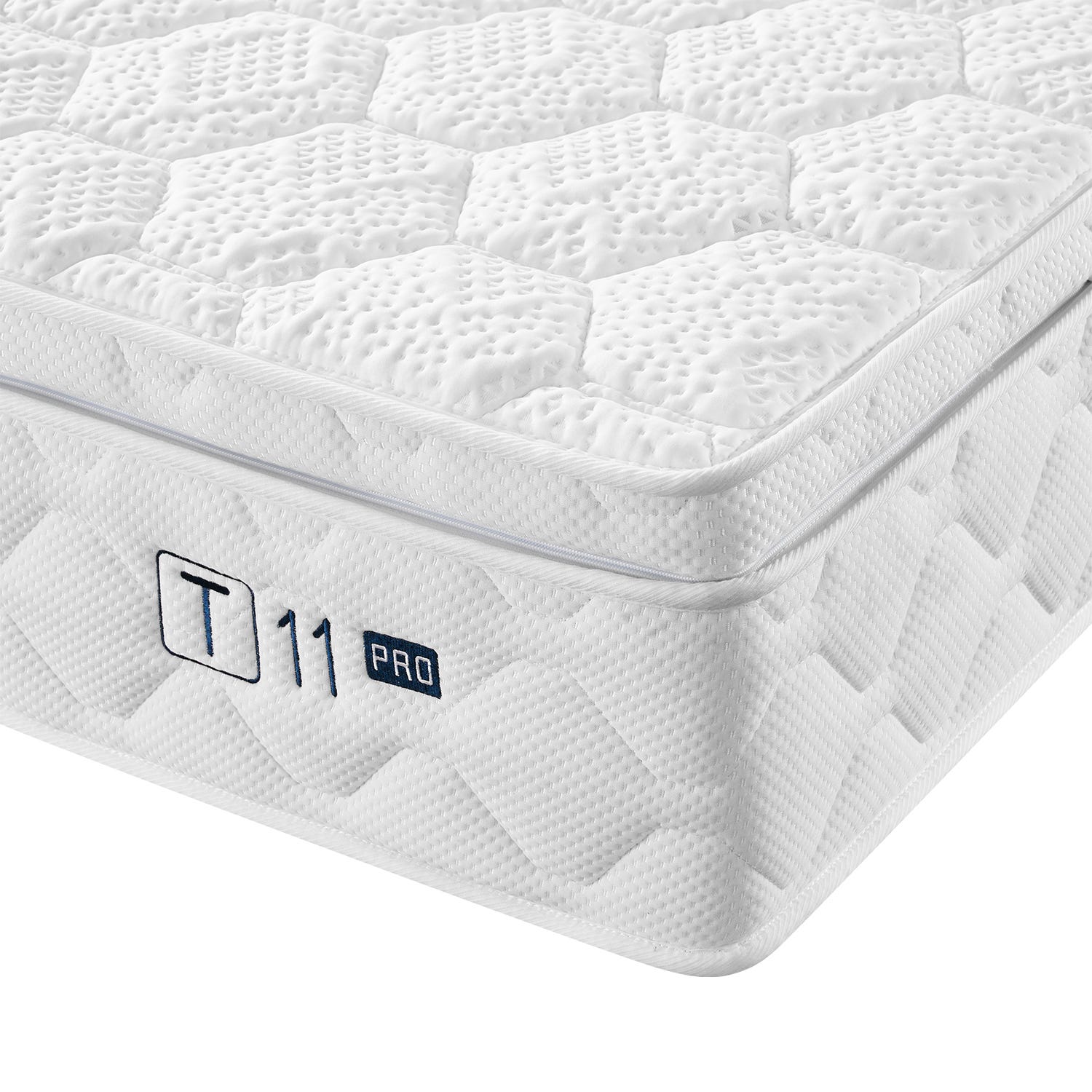
Product pages use "smart mattress" and "smart bed" as if they were interchangeable, and the swap quietly changes what arrives at your door. They are not the same category. One names a mattress with the intelligence built into it; the other names a bed system — often centered on the base — that may or may not include a sensing mattress at all. This guide separates the two terms, shows where the intelligence physically sits in each, uses DeRUCCI's own two product lines as the worked example, and answers the question underneath the vocabulary: can you have both?
Two Terms, Two Products: Why the Words Get Mixed Up
The confusion is structural: marketing copy uses both words for both products. Strictly, a smart mattress is a mattress-form product with sensing, zoned adjustment and a control algorithm built into the mattress body. A smart bed is a system term covering the whole bed, base included, wherever the intelligence happens to sit.
| Smart mattress | Smart bed | |
|---|---|---|
| Physical carrier | The mattress itself | The bed system, typically including the base |
| Where the intelligence sits | Inside the mattress body | Anywhere in the system — base lift, linked controls, or the mattress |
| Typical makeup | Comfort stack + sensing layer + adjustment units + algorithm, in one product | Adjustable base, possibly a mattress, possibly scene control — sold as one ecosystem |
| What the word covers | One product form | An umbrella term for a whole setup |
A smart mattress is a complete product: you place it on a flat base or a compatible adjustable frame, and everything — the sensors reading your posture, the flexible units changing support zone by zone, the algorithm deciding when — is inside the mattress. A smart bed is a broader claim. The phrase usually points at a base that lifts the head or the legs, sometimes at a full setup with lighting and scene control, and sometimes at a base-plus-mattress package. The word itself tells you a system is involved; it does not tell you where the intelligence lives. That has to be checked product by product.
Where the Intelligence Sits: Inside the Mattress vs Across the Bed System
Follow the hardware and the categories separate cleanly. In a smart mattress, the sensing and adjusting happen inside the mattress body — posture is read, zones respond, the surface under you changes. In a smart bed built around a base, the moving part is mechanical: angles change, your position relative to the floor changes, while the surface stays what it was.
On DeRUCCI's side, the T11 series is the mattress-form example, with the T11 PRO as the flagship: eighteen flexible adjustment units, nine per side, mapped to six zones per side — shoulders, back, lumbar, hips, thighs, calves — governed by the AI Tidal Algorithm 2.0, which reads posture and responds within twenty milliseconds, and driven by two control hubs so the left and right halves run independently. Every one of those components lives inside the mattress. Nothing about the base is doing the thinking.
The base-centered smart bed flips the location. Its signature capability is position: the head of the bed rises for reading, the legs elevate, presets like zero-gravity recline the whole body to a programmed angle. The mechanism is a motorized frame — genuinely useful, genuinely different from what a mattress can do, and not a substitute for it. Changing the angle of your body and changing the firmness under your shoulder are two different jobs done by two different physical layers. The mattress layer of the "what's actually moving" question — how zoned firmness changes underneath a sleeper — is covered in How Adaptive Firmness Technology Works.
One Brand, Both Lines: T11 Smart Mattresses and Serene Adjustable Bases
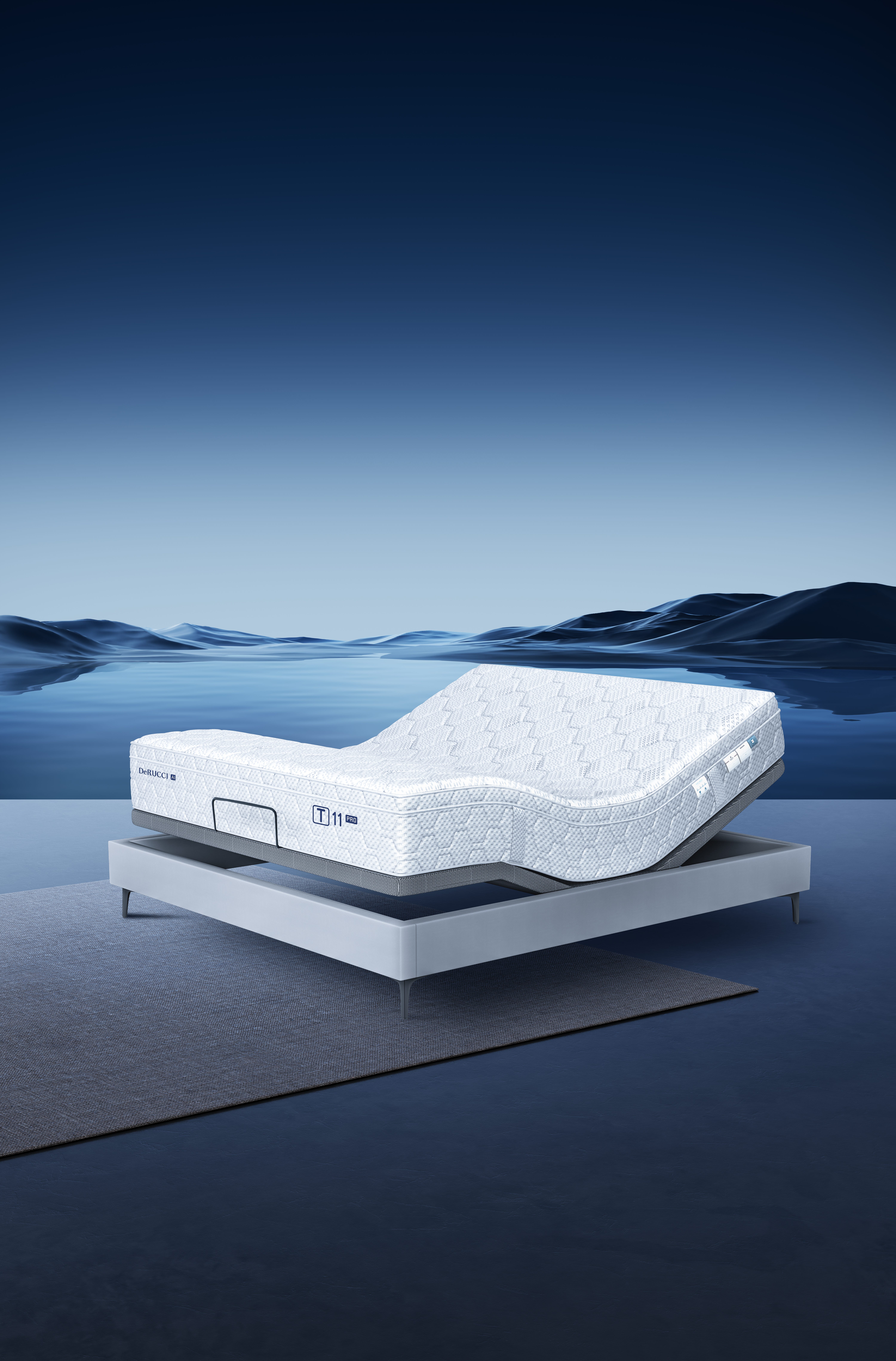
DeRUCCI keeps the two categories as two separate product lines, which makes the boundary easy to see. The T11 series puts the intelligence inside the mattress, in three tiers. The Serene series is an adjustable-base line — BOS1-001, BOS1-002, BOS1-003 — whose motors lift the head and legs. The brand also sells a smart bed form under a separate collaboration.
The T11 line runs three tiers by adjustment resolution: the T11 SE with ten units and three zones per side, the T11+ with fourteen units and five zones, and the T11 PRO with eighteen units and six zones. In all three, the sensing, adjusting and computing happen in the mattress. The current specifications for the series are on the T11 AI Smart Mattress product page.
The Serene series — Serene Lite (BOS1-001), Serene Plus (BOS1-002) and Serene Premier (BOS1-003) — is a different product entity, not a mattress feature. Carbon-steel frames, head lift to 65°, foot lift to 45°, and on the higher tiers preset modes, massage and app control. Its motors belong to the base, its specs belong to the base's own pages, and pairing it with a T11 mattress simply combines two products, each doing its own job.
For completeness: DeRUCCI's portfolio also includes a smart bed form under a separate collaboration. That is a fact about the brand's range, not a claim that the categories merge.
Can You Combine Them? Compatibility Explained
Yes, and the combination is the point: the two layers adjust different things, so they stack instead of competing. The T11 series is compatible with adjustable bed bases — mattress-layer firmness adapts all night while base-layer angles change on command. A flat base plus a T11 is already a complete smart mattress experience; a base adds the position dimension.
- Want only the mattress layer? A flat base or frame plus a T11 mattress delivers the full sensing-and-adjusting system. Nothing is waiting on a base to activate.
- Want only the position layer? An adjustable base under a conventional mattress gives you the angles — reading, zero-gravity, elevated legs — without mattress-form intelligence.
- Want both? T11 series mattresses are compatible with adjustable bases, so zoned firmness adapts all night and the base changes angle on command. Two dimensions, independently controlled.
The definitional grounding for that first option — what makes a mattress "smart" on its own, with no base in the definition — goes back to basics in What Is an AI Mattress?.
Frequently Asked Questions
To check availability in your region, find a store and explore the mattresses and bed frames currently available.