
 American
( English )
 Singapore ( English )

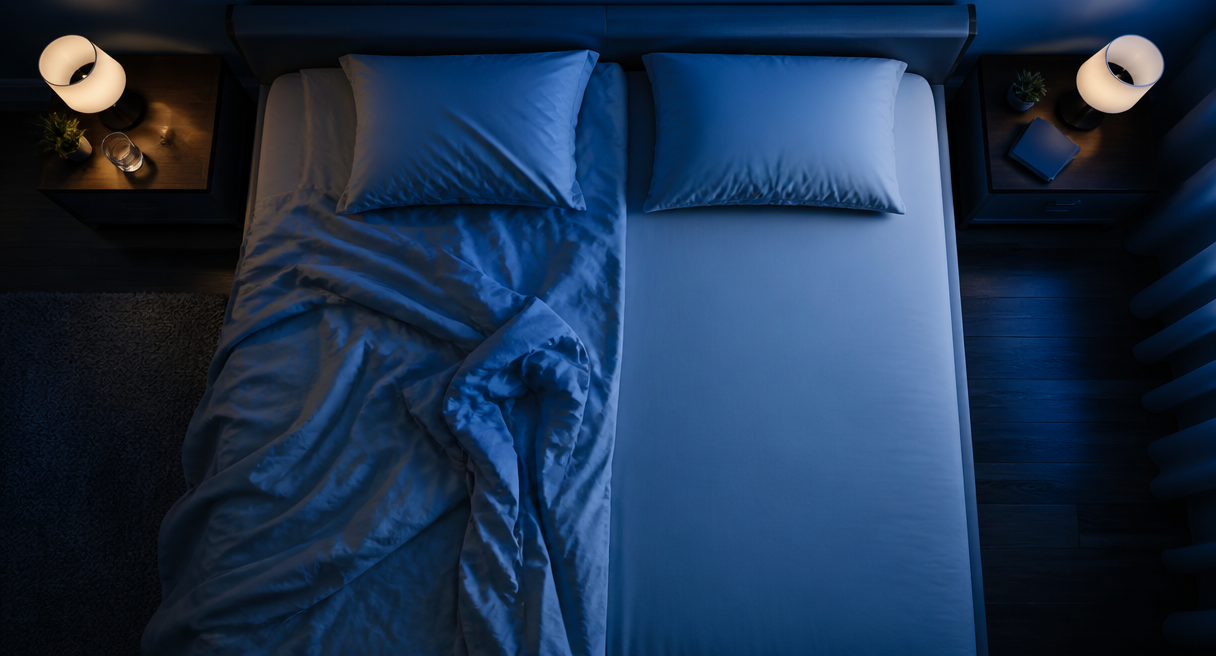
Usually both. And you can find out which one dominates your nights. Tossing and turning has three common sources: discomfort wake-ups from misaligned support, a partner's movement crossing the mattress, and pre-sleep arousal left by evening habits such as caffeine, screens, or a drifting schedule. A zoned mattress like the DeRUCCI T11 series works on the first two physically. Evening habits work on the third physiologically. Neither factor cancels the other, and the question worth asking is not which one is "the real cause" in general but which one is running your nights, something a fair one-variable test on your own reports can answer.
What Are the Three Sources of Nighttime Tossing?
Before blaming anything, separate the three sources: discomfort wake-ups caused by misaligned support, partner movement crossing the bed, and pre-sleep arousal from caffeine, screens, or a drifting schedule. The first two are physical problems a mattress can address; the third is physiological and belongs to evening behavior.
First, the body gets woken by discomfort during the night. Support misalignment and pressure points produce brief arousals that end in a change of position, which feels from the inside like tossing and turning. Second, partner disturbance: movement on one side of the bed transmits to the other, and the receiving sleeper repositions. Third, arousal residue at sleep onset. Caffeine, screen exposure, and a drifting schedule raise the threshold for falling and staying asleep, which fragments the night from the start.
The mechanisms are different in kind, and that difference is useful rather than academic. A mattress fixes what a mattress can reach: zones that push back against load, pressure points that get dispersed, partner motion that gets isolated by structure. Evening habits fix the rest, working on sleep-onset latency and continuity through the night's front door.
How Does the Mattress Mechanism Work?
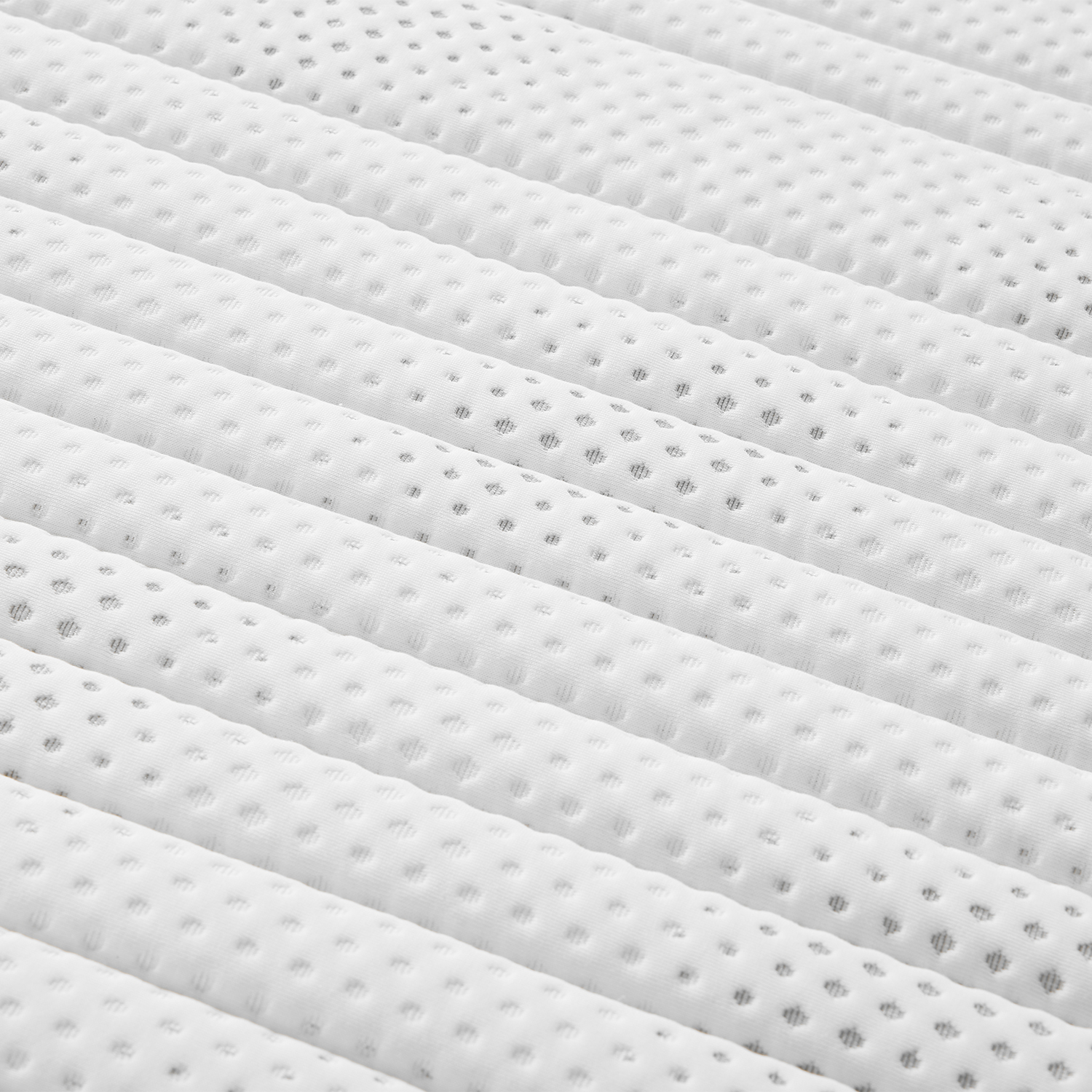
Physical support is the mechanism: zones push back where load concentrates, dispersing pressure points, while structural separation blunts what crosses from the other side of the bed. The zone tiers run three, five, or six mapped regions by model, and only the flagship adjusts both partners independently at once, under 28 dB.
The zone tiers differ by model. The three-zone tier, on the T11 SE and T11 z SE, maps the shoulder, waist, and hip regions, the three most heavily loaded areas for side sleepers. The five-zone tier, on the T11+ and T11 z+, adds back and leg regions. The six-zone tier, on the T11 PRO, further splits thigh and calf into separately addressed regions.
Zoning works because it is a physical mechanism that pushes back, not a software label sitting on uniform foam. Side sleepers load shoulder and hip most heavily and need those regions to sink so the spine stays roughly level. Back sleepers concentrate load at the waist and need firmer support there so the pelvis does not sink. A single fixed firmness usually compromises one of the two sleep styles, which is one structural reason for frequent repositioning during the night.
Partner disturbance is the product answer to the second source. Most "smart" beds, including DeRUCCI's own entry tier, cannot actually adjust both sides at the same time. The T11 PRO carries 18 flexible adjustment units, nine per side, driven by two control boxes; each side independently adjusts its own six zones, and both support maps take effect simultaneously. Adjustment noise is rated below 28 dB, and in intelligent sensorless mode the design intent is to be imperceptible rather than merely quiet. Low disturbance to the other sleeper is one of the four non-negotiables of the partner use case.
What Does the Certification Movement Data Show?
Certification testing gives the discomfort mechanism a number, and the scope matters as much as the figure: these results attach to one model, the T11 SE, tested under CAICT Tel Labs certification conditions. Read them as support for the mechanism, not a forecast of your personal percentage.
DeRUCCI's published specifications for the T11 SE cite CAICT Tel Labs certification testing: nighttime movements reduced by 27.5%, sleep-onset latency shortened by 37.3%, deep-sleep duration extended by 4.5%, and continuous deep sleep extended by 5.9%, with the benefits phrased as Daily Energy Renewal and Enhanced Overnight Recovery.
The scope is specific. It is worth keeping specific. Those four figures attach to the T11 SE and to the certification-testing context. Other numbers in the series' records, sensor accuracy, detection speed, service certifications, come from separate tests and stay separate. The movement figure says the discomfort mechanism responds to zoning in that tested setting. It does not promise you a fixed percentage off your own tossing, because your nights include whatever your habits contribute.
What Does the Habits Evidence Show?
The habit-side evidence is behavioral: among 1,455 surveyed poor sleepers, evening routines rank right alongside bedding changes, and the two run in parallel rather than competing. Real behavior walks both paths at once, which is why attribution is personal rather than statistical.
National survey data from 1,455 respondents with sleep troubles shows the two approaches running side by side. Listening to audio to relax before bed: 46%. Keeping a regular schedule: 45%. Eating and drinking less in the evening, including less coffee and tea: 38%. Consuming sleep-aid foods or drinks before bed: 38%. Improving bedding: 35%. Improving the bedroom environment: 34%. Massage devices or foot baths: 29%. Moderate exercise: 29%. Reading: 26%. Asked more broadly about improving the sleep environment overall, 52% say they would. That last figure uses a wider frame than the bedroom-item list, so read the two separately.
Two interview voices, relayed as recorded. A 44-year-old woman on support: "I feel my sleep has become lighter... I want a slightly firmer mattress with stronger support; with a soft bed, my back sometimes aches when I wake up." And a 35-year-old man who changed everything at once, a latex mattress, a blackout cover, double-glazed vacuum-insulated windows. He is exactly the case that shows the problem: with that many variables moved together, he cannot tell what worked.
On the product side, the report connects what you see on the mattress to what the bed can adjust — zone-level support and firmness adaptations — and for those who add an adjustable base, the T11 series' specifications list mode options such as Snore Relief, Zero-G and Gentle Wake for use with DeRUCCI adjustable frames. For the evening side, Technology and Sleep goes deeper on screens and routines, and clinician-education guidance such as How to Get More Deep Sleep from Cleveland Clinic covers the behavioral levers: caffeine timing, screen curfews, schedule regularity.
How Do Both Factors Compare Side by Side?
Set side by side, the two factors work differently and neither cancels the other: one changes the support map physically, the other lowers pre-sleep arousal physiologically. Each is verifiable in your own bed with a one-variable test, and the survey's parallel 35% and 46% reflect exactly that.
| Dimension | Mattress factor | Evening-habit factor |
|---|---|---|
| Mechanism | Physical: zones push back, pressure points dispersed, partner motion isolated | Physiological: sleep-onset latency and continuity shaped by evening arousal |
| Path to effect | Changes the support map so discomfort wakeups decrease | Lowers pre-sleep arousal so continuity improves |
| Evidence form | CAICT Tel Labs certification-testing figures (T11 SE: 27.5% fewer movements, 37.3% shorter latency, 4.5% and 5.9% deep-sleep extensions) | Survey behavior structure (46% audio, 45% regular schedule, 38% caffeine care, 35% bedding) plus clinician education |
| How to verify | Compare movement trends before and after a mattress or setting change | Change one habit on the same bed and compare multi-night reports |
| Likelihood of working alone | Real for discomfort-source and partner-source tossing; varies by person | Real for arousal-residue tossing; survey shows both paths in parallel |
The table declares no winner. The same population reports improving bedding and listening to audio before bed; both mechanisms are real, and both are separately verifiable in your own bed. Which one dominates your nights is a personal fact, not a statistical one.
How Do You Attribute Your Own Tossing?
Attribution is a single-variable experiment you run on yourself: freeze the evening, shift exactly one mattress variable, compare equal-length windows on valid nights, then swap roles and change one habit. The arbiter is the multi-night movement trend, never one morning's feeling, and the metrics that count are the ones tied to adjustment.
The test itself is simple to describe. Fix your evening habits and change exactly one mattress variable, a firmness setting, a mode, a zone configuration, and run an equal-length window on each side of the change. Then reverse the roles: same bed, one habit changed, everything else constant. The arbiter is the movement and body-movement trend across nights that met the report-generation conditions, at least three hours in bed and two hours of actual sleep, rather than how any single morning felt.
Which readings to lean on follows the same test used throughout sleep tracking: a number matters when it can change something, ideally what the bed does tonight or what you decide tomorrow. Readings connected to adjustment qualify. Numbers that only appear on a dashboard do not, because they can move while nothing changes.
To see how those movement readings are produced in the first place, How AI Smart Mattresses Track Sleep Health covers the sensor layer. One caveat worth repeating: monitoring and report functions are wellness features and are not intended for medical diagnosis or treatment.
If the test lands on the mattress side, the T11 series lays out the zone tiers by sleep position, three-zone, five-zone, or six-zone, as the next step; find a store near you and confirm availability in your region.