
 American
( English )
 Singapore ( English )

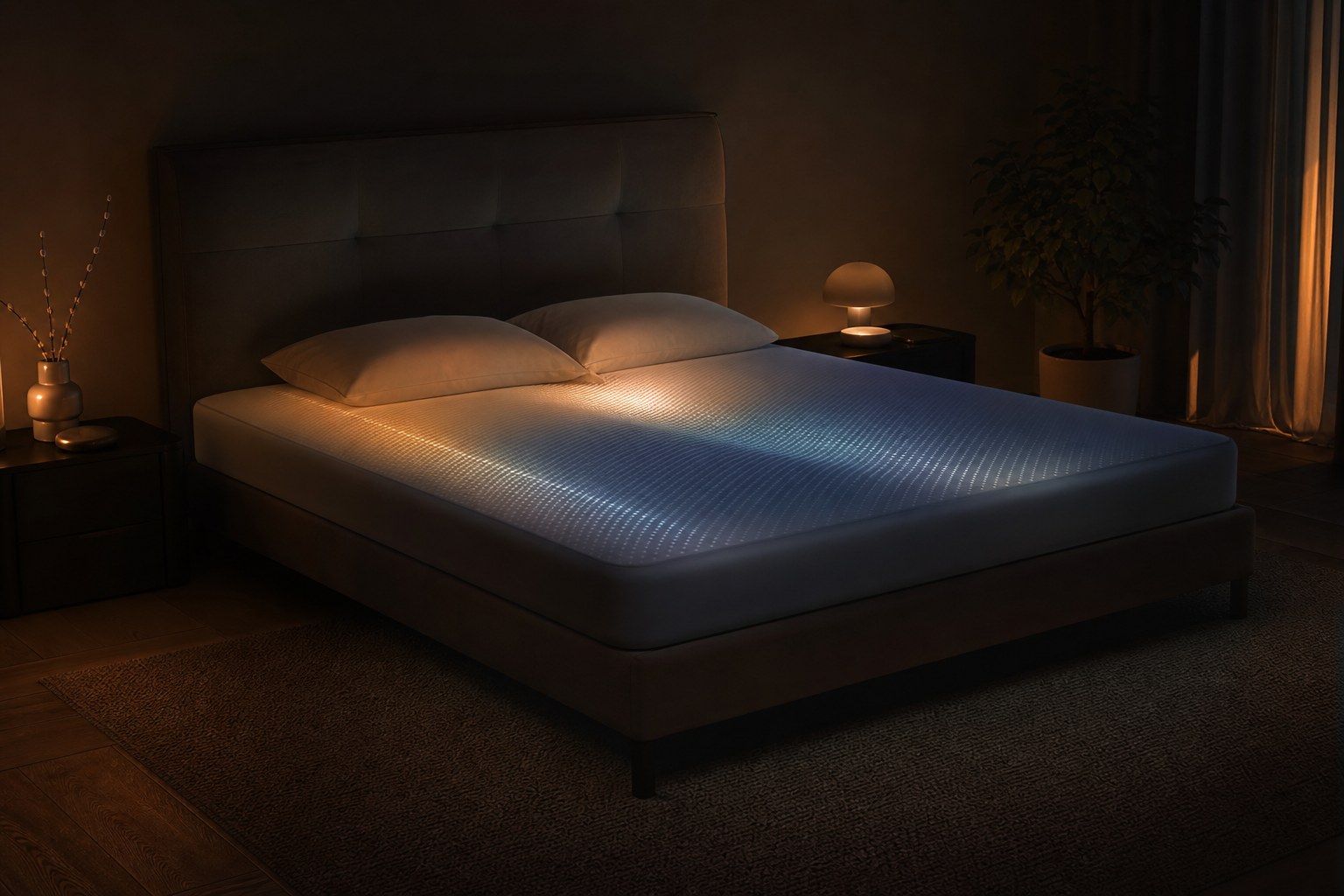
Anyone comparing a smart mattress vs conventional mattress options runs into the same wall: the price difference is obvious, the feature list is long, and what those features physically do between midnight and morning stays vague. The short version: DeRUCCI's smart mattress line adds three active layers — sensing, adjustment, and an algorithm layer — where a conventional mattress has none, and on some models a fourth layer that manages temperature. Every other difference follows from those layers.
The Short Answer: Three Active Layers, Plus One for Temperature
A smart mattress adds machinery a conventional mattress does not carry: a sensing layer that reads body state, an adjustment layer that changes support, and an algorithm layer that decides when and how much to adjust. Some models add a fourth layer for temperature. A conventional mattress offers one structure, fixed at the factory.
In the T11 PRO those three roles run under one name, AI Tidal Algorithm 2.0, which integrates three algorithms: adaptive adjustment, sleep monitoring, and sleep staging.
Set that against the conventional side. A traditional mattress keeps one character — its coil tension, foam density, how firm the middle third feels — from the day it arrives until the day you replace it, often a decade later. The structure is not slow to react; it has nothing to react with. What the active layers buy you is support that changes through the night instead of staying fixed.
If the category itself is new to you, the baseline definitions sit in What Is an AI Mattress?; this article stays on the comparison.
Smart Mattress vs Conventional Mattress: Why a Fixed Structure Can't Follow You
You do not sleep in one position. Over a night the body shifts repeatedly without waking you, and each shift moves the load from one set of points to another. A fixed structure answers every position with the same support map; the active layers answer each one differently. That is the core gap.
The posture you fall asleep in is rarely the posture you wake up in. Somewhere in between, you turned, and the turning was not a decision — it was the body redistributing load. On your side, the weight concentrates at the shoulder and hip. On your back, it spreads across the lower back and pelvis. Same body, same night, two different jobs for the mattress.
The conventional mattress has one answer: whether you are on your shoulder or your pelvis at 3 a.m., it delivers the one support map it was built with. The smart mattress does something with that information. The sensing layer registers the change, the algorithm layer translates it, and the adjustment layer acts; according to official specifications, the algorithm layer's analysis of the sensor data takes about 20 milliseconds, so it keeps up with each turn. The algorithm side rests on a training base of more than one million ergonomic data points and over one million sleep profiles. Those figures are manufacturer specifications rather than third-party lab measurements, so read them as indicators of scale, not as field test results.
Imperceptible by Design, Not Merely Quiet
DeRUCCI names its Intelligent Sensorless mode with a precise word: imperceptible. Quiet means the noise is tolerable; imperceptible means the sleeper does not register that adjustment happened at all. The mechanism is manufacturer-rated below 28 dB, and the design target shapes how gently adjustments run all night.
The distinction is not wordplay. A mechanism could be quiet enough to tolerate and still noticeable — a faint hum, a slow shift under you that pulls you back toward the surface of sleep. Imperceptible is a stricter bar, and it forces different engineering: gentler adjustment curves, softer triggers, a lower intensity of change per action. That is also why the mode carries the word "sensorless" in its name — the aim is for the technology to disappear into the night rather than announce itself.
How the air chambers and zones actually produce that gentleness is covered in How Adaptive Firmness Technology Works.
Two boundaries. First, do-not-disturb mode: the surface stops adapting for the whole night, one fixed setting. If zero adjustment is what you want, this mode is how you get it — the trade is giving up that night's adaptation. Second, the network: offline, the mattress keeps adjusting firmness automatically — per the product materials, the bed does not brick without Wi-Fi — but it cannot generate the daily report, fetch the latest algorithm version, or show heart-rate and breathing data. Parts of the active layers depend on a connection, and that dependency is worth knowing before you buy, not after.
The Fourth Layer: Temperature as an Active Variable
Temperature is the newest dividing line between the two categories. Some smart mattresses treat it as something to manage; a conventional mattress has no position on it at all. Whether a model heats actively, cools, or only ventilates passively is a separate checklist item — the word "smart" on the spec sheet does not answer it.
On the temperature-active side of the line, the T11 PRO carries graphene far-infrared heating in the leg zone — heating, not cooling, and that zone only, per official specifications. What it feels like is warmth arriving at cold calves and feet on a winter night; what it is not is a health intervention.
There is a passive half to the story too. The 3D-Plus material used in the line has 4.4× breathability, per DeRUCCI's official materials page, which helps heat dissipate rather than build up under you. Passive dissipation is real but limited — it removes a source of discomfort; it does not add coolness on demand.
For shoppers, the practical move is to check where a given model stands: no temperature feature, passive ventilation only, or active heating, and in which zones. The three sound similar until summer actually arrives.
Frequently Asked Questions
Once the layer picture is clear, the next step is checking how a specific model implements it: the T11 smart mattress product page lists the active layers and temperature equipment as sold. A showroom visit is the other half — a few minutes on a display unit in Intelligent Sensorless mode tells you more about "imperceptible" than any spec table.
To try one in person, find a store and check global showroom addresses.