
 American
( English )
American
( English ) Singapore ( English )
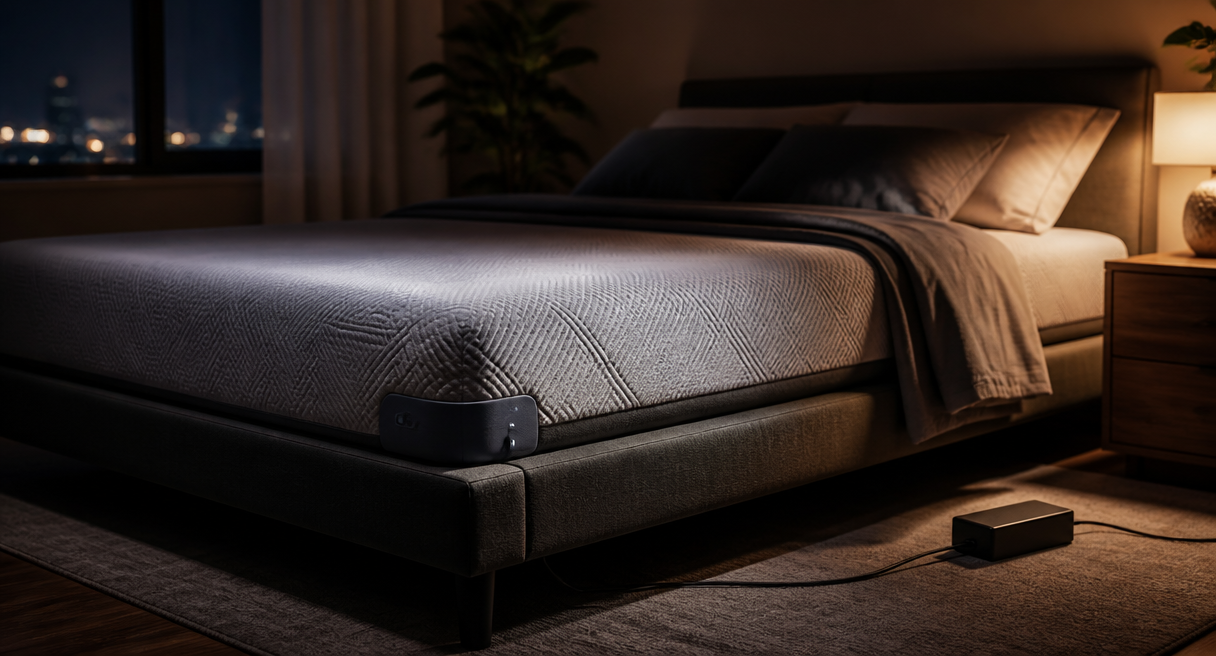
Plugging a mattress into the wall takes some getting used to — the bed is the one piece of furniture we trust with our unconscious hours, and now it has a power cord. The short answer on smart mattress safety: the power that reaches the sleep surface is not the power in your wall. According to DeRUCCI's official information, the T11-series AI mattress runs from an ultra-low-voltage control box on a 24V internal safety voltage, the mattress body is made of insulating material and does not carry current, a full night of continuous running is officially rated at about 0.3 kWh, and the wireless control box is CE-certified with a maximum transmit power of roughly 70mW. Here is the whole chain — voltage, power draw, warmth, radiation — and what to check on the showroom floor before you buy.
What Happens to the Voltage Between Your Wall and a Smart Mattress?
Between the wall socket and the sleep surface, the power is stepped down twice before it matters: the mattress works from an ultra-low-voltage control box carrying a 24V internal safety voltage, the converter runs on 5V, and the official human-safety threshold sits at 36V. The mattress body itself is insulating material that carries no current.
A powered bed raises two separate worries — could current reach the sleeper, and could the electronics fail — and DeRUCCI's official information answers both at the voltage level. The mattress does its work through an ultra-low-voltage control box and is, in DeRUCCI's own words, "as safe as your traditional mattress." The internal voltage is a 24V safety voltage, and the metal parts have passed corrosion-, flame-, and heat-resistance testing for year-round climate changes. The materials layer: the whole mattress is built from insulating material — it does not carry current — and the converter uses 5V, set against the official human-safety figure of 36V.
In plain terms, mains power enters the system, is isolated and stepped down at the control box, and what continues into the mattress is an ultra-low voltage far below the threshold used for human safety. If the concept of a powered mattress itself is new — what is actually electric in there, and what does it do — What Is an AI Mattress? covers the basics.
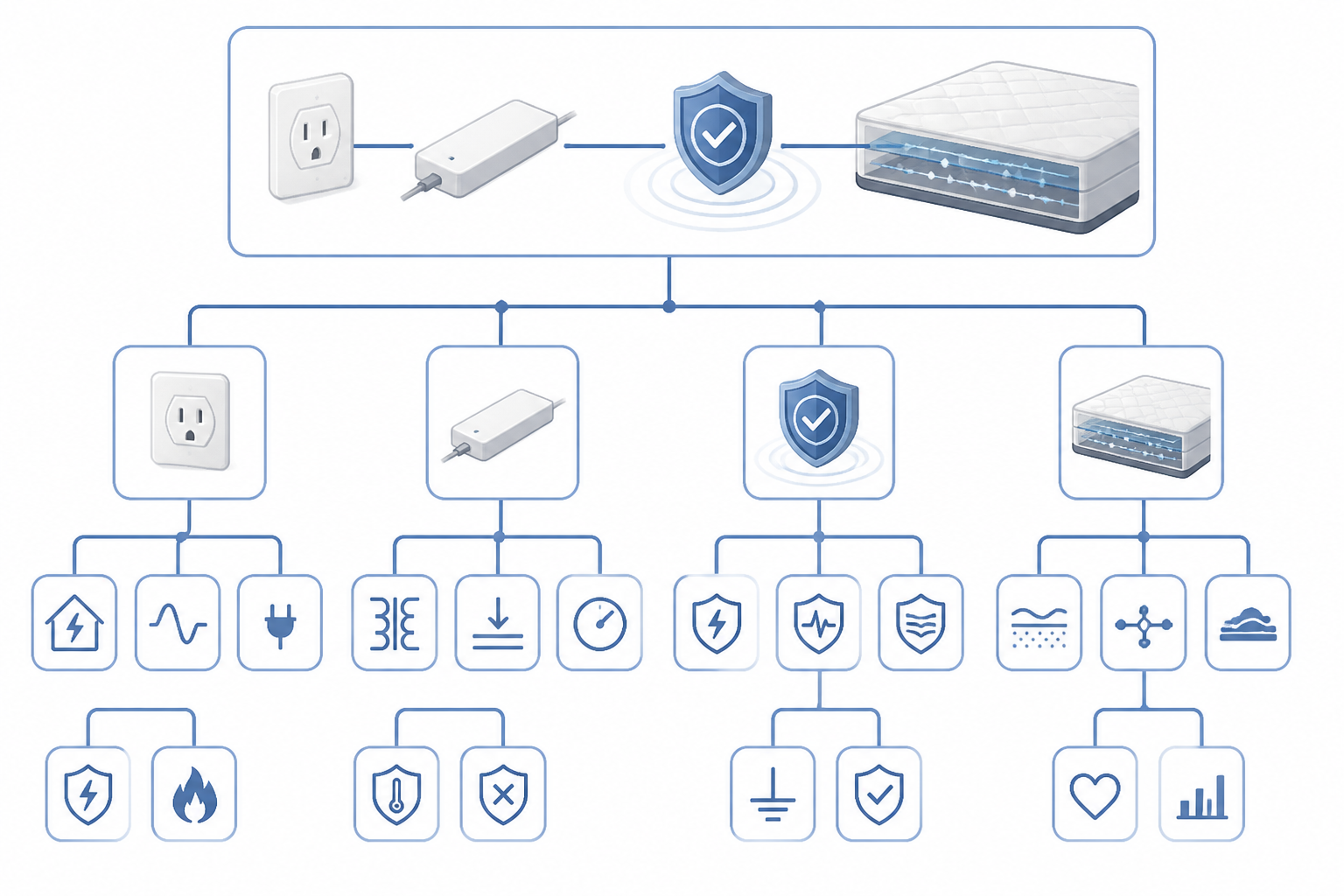
(This image is AI-generated for reference only, not an actual product photo.)
How Much Power Does an All-Night Smart Mattress Actually Use?
All-night use is a small load, officially rated: about 0.3 kWh per eight hours of running, roughly 10 kWh a month, heating at most 0.05 kWh per hour on top. Rated power runs 20W on the T11 SE, T11+, T11 z+, and T11 z SE, and 85W on the T11 PRO.
Those two kinds of numbers are worth telling apart. Rated power — 20W or 85W depending on the model — is a capability figure, what the mattress is designed around. The 0.3 kWh figure is the official estimate for a night of actual running. For scale, 20W is roughly an old-style incandescent light bulb, and even the PRO's 85W sits below what most laptops draw at full load. The heating function is the one line item that adds materially, at most 0.05 kWh per hour by the official figure. Across a month of all-night running, the official estimate lands near 10 kWh.
Is a Warm Smart Mattress Surface Normal — and When Should You Worry?
Warmth after a night's use is normal physics — your body is the heater, and the mattress simply holds the heat, as traditional mattresses do unnoticed. The line that matters is localized: warmth is fine, an abnormally hot spot is not. In daily use, the part that deserves real caution is the power components — worn cables, cracked plugs, mismatched adapters.
Picture the scene: you climb into a bed that has been running all evening, and the surface feels gently warm. That is your own heat being retained, not a malfunction. DeRUCCI's official information says the same happens with a traditional mattress, which also accumulates body heat — people simply do not notice it there. The operative sentence is a boundary rather than a reassurance: warmth is normal as long as no single spot is abnormally hot. A localized hot patch is the signal to stop and have the unit checked.
Daily life is harder on the power parts than on the mattress itself. Cables get kicked under bed frames, plugs get yanked out by hand or by a passing vacuum cleaner, and wear builds quietly over the years. DeRUCCI's care guidance states the rule flatly: no damaged or substituted power components. A frayed cable, a cracked plug, or an adapter that does not match the nameplate rating is not a cosmetic issue on a powered bed — it is the leading cause of electrical failure and, at worst, a real safety risk. The response is to stop using the mattress and request a replacement, not to improvise.
The official care guidance runs in the same direction, in three rules:
1. Do not disassemble, repair, or modify the mattress yourself — for service, contact your dealer.
2. Use the matched power cord and a compatible adapter — no damaged plugs, no substitutes.
3. Avoid heavy wet washing — trapped moisture can deform the layers or breed mold.
The low-voltage and insulation statements are materials and electrical-safety statements, not coverage terms — damage-related terms are set regionally, so confirm them with your retailer in writing.
How Much Electromagnetic Radiation Does a Smart Mattress Emit?
The wireless parts speak the same "language" as home Wi-Fi and Bluetooth — the 2.4000–2.4835 GHz band — but more quietly: a maximum transmit power of about 70mW, from a CE-certified control box mounted under the foot of the mattress, away from the head and torso. DeRUCCI's official information states that normal powered use will not affect human health.
The everyday translation: you already share a room with a Wi-Fi router and probably a Bluetooth speaker, both speaking the same 2.4 GHz band. The mattress's control box speaks it at a lower volume — around 70mW at maximum — and it sits at the foot of the bed rather than at your pillow. Same type of exposure as the household wireless devices you already live with, weaker, and farther from your head.
The certification on record for the control box is CE. And for general questions — whether electromagnetic fields of this type affect health in general — the WHO's Electromagnetic Fields Q&A is the authoritative starting point.
How Do You Put the Safety Answers to Use Before Buying?
Before buying, put the floor sample through the official numbers: the power cord and plug should be the matched, undamaged parts the care guidance requires, the control box should sit at the foot of the mattress, and the printed electrical specifications should show the 24V internal safety voltage and 5V converter. Regional damage terms belong in writing.
The checks take a few minutes. On the floor sample, look at what a two-minute demo skips: the power cord and plug should be intact and matched, and the control box should be in its place at the foot of the mattress. Ask to see the printed electrical specifications — the 24V internal safety voltage and 5V converter appear there, and a store that can produce the page quickly is telling you something about its after-sales setup too. Since coverage terms for damage differ by region, ask for them in writing rather than from memory.
From there, the research context behind the product line is on the DeRUCCI Sleep Science page, and to put your remaining questions to a human, find a store near you.