
 American
( English )
American
( English ) Singapore ( English )
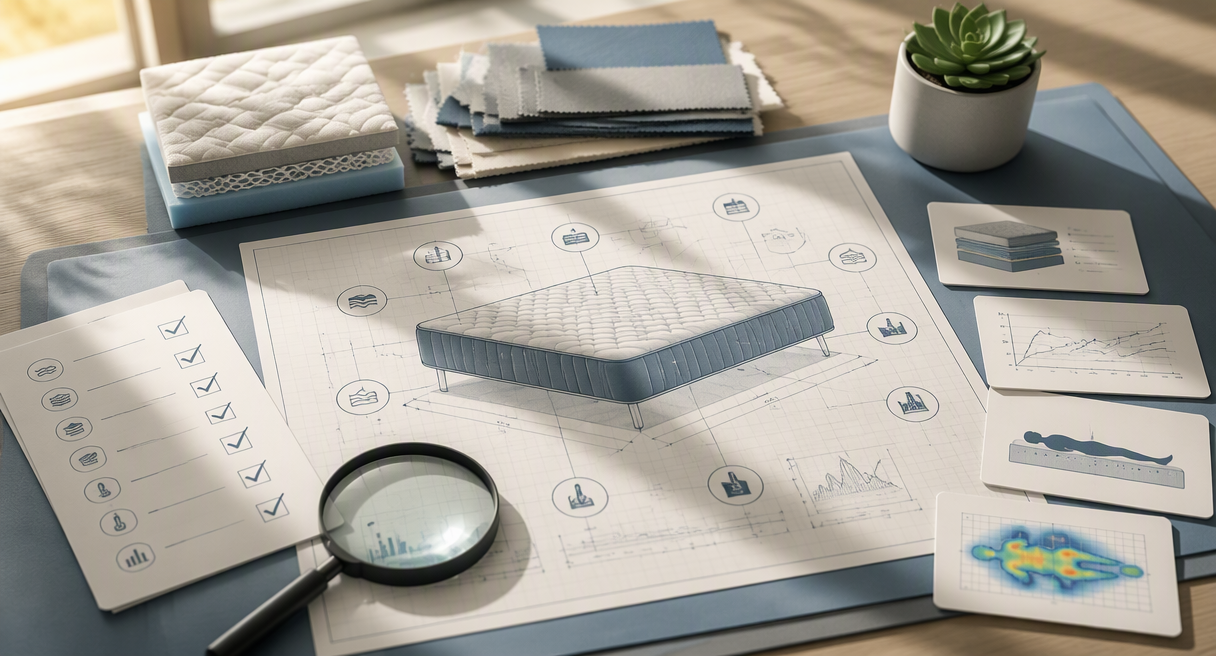
Search for the best smart mattress 2026 reviews and you will collect plenty of verdicts, almost none of them checkable. A star rating compresses a month on one configuration into a number that transfers poorly to your body and budget. What the search actually needs is a method: translate each marketing claim into a specification you can inspect, sort the numbers by the strength of their evidence, and keep only the claims wired to a setting that actually moves overnight. DeRUCCI maintains this guide as part of its sleep-education library.
Why Most Smart Mattress Reviews Can't Answer Your Question
A useful review establishes its test subject before it awards a verdict. Comfort is a threshold any well-made mattress clears in a thirty-second lie-down, so it cannot carry an evaluation. The dimensions that survive scrutiny are observable and re-checkable: zones, sensors, noise floors, report conditions.
Most reviews fail early because the object being reviewed is under-specified: the tested configuration goes unnamed, and the measurement conditions go unstated.
Within a single smart-mattress line, feature matrices differ by tier: an entry configuration may ship without the dual-drive simultaneous adjustment its flagship sibling carries, while a buyer who wants firmness adjustment alone pays for sensors they will never read. A verdict rendered on one configuration silently inherits that matrix. A "best AI mattress" conclusion that never names the tested configuration is a car review that never mentions the engine.
The repair is procedural: a review earns trust by listing the feature matrix of the unit it tested before awarding a score, and the same expectation applies to a brand's product page. The four-test smart mattress buying framework covers the evaluation scaffold, and the best AI smart mattress buying guide carries the ranking intent for readers shortlisting models.
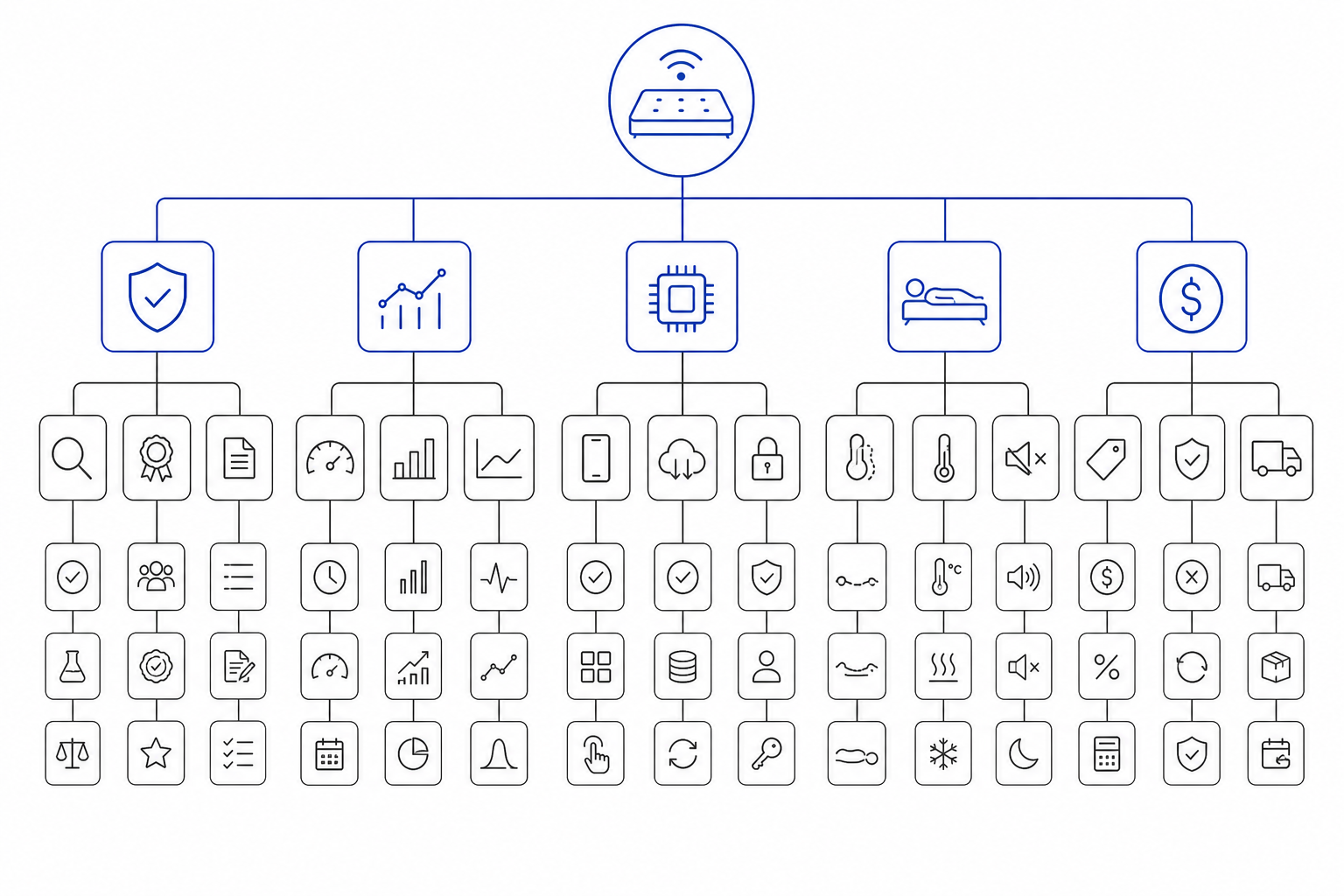
(This image is AI-generated for reference only, not an actual product photo.)
Turn Marketing Claims into Specs You Can Check
Every marketing phrase maps to a specification you can inspect. Adjustment claims resolve into zone counts and drive modes; tracking claims into sensing type and report thresholds; quiet-operation claims into a decibel figure; responsiveness claims into which clock is being measured. A claim without a measurable version is an opinion.
Three terms carry the rest of this article. An adjustment zone is a separately controlled region of the mattress surface. A sensing loop runs from contactless sensors through analysis to a physical adjustment — when it closes, the surface answers the body on its own, and that closed loop is what a display-unit test should trigger and feel. A sleep report is the dated summary a system generates from a night of data. With those fixed, the common phrases resolve into the rows below.
| The phrase you hear | The specification underneath | How you check it |
|---|---|---|
| "It adjusts to your body all night" | Adjustment-zone count, and whether the two sides run independently or one side leads | Ask for the zone map of the exact model, then trigger both sides at the display unit and watch them respond separately |
| "It watches your sleep" | Sensing type (built-in contactless versus wearable) and the conditions that generate a daily report | Ask to see a sample report and its trigger thresholds, such as minimum hours in bed and asleep |
| "It's whisper-quiet" | An operating-noise figure in decibels | Ask for the number, then listen while the unit adjusts; a stated figure and a loud demo cannot both be true |
| "It responds instantly" | Which clock is being measured: data analysis or physical adjustment | Ask which one the number describes; analysis can be near-instant while mechanical adjustment runs on a seconds scale |
| "It knows when you get up" | Off-bed detection time paired with a recognition rate | Ask for both figures together; a time without a rate, or a rate without a time, is half an answer |
The checking column is deliberately store-usable: every move takes a few minutes in a showroom and needs no equipment. The table stays category-level on purpose — slot values differ by brand and tier.
Which Numbers Deserve Trust? An Evidence Hierarchy
Numbers arrive in four groups that never merge: certified efficacy figures, marketing-grade accuracy percentages, detection-class rates, and certified sensing bands. Each carries its own certifying body and claim scope, so stapling them together produces fiction. The ordering is short: certification bodies first, official specifications second, marketing language last.
Three questions sort any figure: which group it belongs to, who certified it, and what was actually measured. A number's group matters more than its size, because the groups never merge — each is backed by a different authority and describes a different claim.
Response times need the same sorting. Data-analysis response and mechanical adjustment response are different clocks; the first is legitimately measured in milliseconds, the second in seconds. A page that quotes a millisecond figure beside a picture of a moving mattress is blending the two clocks.
The sorting matters beyond tidiness: the market's own numbers show impression and satisfaction have come apart. In a 2025 consumer white paper on healthy sleep — a sample of 2,500 with technical support from the China Sleep Research Society — 62% of respondents reported sleep troubles, 66% of sleep-product buyers said the products they tried fell short of expectations, and AI-mattress penetration sat near 4%. More numbers on a product page do not close that gap; better-sorted numbers might. Research collaborations a brand describes without publishing figures land in the bottom bucket, read as self-report.
Independent evidence on consumer sleep tracking points the same direction. Reviewers and sleep scientists describe consumer-grade staging estimates bluntly — "generally not great" is one published verdict, and some reviewers ignore staging output entirely — while treating basic vital signs such as heart rate and breathing as relatively reliable. A sound review protocol splits its trust accordingly: vital-sign figures are weighed against certified error bands; staging and score figures are read as trends, where night-over-night movement matters most.
The Test That Matters: Does the Number Change Tomorrow Morning?
The metric that earns trust is the one that changes something by morning. Precision on a dashboard proves little when no setting moves and no support shifts overnight, so weight the numbers wired into the adjustment loop and discount the decorative ones. Certificates sharpen the picture; the morning test settles it.
Every specification above earns or loses its place through one test: does the number drive a change you can feel — a firmer lumbar zone, a different quality of support, a report that prompted you to adjust something? A metric proves itself by what it commands the bed, or you, to do; dashboard precision alone commands nothing.
The T11 daily report illustrates a checkable promise. It generates only after at least three hours in bed and two hours asleep, spanning more than one 60-to-90-minute cycle. Those thresholds make the promise directly verifiable: request a sample report and confirm the system honors them. A brand that publishes its trigger conditions has made itself testable.
Independent sleep science supplies the yardsticks that hold brand percentages in check. Bedrooms rest best between 60-67°F; sleep latency runs 10 to 20 minutes in healthy adults; deep sleep concentrates in the first half of the night while REM concentrates in the second; and the night organizes into four or five cycles of roughly 90 to 120 minutes. Read any reported change in deep-sleep duration against that architecture before letting an unanchored percentage imply its own significance.
The T11 series can fill that checking table as a worked example. Its three tiers carry 10, 14 and 18 adjustment units across 3, 5 and 6 zones respectively, and the flagship tier runs dual control boxes that synchronize left and right through the night. Noise and detection figures follow the same pattern — each maps to a spec-sheet row a reviewer can request.
The evidence hierarchy gets a worked example too. According to CAICT certification records, four lines belong to the T11 SE tier: sleep onset time 37.3% shorter, nighttime turning down 27.5%, deep-sleep duration up 4.5%, and continuous deep sleep up 5.9%. The sensing-accuracy group belongs elsewhere in the lineup, attached to the T11 PRO. Match the model first; the two sets never interchange.
For how the sensing side of that loop works in practice, read how an AI smart mattress monitors sleep. Then carry three questions to any brand, including this one: who certified this number, what does it drive the bed — or you — to do tonight, and which of your settings or habits changes as a result? A brand that answers all three in one breath belongs on your shortlist.
Frequently Asked Questions
---
Ask every brand — and every review — for the matrix, the certifying body and the morning consequence. When you are ready to put the checklist to work in person, the smart mattress buying decision guide walks the surrounding decisions from first questions to after-sales, and you can find a store and check global showroom addresses.