
 American
( English )
American
( English ) Singapore ( English )
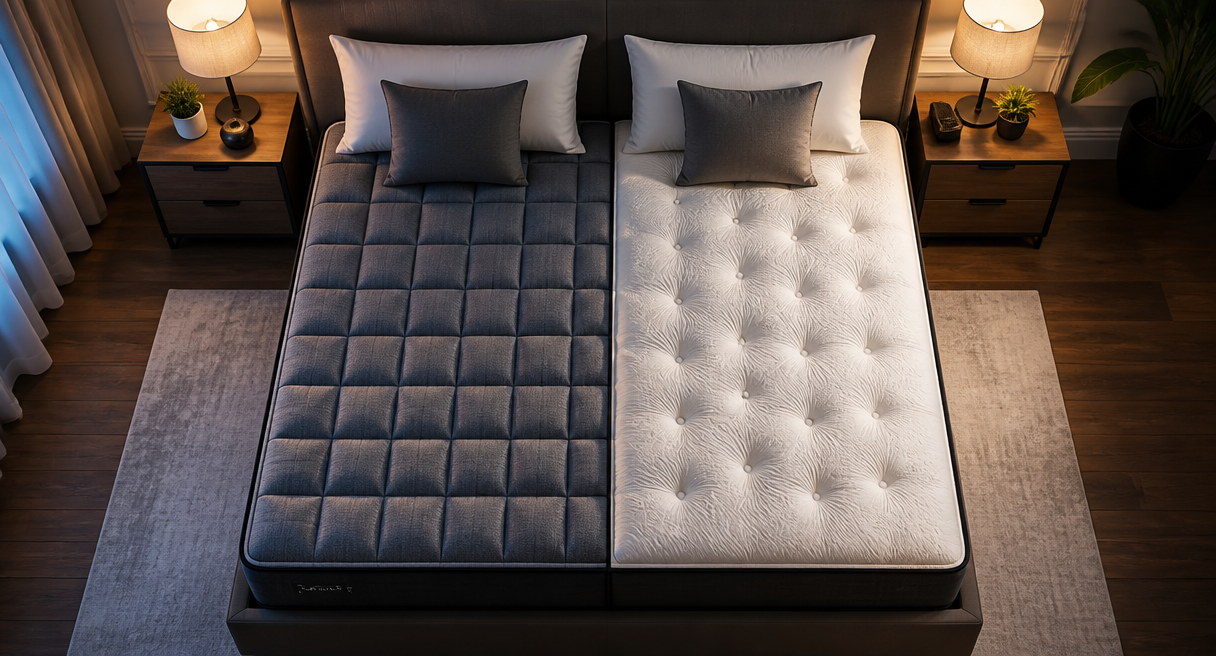
For a couple whose firmness preferences genuinely diverge, a dual-firmness smart mattress is usually the better answer — but only if both sides adjust at the same time. What actually separates the options is timing: can both sides adjust at once, or does one partner wait? Whoever lies down second on a one-side-first bed spends the first minutes on a still-forming surface. Two singles pushed together buy independence but give up the continuous bed surface; a topper changes surface feel, not the support zoning underneath.
Why Does One Uniform-Firmness Bed Shortchange One Partner?
A side sleeper's heaviest loads sit at the shoulder and hip, which need to sink to keep the spine level; a back sleeper's load concentrates at the lower back, which needs firmer support. Those are two different support maps. Firmness depends on body weight, sleep position and comfort, so the mismatch between partners is structural, not a calibration error.
Think of firmness as a load question. Lying on your side, your shoulder and hip carry most of your weight and need to sink for the spine to stay level. Lying on your back, the pelvis wants firmer resistance so it doesn't drop. Put one of each sleeper type on a surface set to a single number, and whoever's map the surface matches, the other spends the night compensating. Because firmness also tracks body weight and personal comfort, no single setting fixes it — which is why dual firmness exists as a core proposition of the smart mattress category. It is built for exactly this pairing.
Co-sleeping stays workable, then, under one stricter condition than most "adaptive firmness" marketing implies: the mattress must hold two different support maps on the same surface, at the same time. The premise itself — two people who want to keep sharing one bed — has research behind it: a peer-reviewed study published in PMC (Drews et al., 2020) found bed-sharing in couples associated with increased sleep quality.
Which Dual-Firmness Smart Mattresses Adjust Both Sides at Once?
Most "smart" beds — including DeRUCCI's entry tier — cannot adjust both sides at once. Within the T11 series, only the T11 PRO does: eighteen flexible adjustment units, nine per side, run by two control boxes, so each partner's six zones take effect without waiting. Below the PRO, the mattress adjusts one side first and the other partner waits.
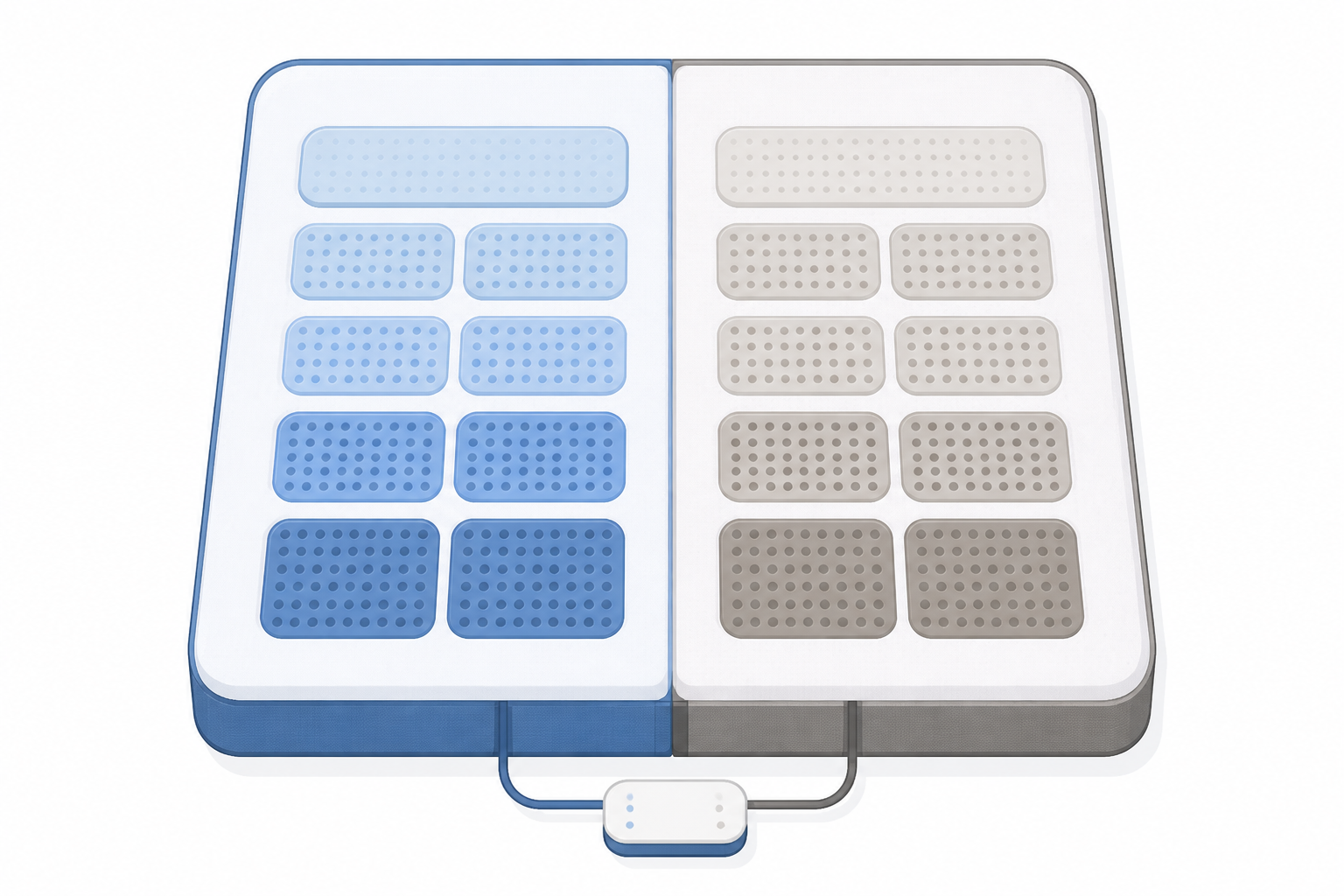
(This image is AI-generated for reference only, not an actual product photo.)
"Each side adjusts independently" is true across the line — but below the PRO it means one side finishes before the other starts. The spec sheet tells you as much, if you know where to look: the T11 SE runs a one-side-first three-zone system with a single control box, the T11+ a one-side-first five-zone system with one, and the T11 PRO simultaneous left–right adjustment across six zones per side with two. On the PRO, both partners' support maps stay live through the night rather than taking turns.
What Actually Matters When Comparing the Three Options?
Judge the three options on what you can check: whether both sides adjust at once, whether the zones map to each partner's shoulder, waist and hip, how quiet one partner's adjustment is for the sleeping one, and what the service terms cover. A comfortable first minute in a showroom tells you none of these things.
Timing first. If one side must wait for the other to finish forming, the later partner sleeps those minutes on an unfinished surface — and the same question frames the two-singles option, which gets independence for free but gives up the continuous surface and any coordination between the halves. That is the line between a true double bed and a single smart mattress sold to two people.
Then where the zones land. Two firmness settings, two people — that alone doesn't mean either of them is well supported. The zones have to reach each partner's shoulder, waist and hip; a number can read "right" while the body underneath it is still hanging or sagging.
Quiet, too. Adjustment noise and motion have to stay below the level that wakes a sleeping partner — testable in a store, one partner resting while the other adjusts.
The last one is the service period. A smart mattress is a multi-year service relationship, not a one-night purchase, and the warranty and after-sales terms are where the promise becomes enforceable.
What Do Two Singles and a Topper Each Trade Away?
Two singles pushed together buy total independence and lose the one-piece bed — no seamless middle, no coordination between the halves. A topper works at the surface only: enough for a mild firmness disagreement, not for reconciling a side sleeper's shoulder-and-hip needs with a back sleeper's lumbar support. The trade is continuity against independence.
Start with the topper, because it is the cheapest fix and the most limited. It changes what your skin feels — a few points of perceived firmness, a slightly plusher hand. It does not change what the core does underneath: your shoulder still sinks or doesn't based on the mattress below it, and your lumbar still gets whatever support that mattress provides. For a genuine mismatch, that ceiling is the problem. DeRUCCI's current line includes no topper products, so this part is category guidance rather than product advice.
Two singles solve independence the blunt way: each half is its own mattress with nothing shared. The costs sit in the middle — the gap or ridge at the joining line, and the fact that two separate systems never act as one bed. Whether that trade works is a household decision rather than a technical one. Movement transfer between partners is its own mechanism, separate from adjustment noise, and is covered in Best Smart Mattress for Couples: Motion Isolation.
Which Two Numbers Matter Most for Couples?
Two manufacturer specifications carry real weight for two sleepers: in Intelligent Sensorless mode the adjustment mechanism is rated below 28 dB, and the dual-layer TPU airbags passed ten-thousand-cycle bending tests under a 280 kg load. One covers the partner who is asleep; the other covers whether your chosen firmness survives years of two-body loading.
The quietness figure first. In Intelligent Sensorless mode the mechanism is rated below 28 dB by the manufacturer, and the brand's own wording stresses that the design goal is to be imperceptible, not merely quiet — the difference between a bed that is silent enough and a bed whose adjustments you never notice. The test in a store is simple: one partner rests, the other adjusts a side, and you listen for whether it stays quiet enough to ignore.
The durability figure answers a couples-specific risk. A double mattress is loaded by two bodies; if the support structure fatigues after a year of that, the firmness you picked at purchase is no longer the firmness you sleep on. The dual-layer TPU composite fabric airbags passed ten-thousand-cycle bending tests under a 280 kg load at a CNAS-accredited laboratory — a direct answer to the risk of buying an adjustment range and slowly losing it.
What Can You Verify Before Buying?
The DeRUCCI AI App pairs over Bluetooth and can connect both partners' phones at once, each showing zone responses in real time. A spec sheet confirms zone count, left–right mode and monitoring inclusion — never personal fit. Lie down in real sleep positions for more than a few minutes, and ask staff to demonstrate how zones adapt to different bodies.
Take the phone-pairing demonstration first: connect both phones, then have one partner change a zone so the other watches the response land on their screen — a thirty-second test of whether the floor model's left–right mode is simultaneous or one-side-first. On the spec sheet, the three lines worth photographing are zone count, left–right mode, and monitoring inclusion. The sheet stays silent on fit: whether the shoulder sinks enough, the lumbar zone holds the pelvis, and both preferences converge after tuning can only be answered lying down together, for more than a few minutes, while staff demonstrate zones adapting to two bodies.
At the March 2026 launch event, TIM — a technology video creator who serves as DeRUCCI's "Smart Sleep Explorer" — tested the Pro H-DESIGN smart bed and was quoted, as relayed by Huaxia Times, saying the left–right zone adjustment, adaptive firmness and snore intervention "precisely addressed the real pain points of differing sleep needs between partners and nighttime snoring disturbance," with the bed sensing "body posture and breathing rhythm automatically — truly adaptive, it knows what you need." Note the boundaries: this is a brand-partnered testimonial about a smart bed, not a T11 mattress, and where it describes posture and breathing-rhythm sensing, those functions are wellness-oriented — not intended for medical diagnosis or treatment.
Two more things are worth knowing. Even at the top of the adjustment range, a small share of users will not find their ideal firmness — sensory mismatch, not a defect, since official tiers are designed around general comfort ranges. And graphene far-infrared heating exists only in the T11 PRO's leg zone, per-side controlled in the app — a plus for a partner who runs cold, not a core firmness feature.
Run the checks above, then find a store near you to confirm whether simultaneous left–right models are available in your region. For the next step in couple decision-making, read Adjustable Mattress for Couples.