
 American
( English )
American
( English ) Singapore ( English )
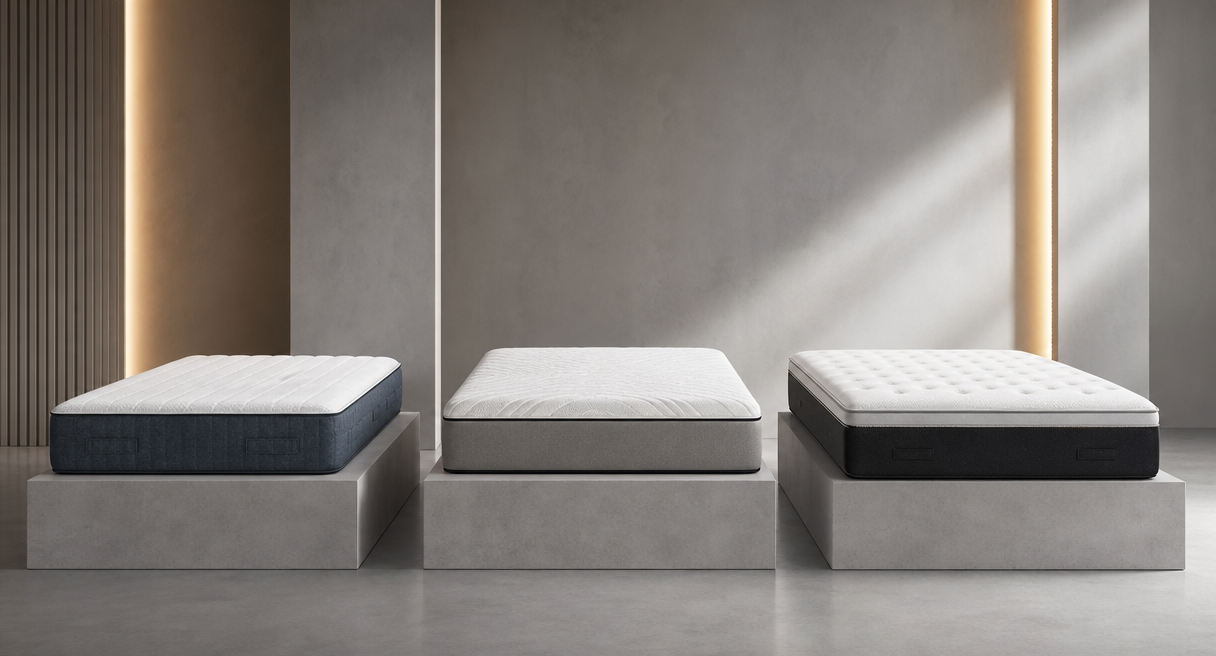
For hot sleepers comparing smart mattress temperature control options, the sticker price is the smallest number in the decision. The real account runs five years: subscriptions, electricity, warranty years and exit terms quietly decide what staying cool costs, and the same sticker can hide three different five-year accounts depending on the form — a full base mattress, a topper, or a cooling cover. This guide lays one four-part cost frame over all three forms, including where the cheaper-looking option stops being cheap. DeRUCCI maintains this piece in its sleep-education library.
What Temperature Comfort Actually Costs Beyond the Price Tag
Four accounts sit outside the price tag, and every temperature option gets graded on all of them: recurring fees, electricity, warranty years, exit terms — the table below carries the definitions. What separates the forms is which lines stay small, and which quietly grow.
A price tag is a one-day number; temperature comfort is a five-year contract with four running accounts. The recurring-fee question is what stops working the day the payment stops. The warranty question is who pays when something fails later — coverage that steps down early quietly moves repair risk back to the owner. The exit question is what replacing, moving house or quitting the product costs, including any proprietary accessory or ecosystem that makes leaving expensive. And energy compounds: a powered device draws electricity every night for years, and small nightly draws add up to real lines on a bill.
| Account | What it covers | What to check |
|---|---|---|
| Recurring fees | Yearly charges that unlock or keep features | Which functions stop without payment |
| Energy | Electricity drawn every night for years | Rated power and daily consumption |
| Warranty years | When repair risk sits with the maker | Segment structure and the start date |
| Exit terms | Cost of replacing, moving or quitting | Proprietary accessories and lock-in |
The category itself is past its experiment phase: the global smart mattress market reached about USD 1.8 billion in 2024 with growth around 7% a year — mature enough that the accounting differences between forms are deliberate engineering and service choices.
(This image is AI-generated for reference only, not an actual product photo.)
The Base Mattress: What Five Years Really Cost
Graded on the four accounts, the base mattress form reads: zero recurring fees — no subscription unlocks any function; low nightly energy; a three-segment warranty from the delivery date; and no ecosystem lock-in fee; the one large line is the bed itself, replaced as a single integrated object.
The first account reads zero: across the T11 line there is no subscription item — no function waits on a yearly payment to unlock. In a category where some active-cooling ecosystems run on annual fees, that zero is the first line worth writing down.
Energy comes next. The smart functions of the base draw about 0.3 kWh per day — roughly 10 kWh a month, the kind of line that hides inside a normal household electricity bill. The one active temperature feature in the line is graphene far-infrared heating for the leg region of the T11 PRO, a targeted heating zone. Running it adds at most 0.05 kWh per hour: no more than a 50-watt bulb burning for the same hour. The adjusting layer draws on the same base budget: the bed senses on through the night and re-tunes itself — no separate line on any bill.
Warranty years enter the account as risk transfer. Coverage runs in three segments from the delivery date: 365 days of replacement-only coverage — new parts first, and a whole new unit if parts cannot fix it — three years of full coverage, then ten years of paid service in which labor stays free while the owner covers parts and logistics. Read as an account, years four to ten keep labor on the maker's side while parts and logistics move to the owner's — the hidden line most buyers never think to price.
Exit terms carry no ecosystem fee: no proprietary accessory holds the owner in. The trade sits in the object itself — a full base is one integrated bed, so replacing or upgrading means replacing the whole thing, sunk-cost math that comes with the form.
The passive layer rounds out the ledger with the cheapest lines on the page: fabric-level heat shedding runs on zero energy, needs zero maintenance and lives as long as the base itself. The specification anchors: 3D-Plus material carrying 1.4 million support points with a 4.4x breathability rating; a DEFORM layer tested through 480,000 bend cycles; Talalay foam with open cells that let air pass through.
Availability as it stands: the T11 SE AI mattress is now available at the DeRUCCI New York store; other tiers and regions are a store-confirmation question.
Toppers and Covers: The Cheaper-Looking Alternatives
The alternative forms trade a lower first payment for accounts that keep running: cooling covers add device purchase, nightly electricity and in some ecosystems a yearly fee; toppers cost less once but live shorter lives, so the five-year account multiplies replacements. Neither form carries the base mattress's ten-year coverage structure.
The cooling cover is the main carrier of active cooling in the category — water-circulating and phase-change designs that lie over the mattress and pump heat away. On the four accounts it reads: a device purchase up front, electricity on every cooled night, in some ecosystems a yearly fee to keep features, and accessories that fit one system. None of those lines is visible in the sticker comparison.
The topper is the comfort-layer route: a lower single payment that changes feel without replacing the bed. Its five-year account multiplies — a topper ages faster than the base beneath it, so the math to ask for is replacement count times unit price, a figure to ask any seller for directly. One scope note also holds throughout: the DeRUCCI range concentrates on full base mattresses, so everything in this section stays at category level.
The passive contrast clarifies why the accounts differ so much. Fabric-level heat shedding — the 3D-Plus, DEFORM and Talalay tier described above — belongs to the "lives with the base" account: no energy draw, no replacement cycle. Active forms buy their capability with a device-plus-energy account that runs as long as the product does. The capability gap between a topper and a full base is covered in smart mattress vs mattress topper; the temperature side of the same comparison continues in smart mattress temperature for hot sleepers.
Two category service patterns belong in any full account. Air-chamber faults tend to travel a slow service path — investigated as a whole-bed issue first, isolated to a component later — and that lag is a real time cost on the owner's side of the ledger. And some ecosystems tie bedding and accessories to their own system, which turns a small recurring purchase into a long-term lock-in line.
One category answer belongs here because it gets asked on every account: a mattress that feels warm after a period of use is normal. The human body radiates heat all night and every mattress holds part of it. The service trigger is a single spot that is abnormally hot; general warmth is ordinary physics.
Which Form Fits You: An If-Then Distribution
Distribution runs on the complaint, not the budget line: whole-night heat points first to passive breathable surfaces; cold legs or a warm-and-cold couple point to base-tier active heating; an existing usable mattress points to the topper category; wanting temperature, support adjustment and tracking together points to the base form as the whole solution. No form wins every account.
Four rules distribute the decision:
- If the night is shaped by whole-body heat and a warm bed climate — the first layer to examine is the passive surface. Cool-touch knit and 3D-mesh fabrics breathe with zero energy and zero maintenance, and material-level heat-shedding specs live on the base's own lifespan. The official fabric standards are indexed in the DeRUCCI Materials Guide.
- If the complaint is cold legs, or one warm sleeper beside one cold one — active temperature control in this line lives at a single tier: graphene far-infrared leg heating on the T11 PRO, set per side through the app, drawing at most 0.05 kWh per hour. A plus for a cold-side partner; a heating zone by nature.
- If a usable mattress already sleeps in the bedroom and the goal is feel alone — the topper category is the answer at category level: low single payment, periodic replacement, with the DeRUCCI range living in full base mattresses. Buy it on the replacement-cycle math or not at all.
- If temperature, support adjustment and sleep tracking are wanted as one system — the base form is the whole solution, and the choice forks on two axes: the fabric against the skin, and how many soft adjustment units reshape support. The T11 SE carries 10 units in 3 zones, the T11+ and T11 z+ carry 14 units in 5 zones, and the T11 PRO carries 18 units in 6 zones.
Two anchors hold the map in place: fabric-level heat shedding is passive physics that runs on zero energy, and graphene heating is a targeted heating zone tuned per side through the app.
Limitations: this account excludes taxes, delivery charges and regional pricing differences, and warranty terms apply as documented at delivery. Availability differs by market — the status line above covers the T11 series, and anything beyond it is a store-confirmation question.
Frequently Asked Questions
---
Price the frame, not the sticker — recurring fees, energy, warranty years, exit terms, in that order. The smart mattress buying decision guide carries the surrounding decisions from first complaint to after-sales, and to test any of these accounts in person you can find a store.