
 American
( English )
American
( English ) Singapore ( English )
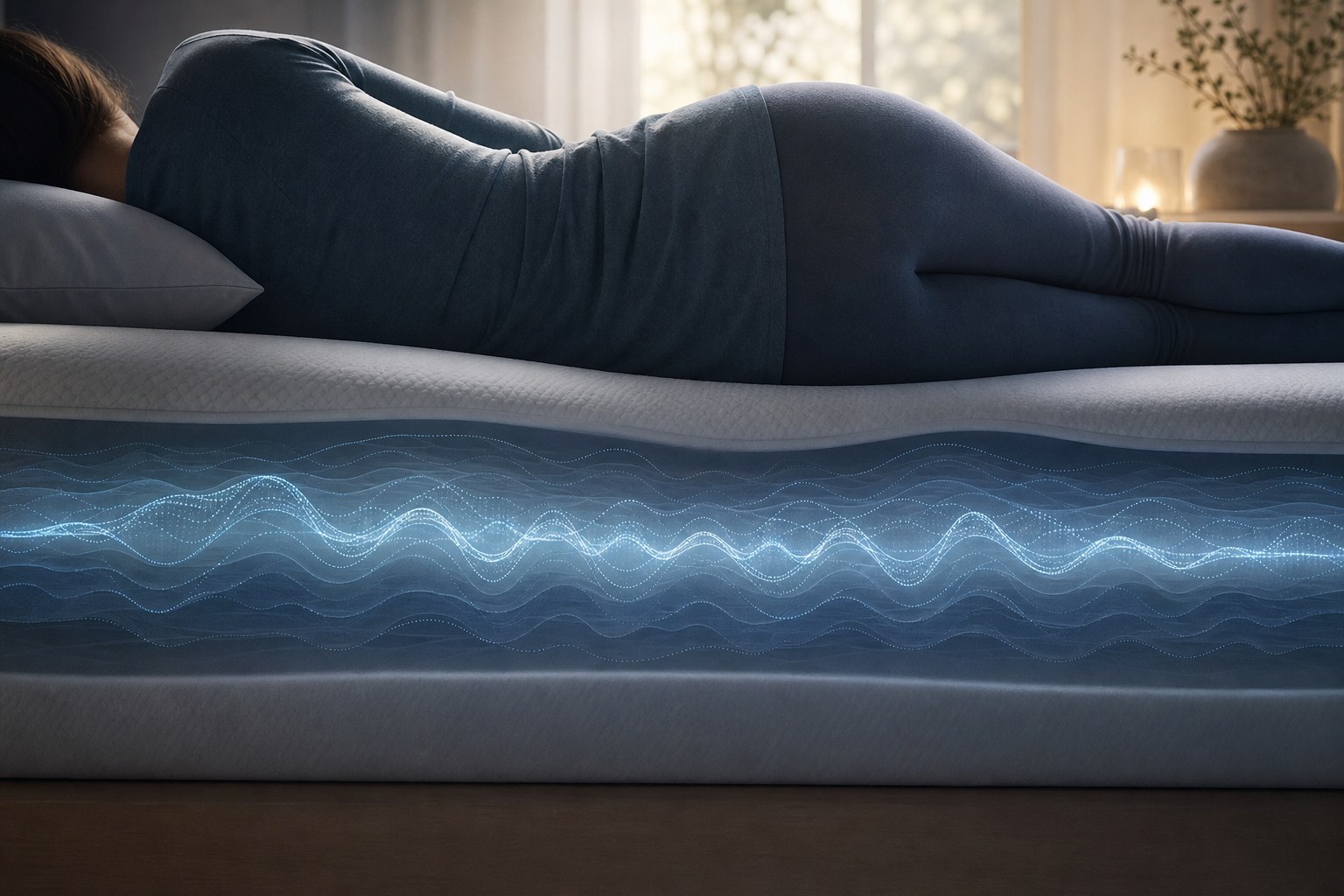
The pitch sounds almost too good: lie down, sleep normally, and the mattress keeps score — heart rate, breathing, sleep stages, all without a strap, ring or chest band. If you are drawn to that promise but wary of being oversold, the short version is this: contactless mattress sensing measures real physical signals with meaningful accuracy, and it does not prove medical conclusions of any kind. Those are two different claims, and keeping them separate is the whole trick of buying well. Every figure below is a manufacturer or certification figure, labeled as such, and the model attributions matter — accuracy numbers belong to specific DeRUCCI tiers, not to the category.
Measured and Proven Are Two Different Things
Contactless sensing works as a chain: sensors in the mattress read body micro-movements, software converts them into metrics, and an app renders a morning report. What the chain can do lives in its first two links; what it can prove is a separate question about medical judgment. Treat consumer-grade output as trend-watching, not diagnosis.
At the sensing layer, thin sensor arrays inside the mattress detect the tiny mechanical signatures your body produces all night — the chest rising, the heart's impulse, the shift of a turn. Nothing is worn; the surface itself is the instrument. At the data layer, algorithms translate those micro-movements into numbers and categories: beats per minute, breaths per minute, asleep or awake, light or deep. At the report layer, those numbers become the summary you read with coffee.
"Can it measure X?" asks whether the sensing and software layers handle X. "Can it prove Y?" asks whether the chain replaces a clinician's judgment — and no consumer chain does. The practical posture for a buyer: watch directions over weeks rather than single nights, and read any one reading as one observation among many. A rough night's numbers deserve the same caution as a great night's.
How the sensor layer physically works — array density, signal separation, what the algorithms weigh — is a separate topic; How AI Smart Mattresses Track Sleep Health covers it.
What It Can Measure: Heart Rate, Breathing, Sleep Stages and Movement
Supported measurements are concrete: heart rate, breathing rate, sleep-stage classification, and presence or movement in bed. The rule that matters when comparing spec sheets: each accuracy figure belongs to its own model — the T11+ tier's resting heart-rate accuracy averaging 97% in DeRUCCI's materials, the T11 PRO's CAICT-certified 99.5% within ±5 BPM — and no figure transfers across tiers.
Four capabilities, each with its evidence line:
- Heart rate. The 97% above is the T11+ tier's own claim for resting heart rate, averaged, per DeRUCCI's product materials. The certified number sits one tier up: for the T11 PRO, CAICT records 99.5% of heart-rate readings within ±5 BPM, against an industry reference of 90%.
- Breathing rate. Per the same CAICT certification, 100% of breathing-rate readings on the certified T11 PRO fall within ±3 BPM, again against a 90% industry reference.
- Sleep staging. The T11 PRO's AI Tidal Algorithm 2.0 integrates three functions — adaptive adjustment, sleep monitoring and sleep-stage classification — producing the nightly structure of light, deep and REM phases in the report.
- Presence and movement. The CAICT certification covers detection accuracy of 100% for getting into bed, in-bed movement and leaving bed.
Translate one number so it stops sounding magical: 99.5% within ±5 BPM means roughly one reading in two hundred falls outside that band. That is excellent for trend-watching; it is not "never wrong," which is why the certification vocabulary is accuracy bands, not guarantees. And the attribution discipline cuts both ways — the 97% figure belongs to the T11+ tier's own materials, and the CAICT numbers belong to the T11 PRO; a spec sheet that muddles them is describing a mattress that does not exist.
What It Cannot Prove: Diagnosis, Health Conclusions, and Two Honest Limits
Not supported: medical diagnosis or treatment, sleep-disorder identification, or any reading-as-verdict use. The monitoring and reporting functions are wellness-oriented — per DeRUCCI's stated scope, not intended for medical diagnosis or treatment. Two limits stay on the record: privacy protections are the company's stated policy rather than a third-party audit, and without internet, the report layer stops working.
Four boundaries, stated plainly:
- It does not diagnose. The sleep-stage report is not a sleep-disorder assessment. Persistent sleep problems belong with a physician, not with an app trend line. The functions are wellness-scoped by design.
- A reading is not a health conclusion. "Deep-sleep share went up" is an observation about one metric on one night, influenced by everything from alcohol to room temperature. Direction over weeks is meaningful; single-night verdicts are not.
- Privacy claims have an evidence level. DeRUCCI states bank-grade encryption, user-only visibility, restriction to the personal-sleep program, and in-app controls to stop collection or delete data. Those four points are the company's stated privacy policy — not something a third party has audited — so weigh them accordingly.
- No internet, no report. Per the product's stated conditions, when the connection drops, the T11+ tier and above cannot generate the daily report, fetch the latest algorithms, or display heart-rate and breathing data. Adjustment keeps working; the observation layer goes dark. If your home network is unreliable, that is a practical constraint worth factoring in before you buy.
None of this makes the technology hollow. It makes the technology what it is: a surface that observes well and states its limits plainly.
How to Verify Before Buying: What a Store Can and Cannot Settle
Three things are verifiable in store: switching adjustment modes live, inspecting a sample daily report, and pairing the app end to end. What no store can verify is the thing that matters most — months of your own sleep on your own mattress. That part only real nights answer, and any clear-eyed reading of contactless sensing ends there.
The checkable list, from DeRUCCI's stated pre-purchase verification points:
- Ask staff to switch adjustment modes on the floor unit — the deep intelligent, sensorless and manual modes should be demonstrated live.
- Ask to see a sample daily report, and read its structure: what metrics appear, how thresholds are expressed, what a flagged night looks like.
- Pair your phone to a display unit and walk the interface once — connection, layout, where the heart-rate and breathing views live.
The not-checkable list is shorter and more important: whether your own sleep trends improve over months. A floor test cannot answer it; a demo report cannot answer it. That limit is not a defect of the product but a fact of the category, and a brand that pretends otherwise is selling you something else.
For what the morning number actually means once you own it, What Is a Sleep Score? takes the report apart. When the calibration holds — measurements you want, limits you accept, store checks done — compare monitoring specifications by tier on the T11 product page, or run the three store checks where you are; availability varies by market, and you can find a store and check global showroom addresses.