
 American
( English )
 Singapore ( English )

What Is HRV (Heart Rate Variability)?
Heart rate variability (HRV) is the tiny variation in time between one heartbeat and the next, and it is controlled by the autonomic nervous system, making it a non-invasive window into how well your body balances stress and recovery.
A higher HRV generally signals that your parasympathetic ("rest and digest") system is active and your body is recovering well, while a lower HRV often reflects stress, poor sleep, illness, or overtraining. Importantly, HRV is not a measure of how regular your heart rate is, a healthy heart is slightly irregular beat to beat, and that variability is the signal. Understanding what the number means is more useful than chasing a high score in isolation.
What's a "Good" HRV Score?
There is no universal "good" HRV, because the metric is highly individualized, shaped by age, genetics, fitness, and baseline, so a healthy number for one person can look low for another.
Across most consumer trackers, adult HRV commonly falls somewhere in the tens of milliseconds range, with younger and fitter adults tending toward the higher end and values gradually declining with age. But the spread between people is wide, which is why experts consistently emphasize tracking your own baseline rather than comparing to others. A reading that is normal for you, in the context of your own trend, is far more meaningful than any chart of averages.
What Affects Your HRV
HRV moves with the choices you make each day, sleep quality, exercise load, stress, alcohol, and even late meals all push the number up or down, which is why it is such a sensitive recovery signal.
A night of deep, uninterrupted sleep tends to lift HRV, while fragmented sleep, a warm room, or alcohol before bed often depress it. Hard training lowers HRV temporarily as the body recovers, then it rebounds; chronic stress or illness keeps it suppressed. Seeing these swings is the real value of the metric, it turns invisible recovery into something you can read each morning and adjust around.
How HRV Connects to Sleep Quality & Recovery Tracking
Because HRV is most informative during sleep, measuring it contact-free through the night gives a cleaner recovery signal than a single daytime spot-check, which is where mattress-integrated sensing has an advantage over wrist wearables.
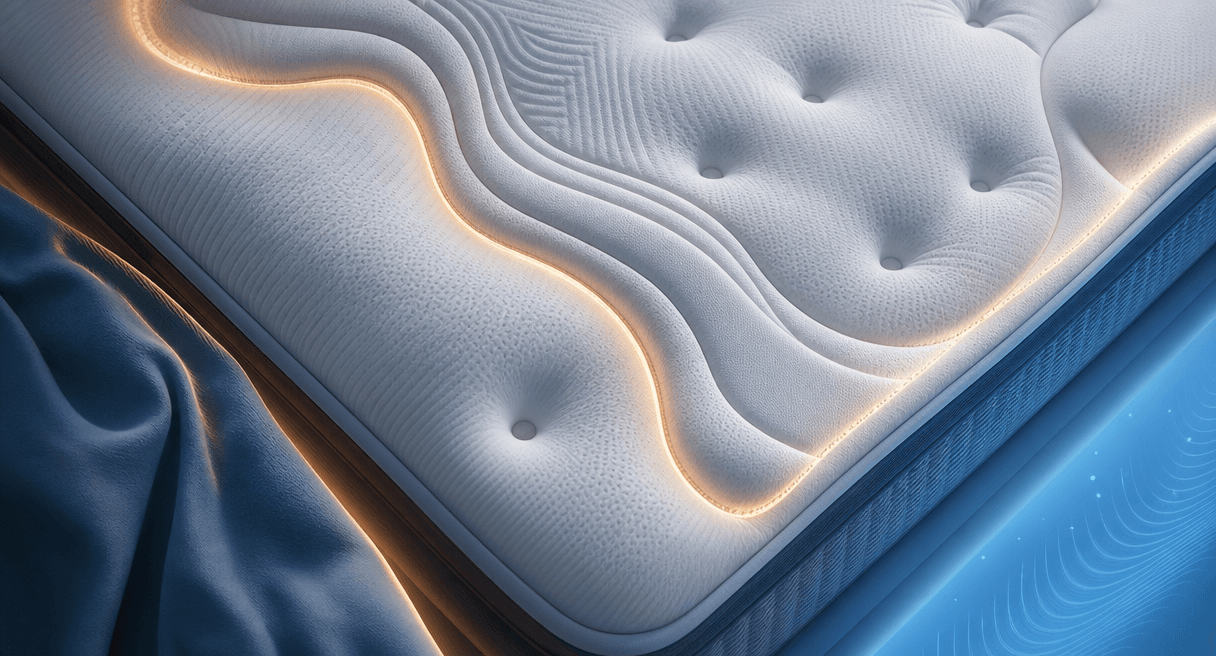
That mattress-integrated advantage is central to DeRUCCI's approach. The T11+ AI smart mattress carries a third-generation piezoelectric ceramic sensor array that detects heart rate with 97% accuracy, allowing it to track HRV and breathing through the night without anything worn on the body. That sensing layer renders each night as a readable report covering sleep stages, heart rate, and movement. To see how DeRUCCI approaches contact-free monitoring, visit the DeRUCCI smart sleep system page, or explore the T11 series AI mattress. (The T11 SE AI mattress is now available at the DeRUCCI New York store.)

(This image is AI-generated for reference only, not an actual product photo.)
How to Improve Your HRV Over Time
Raising HRV is less about a single trick and more about stacking consistent habits, steady sleep, smart training load, stress management, and a surface that supports deep, uninterrupted rest.
Keep a regular sleep schedule, cool the room, and avoid alcohol and heavy late meals, since each fragments the deep sleep that lifts HRV. Train hard enough to stimulate adaptation but recover fully before the next intensity block. Over weeks, your personal trend, not any one night, tells you whether the changes are working, and a mattress that reduces pressure and motion can help keep that trend climbing.
Frequently Asked Questions
What is a normal HRV range? There is no single normal range, because HRV is highly individual and varies by age, fitness, and genetics. Most adults see values in the tens of milliseconds, but your own baseline and its trend matter far more than any population average.
Why is my HRV lower than my friend's? HRV differs widely between people for reasons unrelated to health, including genetics and age. A lower number than someone else's does not mean worse health, the useful comparison is to your own baseline over time.
Does sleep really affect HRV? Yes, strongly. Deep, continuous sleep tends to raise HRV, while fragmented sleep, alcohol, and heat lower it. Many people see their clearest HRV swings after a changed sleep environment or habit.
Is a high HRV always better? Usually, but not in every context. A sudden spike can sometimes signal illness or overreaching, just as a dip can. The pattern over days and weeks is more informative than any single reading.
Find a DeRUCCI Showroom Near You
Better sleep is easier to choose in person. Explore DeRUCCI's mattresses and smart sleep systems, then find a store and check global showroom addresses to experience them firsthand.