
 American
( English )
American
( English ) Singapore ( English )

Smart mattress warranty exclusions are the part of the purchase that almost nobody reads until something breaks — which is exactly the wrong time. The right approach has two halves. First, anchor on the published framework: DeRUCCI's warranty runs in three stages from the delivery date — 365 days of replacement rather than repair, three years of free warranty service, and ten years of paid service where labor stays free and only materials and logistics are charged. Second, verify the exclusion terms deliberately: the detailed exclusions live in the product manual and regional documents, not in any summary page, so the working skill is knowing exactly what to ask for before you pay.
What Is the Three-Stage Warranty Framework?
Anchor every exclusion question on the framework first, because without it you cannot tell a fair term from a hostile one: 365 days of replacement-only service for verified quality defects, three years of free repair, and ten years of paid service where labor stays free and only materials and logistics are charged — every clock starts at delivery, not at purchase.
Stage one covers the first year. From the day of DeRUCCI delivery, and including the 365th day, a verified product quality problem is resolved by replacement: the faulty component is replaced with a brand-new part at no charge, and if replacing parts cannot solve the problem, the entire product is replaced with a new one — again at no charge.
Stage two covers the next two years. Within three years of delivery, quality problems receive free repair service, with the customer bearing no costs. Stage three extends to ten years: beyond the free windows, service continues on a paid basis where the customer covers only the necessary materials and logistics, while labor remains free.
Four anchors hold the framework together: labor is free throughout; materials and logistics are the charged components in the paid stage; the stages run in sequence rather than as parallel options; and every clock starts at delivery, not at purchase. The official outlet for after-sales information is the DeRUCCI service & support page.
What Does the Three-Year Free Stage Cover in Practice?
The three-year stage is free in the fullest sense: for quality defects within warranty scope, DeRUCCI arranges the repair and covers it, with the customer paying nothing. The overseas store statement matches on all three points: three years, counted from delivery, including free repair.
The overseas store page puts the middle stage in one sentence: "Enjoy peace of mind with a 3-year warranty (starting from delivery), which includes free repair services." Three claims there — three years, counted from delivery, free repair included — line up with the framework exactly.
What "free repair" covers in practice: quality defects that fall inside the warranty scope are repaired at no charge, with DeRUCCI arranging the service. What sits outside that scope is defined by the exclusion terms, which DeRUCCI publishes in the product manual rather than in summary materials — the exact boundaries are what to confirm in writing for your region.
DeRUCCI's official information adds where the rest lives: detailed after-sales terms are found in the AI mattress instructions that accompany the product.
Where Do the Smart Mattress Warranty Exclusions Actually Live?
Two documents outweigh everything else in this decision: the AI Mattress User Manual that ships with the mattress, and whatever written terms your regional retailer provides on request. The framework is something a buyer can stand on; the exclusion list is something a buyer must confirm in their own region, in writing, before paying.
DeRUCCI publishes the three-stage framework openly, but the detailed exclusion terms sit inside the product manual rather than on any summary page. What the official care guidance does flag from the user's side are the behaviors most likely to appear in exclusion terms: self-disassembly or modification, mismatched power components, and heavy wet washing. Hold those as the behaviors to ask about directly, and get the actual list from the manual and your region's written terms, not from a conversation.
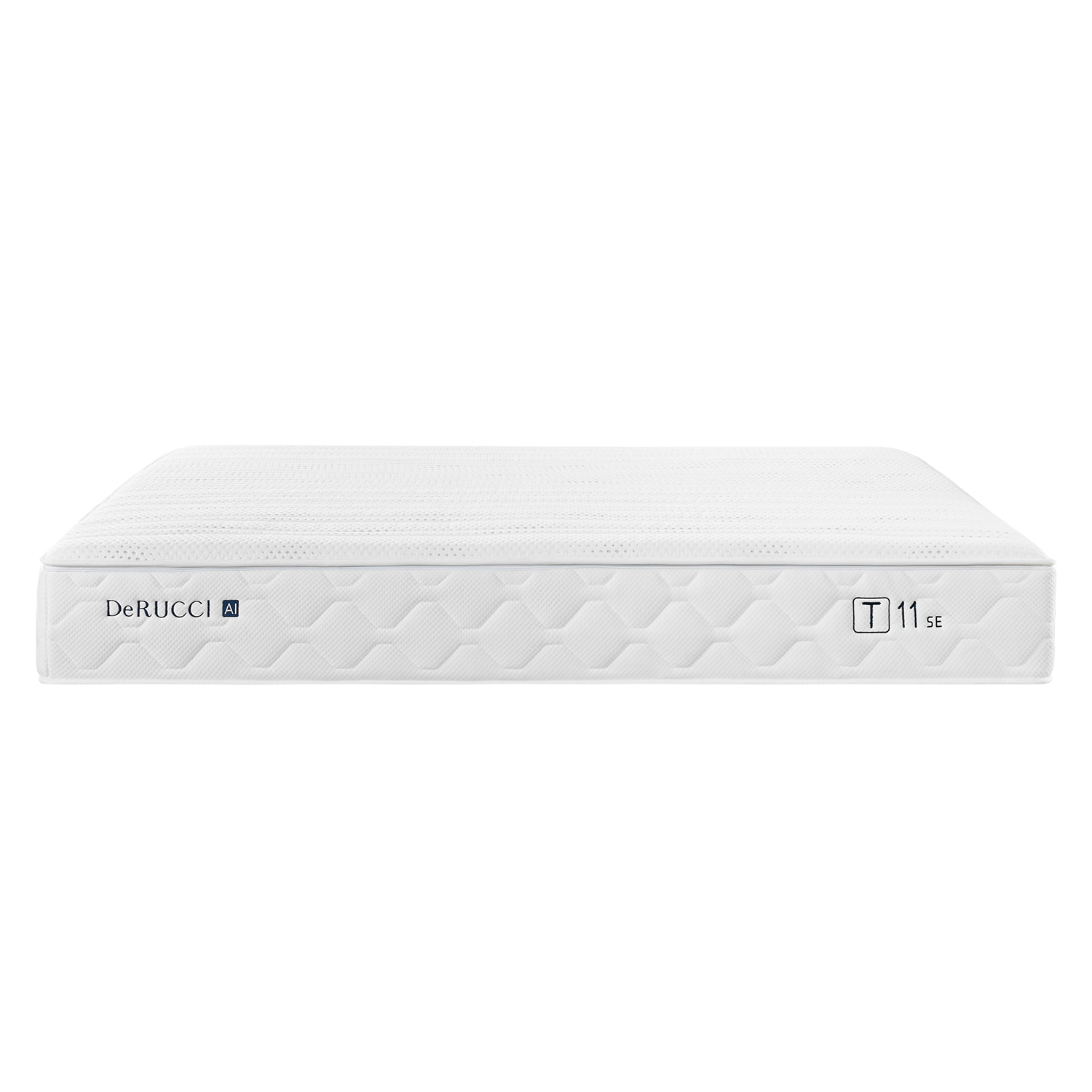
Availability follows the same discipline. One recorded statement places the T11 SE at the DeRUCCI New York store, but the model-by-model regional availability picture is still taking shape — confirm in store or in your region before planning around a specific model.
Why Do "X-Year Warranty" Claims Deserve Separate Questions?
Category risk explains why exclusions deserve separate verification. A multi-layer warranty is not one long flat warranty; the same "ten years" can hide free repair or billed parts. The defect-versus-damage line is where most disputes sit, and cost ambiguity usually lands on the owner unless the contract says who decides.
Start with why smart mattresses specifically reward careful buyers: "a 10-year warranty" can mean ten years of free repair, or one year of replacement plus nine years of billed parts — and the difference only surfaces when something actually fails. The defect-versus-damage boundary is where most disputes in this category sit: a slow air-chamber leak or control software lagging behind the hardware's own drift is exactly the kind of ambiguous durability fault that the brand and the owner will each read differently. Unless the contract states who adjudicates, the cost of ambiguity — assembling evidence, escalating, waiting weeks — tends to land on the owner.
The fee structure deserves equal suspicion. After-warranty service only means something when its structure is transparent: "labor free, parts billed" and "a fixed charge per visit" are very different promises. The phrase "we warranty it for X years" can hide three independent cost lines — labor, logistics, and replacement parts — any one of which can be billed separately once the free window closes. A diagnostic home visit can itself be a billed item, and some service flows require the customer to arrange and pay for transporting the faulty unit before repair even begins. And because a smart mattress contains power electronics, motors, and air chambers, its exclusion language is inevitably more complex than a traditional bed's — with more interpretation room around "improper use."
So ask, aloud and specifically. One question does more work than any other: "In the first year, is a verified quality defect resolved by replacing the part, replacing the whole unit, or repairing in place — and who decides which path is taken?" Translate each anchor of the framework into a question you can actually ask in a store or a support chat, because a standard you cannot articulate is a standard you cannot verify. Precise wording beats broad topics — vague phrasing lets the seller answer a different question than the one you asked.
How Do You Verify Warranty Exclusions Before You Buy?
Five steps verify the terms before purchase: compare against the three-stage framework, ask who adjudicates defect versus damage, unpack the labor, logistics, and parts cost lines, request three documents in writing, and probe the user-responsibility boundary. The three-document test is the sharpest single move — hesitation about paperwork is itself a diagnostic signal.
The five steps, in order:
1. Compare against the framework. 365 days / 3 years / 10 years, labor free throughout, materials and logistics charged in the paid stage. Anything that cannot be mapped onto those anchors needs clarification.
2. Ask who adjudicates. Who rules on defect versus damage, and who decides between part replacement, whole-unit replacement, and in-place repair in the first year?
3. Unpack the "X years" cost lines. Labor, logistics, and parts — which are billed after the free window? Is the diagnostic visit itself charged? Who pays to transport the faulty unit?
4. Request the documents in writing. Three of them, before purchase rather than after failure: the warranty terms, the exclusion terms, and the regional applicability terms.
5. Probe the user-responsibility boundary. Self-disassembly or modification, non-matched power components, and heavy wet washing are the three behaviors the official care guidance flags — ask directly where the boundary sits for each.
On step five, hold those care-guidance points as what they are: user-responsibility notices, not a published exclusions list. They mark the categories of behavior most likely to appear in exclusion terms you have not yet seen — the electrical and liquid events with the widest interpretation room — and the actual boundary belongs in writing.
The three-document test is where all five steps cash out. If a retailer produces all three documents without hesitation, the warranty will most likely be executed as written. If any document is missing, vague, or deferred to "the manual you'll receive at delivery," treat that absence itself as a diagnostic signal — the exclusion language exists somewhere, and delayed display does not mean it favors you.
Once the written terms check out against the five steps, the DeRUCCI smart mattress collection is where to lock in a target model — then find a store near you to confirm current availability and the final service terms in person before committing.